Showing posts with label Anglo Saxon. Show all posts

Saturday, 20 June 2020

The Emergence of the English

A Reconstruction from the Sources:

AD 410. The Romans, therefore, left the country [Britannnia], giving notice that they could no longer be harassed by such laborious expeditions.… No sooner were they gone, than the Picts and Scots, like worms which in the heat of mid-day come forth from their holes, hastily land again from their canoes...... they [the Britons] left their cities, abandoned the protection of the wall and dispersed themselves in flight more desperately than before. The enemy, on the other hand, pursued them with more unrelenting cruelty than before, and butchered our countrymen like sheep. [Gildas]

Again, therefore, the wretched remnant, sending to Aetius, a powerful Roman citizen, address him as follows: "To Aetius, now consul for the third time: the groans of the Britons." And again a little further thus: "The barbarians drive us to the sea; the sea throws us back on the barbarians: thus two modes of death await us, we are either slain or drowned." The Romans, however, could not assist them. [Gildas]

The British provinces were devastated by an incursion of the Saxons [The Gallic Chronicle]

Then all the councillors, together with that proud tyrant, the British king, were so blinded, that, as a protection to their country, they sealed its doom by inviting in among them (like wolves into the sheep-fold), the fierce and impious Saxons, a race hateful both to God and men… [Gildas]

In the year of our Lord 449. Then the nation of the Angles, or Saxons, being invited by the aforesaid king, arrived in Britain with three long ships, and had a place assigned them to reside in by the same king, in the eastern part of the island. [Bede]

In the meantime, three vessels, exiled from Germany, arrived in Britain. They were commanded by Horsa and Hengist, brothers, and sons of Wihtgils. The Saxons were received by Vortigern four hundred and forty-seven years after the passion of Christ... [Nennius]

AD 449.  This year …… Hengest and Horsa, invited by Vortigern, king of the Britons to his assistance, landed in Britain in a place that is called Ipwinesfleet; first of all to support the Britons, but they afterwards fought against them. [ASC]

After the Saxons had continued some time in the island of Thanet, Vortigern promised to supply them with clothing and provision, on condition they would engage to fight against the enemies of his country. But the barbarians having greatly increased in number, the Britons became incapable of fulfilling their engagement. [Nennius]

At length Vortimer, the son of Vortigern, valiantly fought against Hengist, Horsa, and his people; drove them to the isle of Thanet, and thrice enclosed them with it, and beset them on the western side. The Saxons now despatched deputies to Germany to solicit large reinforcements, and an additional number of ships: having obtained these, they fought against the kings and princes of Britain, and sometimes extended their boundaries by victory, and sometimes were conquered and driven back. Four times did Vortimer valorously encounter the enemy; the first has been mentioned, the second was upon the river Darent, the third at the Ford, in their language called Epsford, though in ours Set thirgabail, there Horsa fell, and Catigern, the son of Vortigern; the fourth battle he fought, was near the stone on the shore of the Gallic sea, where the Saxons being defeated, fled to their ships. [Nennius]

AD 455 Hengest and Horsa fought at Aylesford. Horsa fell. [ASC]

…… Horsa, being afterwards slain in battle by the Britons, was buried in the eastern parts of Kent, where a monument, bearing his name, is still in existence. [Bede]

AD 457 Hengest and his son Esc fought with the Britons at Crayford. The The Britons conceded Kent, and fled to London. [ASC]

AD 465  Hengest and Esc fought with the Britons at Wippedfleet. [ASC]

AD 473 Hengest and Esc fought with the Britons and took immense booty and the Britons fled. [ASC]

AD 477.  This year came Ella to Britain, with his three sons, Cymen, and Wlenking, and Cissa, in three ships; landing at a place that is called Cymenshore.  There they slew many of the Britons; and some in flight they drove into the wood that is called Andred'sley. [ASC]

AD 488.  This year Esc succeeded to the kingdom; and was king of the men of Kent twenty-four winters. [ASC]

Those who came over were of the three most powerful nations of Germany: Saxons, Angles, and Jutes. …… From the Jutes are descended the people of Kent, and of the Isle of Wight, and those also in the province of the West Saxons who are to this day called Jutes, seated opposite to the Isle of Wight. From the Saxons, that is, the country which is now called Old Saxony, came the East Saxons, the South Saxons, and the West Saxons. From the Angles, that is, the country which is called Anglia, and which is said, from that time, to remain desert to this day, between the provinces of the Jutes and the Saxons, are descended the East Angles, the Midland Angles, Mercians, all the race of the Northumbrians, that is, of those nations that dwell on the north side of the river Humber, and the other nations of the English. [Bede]

"Three very populous nations inhabit the Island of Brittia, and one king is set over each of them. And the names of these nations are Angles, Frisians, and Britons who have the same name as the island." [Procopius]

After this the barbarians became firmly incorporated, and were assisted by foreign pagans; .... the Saxons were victorious, and ruled Britain. [Nennius]

Britain abandoned by the Romans passed into the power of the Saxons. [The Gallic Chronicle]

[The Britons] took arms under the conduct of Ambrosius Aurelianus, a modest man, who of all the Roman nation was then alone in the confusion of this troubled period by chance left alive. His parents, who for their merit were adorned with the purple, kind been slain in these same broils, and now his progeny in these our days, although shamefully degenerated from the worthiness of their ancestors, provoke to battle their cruel conquerors, and by the goodness of our Lord obtain the victory. [Gildas]

After this, sometimes our countrymen, sometimes the enemy, won the field..........until the year of the siege of Bath-hill, [Badon] when took place also the last almost, though not the least slaughter of our cruel foes, which was (as I am sure) forty-four years and one month after the landing of the Saxons..… [Gildas]

Then Arthur along with the kings of Britain fought against them in those days, but Arthur himself was the military commander ["dux bellorum"]. His first battle was at the mouth of the river which is called Glein. His second, third, fourth, and fifth battles were above another river which is called Dubglas and is in the region of Linnuis. The sixth battle was above the river which is called Bassas. The seventh battle was in the forest of Celidon, that is Cat Coit Celidon. The eighth battle was at the fortress of Guinnion, in which Arthur carried the image of holy Mary ever virgin on his shoulders; and the pagans were put to flight on that day. And through the power of our Lord Jesus Christ and through the power of the blessed Virgin Mary his mother there was great slaughter among them. The ninth battle was waged in the City of the Legion. The tenth battle was waged on the banks of a river which is called Tribruit. The eleventh battle was fought on the mountain which is called Agnet. The twelfth battle was on Mount Badon in which there fell in one day 960 men from one charge by Arthur; and no one struck them down except Arthur himself, and in all the wars he emerged as victor. [Nennius]

AD 516.  [495 x 500] The Battle of Badon, in which Arthur carried the Cross of our Lord Jesus Christ for three days and three nights on his shoulders and the Britons were the victors. [Welsh Annals]

AD 495.  This year came two leaders into Britain, Cerdic and Cynric his son, with five ships, at a place that is called Cerdic's-ore.  And they fought with the Welsh the same day. [ASC]

AD 501.  This year Porta and his two sons, Beda and Mela, came into Britain, with two ships, at a place called Portsmouth.  They soon landed, and slew on the spot a young Briton of very high
rank. [ASC]

AD 508.  This year Cerdic and Cynric slew a British king, whose name was Natanleod, and five thousand men with him.  After this was the land named Netley, from him, as far as Charford. [ASC]

AD 514.  This year came the West-Saxons into Britain, with three ships, at the place that is called Cerdic's-ore.  And Stuff and Wihtgar fought with the Britons, and put them to flight. [ASC]

AD 519.  This year Cerdic and Cynric undertook the government of the West-Saxons [ASC]

AD 547.  This year Ida began his reign; from whom first arose the royal kindred of the Northumbrians. [ASC]

AD 596.  This year Pope Gregory sent Augustine to Britain with very many monks, to preach the word of God to the English people. [ASC]
Conventional view of the Anglo-Saxon settlements in Britain AD 400-500.
Showing Angle, Saxon, and Jute homelands based on Bede's Ecclesiastical History (Book I.15)

Summary
“The obscurity of the period which begins with the landing of the first Saxon invaders is a commonplace of history. Its details are lost, and the materials from which alone its course can be inferred are fragmentary and sometimes obscure. Nevertheless it is possible to exaggerate their incoherence. Gildas, Procopius, and the early traditions of the West Saxon court agree in suggesting that the English conquest of southern Britain was accomplished in two phases, separated by a considerable interval in the early part of the sixth century. Both Gildas and the tradition of a conquest of Wessex close to the year 500 imply that the greater part of southern England was overrun in the first phase of the war. 

“Gildas claims for the Britons a victory which gave them peace from external enemies for more than a generation, and the traditions of the West Saxons suggest that after their early advance they were thrown back to the settlements which they had founded immediately after their first landing. Procopius describes a migration of English peoples to the Continent in the first half of the century.... the Fulda tradition of a landing of Saxons from Britain at Cuxhaven in 531 indicates that these migrations had begun within a few years of the British victory recorded by Gildas. They are not mentioned by any English authority but the period within which they must have fallen coincides with a significant gap in the traditions of Wessex, Kent and Sussex.

“Finally, the West Saxon traditions imply that the second phase of the conquest began in the south immediately after the middle of the sixth century, proceeded very slowly at first, and then culminated in a twofold advance which carried the Saxons as far as the Lea towards the east and as far as as the Severn towards the west....

“But it may at least be claimed that when four independent authorities agree in suggesting a single coherent story, it is unlikely to be very far from the truth.” [Stenton]


….. And the Circus Leaves Town
And there we have the account of the English Conquest of post-Roman Britain according to the sources. We are taught this at school, it is etched on our national identity.

We believe that we speak English today because Germanic tribes invaded and took control over lowland post-Roman Britain. How did that happen? There is little evidence: not much reliable histography, and even less archaeology. There is, however, a huge amount of speculation and conjecture.

The Anglo-Saxon period, stretches from the fifth to the late eleventh century, from the Roman withdrawal to the Norman Conquest; some 650 years termed the Early Medieval Period (or Early Middle Ages). However, it is the near 200 year period from the Roman withdrawal, AD 410, to the arrival of St Augustine, AD 596, that is termed the post-Roman period, or the now unfashionable “Dark Ages”.

How post-Roman Britain became “English” in 200 years is one of the greatest enigmas of cultural history. Easy, you answer; Germanic tribes invaded the country and filled the vacuum left by the Romans. Genetic studies have argued that the Germanic immigrants completely replaced the indigenous population in the east of the country. Others argue for a smaller scale immigration of a Germanic warrior elite taking political control which lead to cultural change, perhaps amounting to just 5 - 10% of the population. Large scale Anglo-Saxon cemeteries uncovered in the south and east of the country containing Germanic grave goods including distinctive Germanic style cruciform broaches were identified as evidence of the invasion. Which forces the question: “How many migrants are needed to explain the fifth-century cultural changes marking the transition from Late Roman Britain to Early Anglo-Saxon England?”

This problem is discussed by Susan Oosthuizen in The Emergence of the English, Arc Humanities Press, 2019. At just 148 pages this is a small book but covers a huge amount of ground on an immensely significant period of British history.

Oosthuizen argues that ever since Edward Gibbon’s interpretation of the history of post-Roman Britain in the 18th century the story of the origins of the English are so well known to appear incontrovertible. Successive generations of historians accepted this view which evolved further into the mid-19th century when that great earthwork Wansdyke was seen as a frontier between Saxons and Britons marking the retreat westwards of the native population.

Oosthuizen examines the early British documentary sources. The first of these, the writings of St Patrick from the 5th century, portrays a period of continuity of Romano-British society and culture. When Patrick returns home to his father’s villa estate he does so unhindered and makes no mention of barbarians in the locality. Next is the sermon of Gildas from the early 6th century. Gildas's vision of post-Roman Britain subjected to attacks by barbarians has stuck with modern writers producing reconstructions of the time. Many fail to realise that Gildas is not writing history, indeed his chronology is garbled; he moves back and forth through time to “relate a series of divine punishments visited by God on British kings and communities who had sinned in rebelling against the Roman empire, the Roman church and Roman standards of public life.” Bede largely follows Gildas for this period but develops the origins of the English, which later would come to influence the foundation stories embedded within the Anglo Saxon Chronicle (ASC). Very early the mass migration from north-west Europe had become fact.

In discussing the archaeological evidence for groups of Germanic immigrants, Oosthuizen argues against a break in exploitation of the British landscape and no evidence of economic collapse after about 400. However, she concedes that there was substantial change in material culture.

In looking at genetics, Oosthuizen draws the readers attention to nineteen individuals buried in a cemetery at Berinsfield, Oxfordshire, between 450 and 550; “the Germanic grave-goods found with them appeared to be clear evidence of an Anglo-Saxon community.” However analysis of their teeth  showed that fifteen of these were in fact local people, three had moved to Oxfordshire from another area in Britain and just one was a European immigrant. How many other apparent Germanic cemeteries have also been incorrectly identified?

Then we come to the biggest puzzle of all; why did the people of Romano-Britain adopt the English language? In answering this Oosthuizen suggests the population of Late Roman Britain was bilingual, probably speaking a Late Roman Latin language and possibly a West Germanic dialect that had developed through many years of trade with the North Sea coastlands and may have been spoken in Eastern Britain since the Iron Age. Over time, as in most countries of the Empire, the Latin language eventually died out. It emerges that language, migration and ethnicity are not necessarily linked.

In conclusion,  Oosthuizen argues that “there is no reliable, contemporary documentary evidence from early British or continental scholars for substantive invasion, settlement, or conquest of Britain from north-west Europe in the fifth century. Material culture begins to reveal the contribution to late antique and early medieval artefacts of late Romano-British craftsmanship, technology, and artistry. Genomic research has been unable to identify the scale, period, or volume of a distinctive immigration from north-west Europe. And linguistic research begins to reveal the extent to which most people in the English lowlands could speak two or even three languages. The origins of the English language itself remain controversial. In all, the most certain evidence appears to show the stability, evolution, and adaption of late Romano-British institutions, culture, languages and society across the fifth and sixth centuries, while absorbing and evolving in response to influences from across the countries that bordered the North Sea.”

The Emergence of the English 
Susan Oosthuizen
Arc Humanities Press, 2019
Paperback, 148 pages

1. Introduction
2. What Can Reliably be said to be Known about Late Antique and Early Medieval England?
3. Ethnicity as an Explanation
4. Another Perspective

From the publisher:
“This book takes a critical approach to the assumption that the origins of the English can be found in fifth- and sixth-century immigration from north-west Europe. It begins by evaluating the primary evidence, and discussing the value of ethnicity in historical explanation. The author proposes an alternative explanatory model that sets short- and medium-term events and processes in the context of the longue durée, illustrated here through the agricultural landscape. She concludes that the origins of the English should rather be sought among late Romano-British communities, evolving, adapting, and innovating in a new, post-imperial context. Though focusing on England between the fifth and seventh centuries, this volume explores themes of universal interest--the role of immigration in cultural transformation; the importance of the landscape as a mnemonic for cultural change; and the utility of a common property rights approach as an analytical tool.”


Afterword
The so-called Arthurian battle list  (Chapter 56, Historia Brittonum, aka Nennius) is included in the above reconstruction of the Anglo-Saxon invasion as it records the wars leading up to the battle of Badon, which the author credits to Arthur. It will be noted than neither Gildas or Bede record the leader of the victorious Britons. Notably, the passage reads similar to the account of Vortimer’s battles from the same document.

Authors of popular accounts of King Arthur provide reconstructions of these battles across north, south, east, and west fighting against the advancing Anglo-Saxons. There is no reason, they argue, to reject the Arthurian battle list above any other part of this document.

However, if Oosthuizen is correct, we must now reconsider the implication of “The Emergence of the English” on the Anglo-Saxon wars; If that invasion never took place then where is your King Arthur now?


Sources:
Gildas; De Excidio et Conquestu Britanniae (6th Century)
Procopius, History of the Wars (early 6th Century)
Bede, The Ecclesiastical History of the English Nation, c. 731.
The Gallic Chronicles: The Chronicle of 511 - THEOD. II XVI [441]
Nennius: Historia Brittonum, c.829
ASC: Anglo Saxon Chronicle, 9th century
Welsh Annals (Annales Cambriae) 10th century
Edward Gibbon, The History of the Decline and Fall of the Roman Empire, published in six volumes between 1776 and 1788.
Frank Stenton, Anglo Saxon England, first published 1943.
Stenton’s seminal work was a huge influence on modern day Anglo-Saxon studies. 


[Read during lockdown 2020]

* * * 


Saturday, 22 December 2018

Mercia - Annie Whitehead

Mercia: The Rise and Fall of a Kingdom
Annie Whitehead
Amberley Publishing, 2018

From the publisher:
“Many people know about Wessex, the ‘Last Kingdom’ of the Anglo-Saxons to fall to the Northmen, but another kingdom, Mercia, once enjoyed supremacy over not only Wessex, but all of the Anglo-Saxon kingdoms. At its zenith Mercia controlled what is now Birmingham and London ‒ and the political, commercial paramountcy of the two today finds echoes in the past.

Those interested in the period will surely have heard of Penda, Offa, and Æthelflæd, Lady of the Mercians ‒ but remarkably there is no single book that tells their story in its entirety, the story of the great kingdom of the midlands. 

Historically, the records are in two halves, pre- and post-Viking, in the way they have been preserved. Pre-Viking, virtually all the source material was written by the victims, or perceived victims, of Mercian aggression and expansion. Post-Viking, the surviving documents tend to hail from places which were not sacked or burned by the Northmen, particularly from Wessex, the traditional enemy of Mercia. The inclusion of those records here allows for the exploration of Mercia post-924.

Mercia ceased to be a kingdom when Alfred the Great came to power, but its history did not end there. Examining the roles of the great ealdormen in the anti-monastic reaction of the tenth century, through the treachery of Eadric Streona in the eleventh, and the last, brave young earls who made a stand against William the Conqueror, this book shows the important role the Mercians played in the forging of the English nation.”

Annie Whitehead, a member of the Royal Historical Society, specialises in the 'Dark Ages'. She has written three books about early medieval Mercia, the ancient Anglo-Saxon kingdom of Mercia; “To Be a Queen” (2013) tells the story of Alfred the Great's daughter; “Alvar the Kingmaker” (2016) features Aelfhere, Earl of Mercia in the 10th century;  “Cometh the Hour” (2017), the first of two volumes set in the 7th century telling the story of the Iclingas, the family who ruled Mercia. Annie Whitehead is also a regular contributor and editor for the English Historical Fiction Authors blog, as well as blogging for her own site; Casting Light upon the Shadow. Mercia: The Rise and Fall of a Kingdom (Amberley, 2018) is her first full-length nonfiction book.

Whereas there are ample books on Anglo Saxon England, there is a dearth of books on Mercia, with just a handful of popular accounts, including: Ian W Walker - Mercia and the Making of England (Sutton, 2000); Sarah Zaluckyj - Mercia: The Anglo-Saxon Kingdom of Central England (Logaston Press, 2011); John Hunt - Warriors, Warlords and Saints: The Anglo-Saxon Kingdom of Mercia (West Midlands History, 2016); and Chris Peers - Offa and the Mercian Wars: The Rise and Fall of the First Great English Kingdom (Pen & Sword, 2017).

Before Whitehead's latest offering, perhaps the most thorough examination of the Anglo Saxon kingdom was Mercia: An Anglo-Saxon Kingdom in Europe (Continuun, 2011), a collection of academic papers edited by Michelle P. Brown and Carol A. Farr.

Owing to the lack of primary source material for pre-918 Mercia, for the Anglo Saxon period most books tend to focus on Wessex using the primary text of the Anglo Saxon Chronicle, the so-called ‘A’ text, written in Winchester and detailing Alfred the Great’s defence against the Viking onslaught.

Mercia added to versions of the Chronicle that were continued in the Midlands but most of what has survived on Mercia was written by its enemies, such as The Venerable Bede, in his record of the ‘Golden Age’ of Northumbria. And of course Welsh poetry writes of many conflicts with their English enemy. Today the kingdom is probably best remembered for the earthwork separating it from Wales, the dyke said the have been constructed by King Offa.

As Michelle P. Brown and Carol A. Farr write in their introduction:

“There is a mystique associated with Mercia which is almost semimythical and of the sort which often surrounds lost kingdoms. Unlike the other major Anglo-Saxon successor states, there is little recollection of this former contender within the current regional topography of England.”

“The Mercian heartland has been largely overtaken by the visible legacy of the Industrial Revolution and King Offa has come to occupy a role in popular imagination as a shadowy warlord, notorious for his brutality and attributed with the construction of an enigmatic earthwork, Offa's Dyke, which, like its Roman precursor, Hadrian's Wall, is chiefly famed for the popular footpath which follows it.”

In Mercia: The Rise and Fall of a Kingdom Whitehead attempts to redress the balance and write a history of the Midland kingdom.

Mercians Arise
Some historians see the kingdom of Mercia as starting with the shadowy Creoda, but he is never given the title of king and owing to the lack of source material his very existence is doubted by many. Whitehead commences her story with the emergence of the mysterious Penda, the pagan king responsible for the death of the kings of several rival Anglo Saxon Kingdoms, particularly as a result from the wars with Northumbria. The author discusses the origins of Mercia and the meaning of the name from the Old English ‘Mierce’; to the Northumbrians these were the people south of the Humber.

Mercia was one of the great seven Anglo-Saxon kingdoms of England, alongside East Anglia, Essex, Kent, Northumbria, Sussex and Wessex. Based around the Royal palace at Tamworth and its homeland around the upper Trent, Mercia went through rapid expansion from the foundations laid by Penda in the 7th century, through the reigns of Wulfhere, Aethelred and Aethelbald to become the dominant Anglo Saxon kingdom under Offa, a prince from the Hwicce, who took Mercia to its greatest achievements in the 9th century.

The historian Frank Stenton termed this period the ‘Mercian Supremacy’, between 600 AD and 900 AD, when the kingdom went on to dominate the Anglo-Saxon Heptarchy and effectively achieved the unification of England south of the Humber.

The Fall
Whitehead then charts the decline of Mercia from its golden age under Offa to its last independent king Burgred who was driven from the kingdom in 874 by the Great Heathen Army who had pillaged the kingdom and burnt the Royal palace at Tamworth. The Vikings installed Ceolwulf II as a puppet king over Eastern Mercia while in the West, English Mercia, Æthelred, Ealdorman of the Mercians emerged as ruler. Æthelred recognised Alfred of Wessex as his overlord and cemented the alliance by marrying his daughter Æthelflaed, Lady of the Mercians. After Æthelred’s death in 911, Æthelflaed ruled the kingdom alone.

But where most commentators see an independent Mercian kingdom ending with King Edward’s deposition of Æthelflaed’s daughter Ælfwynn in 918, Whitehead takes the story up to 1071 and the last ditch attempts by the men of Mercia to reverse the outcome of the battle of Hastings and the young earls who made a stand against William the Conqueror.


Annie Whitehead's Mercia: The Rise and Fall of a Kingdom  should have a place on everyone's Anglo Saxon bookshelf - Highly recomended.

- Edward Watson


* * *


Saturday, 1 December 2018

Anglo-Saxon Kingdoms: Art, Word, War Exhibition

An exhibition at the British Library featuring 180 spectacular treasures spanning 600 years in which the people of the Anglo-Saxon kingdoms tell their story, in their own words. 


Treasures from the British Library’s own collection, including the beautifully illuminated Lindisfarne Gospels, Beowulf and Bede's Ecclesiastical History, sit alongside stunning finds from Sutton Hoo and the Staffordshire Hoard. The world-famous Domesday Book offers its unrivalled depiction of the landscape of late Anglo-Saxon England while Codex Amiatinus, a giant Northumbrian Bible taken to Italy in 716, returns to England for the first time in 1300 years.


Fri 19 Oct 2018 - Tue 19 Feb 2019 

PACCAR Gallery
The British Library
96 Euston Road
London
NW1 2DB


For further details see the British Library website


* * * 

Friday, 25 March 2016

The Staffordshire Saxon Statue

News emerged this week that support is growing for a 114 foot (35 metre) high statue termed the “Anglo of the North” which would overlook the M6 motorway near Stoke-on-Trent.

The Staffordshire Saxon (ITV.com)
With nearly half of the £3.5 million needed already raised, Stoke-On-Trent City Councillor Terry Follows, said, “This is an ambitious project but we already have significant support and together with our partners we are determined to deliver. The benefits would be huge for the city and county.”

The City Council claim the benefits of the warrior statue would be great and “put the city on the map” increase tourism and boost the local economy. Locating sculptures beside main traffic routes as landmarks is a growing trend.

Sir Antony Gormley's well-known steel sculpture  the “Angel of the North” located beside the A1 near Gateshead in Tyne and Wear in 1998, at 20 metres tall is one of the most viewed pieces of art in the world and said to attract £4 million of income a year to Gateshead. Similarly, authorities in Liverpool estimate the Beatles statue attracts around £8 million of business to the city each year.

Arria at night (ElektoLED)
Andy Scott's “Arria the 10 metre high sculpture made of galvanised, welded steel nick-named the “Angel of the Nauld” overlooks the North bound carriageway of the M80 north of Auchenkilns. It is a moving sight when seen with its internal illumination at night. Scott has now completed seventy commissions such as the Water Kelpies at the Falkirk Wheel and the Heavy Horse beside the M8 motorway in Glasgow which have become popular landmarks.

The Centaur, Uttoxeter
© Copyright John M and licensed for reuse under the Creative Commons Licence.
Sited on roundabouts at either end of Town Meadows in Uttoxeter, Staffordshire, marking the 'point of arrival’ into the historic town are two Scott sculptures known as the Centaur, with winged hoof, and the Bull symbolising the market town and the racecourse. However, the Council was criticised for spending £95,000 on the two Scott sculptures, commissioned as part of Uttoxeter's regeneration programme. So why not Stoke-on-Trent?

The Bull, Uttoxeter 
© Copyright John M and licensed for reuse under the Creative Commons Licence.
The Council argue that the Saxon Warrior situated near the M6 motorway at Stoke-on-Trent would be a signpost to the city, attracting business and publicity to leisure attractions.

Once a heavily industrialised area with coal mines and steel works, the six towns of Hanley, Burslem, Longton, Stoke, Tunstall and Fenton, formed a district known as the county of “Staffordshire Potteries” and brought together in 1910 as the county borough of Stoke-on-Trent.

Stoke-on-Trent has been the home of the ceramics industry in England for over 300 year and is affectionately known as the “Potteries” made world famous by Josiah Wedgwood and his distinctive Jasperware. Today less than 50 bottle-kilns survive in Stoke-on-Trent, the best preserved at The Gladstone Pottery Museum in Longton, typical of those once common across North Staffordshire.

Famous sons of the city include Reginal Mitchell, designer of the Spitfire and Edward John Smith, the son of a potter who became Captain of the ill-fated RMS Titanic.

Saxon Staffordshire
The Potteries dialect is said to derive originally from Anglo Saxon Old English. Indeed, the 14th-century Middle-English poem Sir Gawain and the Green Knight uses dialect words native to North Staffordshire and the Potteries, leading to the belief that the work was written by a monk from Dieulacres Abbey near Leek.

One of the most common place names in the United Kingdom, “Stoke” was originally from the Old English 'stoc' meaning simply 'dwelling place'. The majority of these had become independent centres by the late Anglo-Saxon period; the 'Stoke' placename is said to be very rare as a minor placename. Stoke was such a common name to distinguish this settlement it was given the affix of the name of the river Trent, a Celtic name, meaning possibly “great wanderer”. Significantly, the Mercian kingdom was centred on the valley of the River Trent and its tributaries.

Local historians claim Stoke-on-Trent was founded in 670 AD at the crossing place of a Roman Road; it is therefore possible that our placename may have derived from 'stoc(c)' meaning ‘tree-stump’ 'log' 'stake' or 'post' such as may be used in a causeway over wetland.

Staffordshire Hoard
Discovered in a field near near Lichfield, Staffordshire, in 2009, the Staffordshire Hoard was valued at £3.3 million and jointly purchased by the Birmingham Museum & Art Gallery and the Potteries Museum & Art Gallery, Stoke-on-Trent. The purchase resulted in permanent displays at Birmingham and The Potteries. In addition, there are permanent displays of the Staffordshire Hoard in the Chapter House at Lichfield Cathedral and at Tamworth Castle.

These permanent display partners along with Staffordshire County Council have formed The Mercian Trail Partnership and organised a touring exhibition in which the Staffordshire Hoard will visit Bilston Craft Gallery, Wednesbury Museum & Art Gallery, Haden Hill House and Stafford Ancient High House during the summer of 2016.

For the first time UK visitors will have the opportunity to view a large number of items from the collection outside the West Midlands where it was discovered, when the touring exhibition will visit The Royal Armouries, Leeds from May 2016, followed by Bristol Museum and Art Gallery from October 2016.

The Potteries Museum & Art Gallery, Stoke-on-Trent
The Staffordshire Hoard was first displayed at The Potteries Museum & Art Gallery in 2010 when 5,000 people queued for several hours over the first weekend to view a selection of 100 Anglo-Saxon artefacts. The Hoard has been on permanent display at  The Potteries Museum ever since and now includes a Saxon mead hall.


A 9ft clay statue of a Saxon warrior, designed by local artist, Blurton-born, Andy Edwards, was installed at the Potteries Museum & Art Gallery in 2012, exhibiting replicas of items from the Hoard such as sword pommels, helmet fragments and knife fittings, appears to be the inspiration behind the 114ft bronze Saxon Statue to be placed by the M6 motorway. But the Council claim the project was first proposed six years ago following the acquisition of the Staffordshire Hoard by the Potteries Museum.

The initial proposals would have seen the bronze statue erected on the Trentham Estate, overlooking the M6 near junction 15, but the council is also considering other locations within the city itself.

Terry Follows said: “We want to resurrect the plans for the statute, as we believe it would really put Stoke-on-Trent on the map. It could do for the Potteries what the Angel of the North did for the North East, or what the Blackpool Tower did for Blackpool.

“It would bring people here from all over the country and increase footfall for our businesses. People would come to see the statue and then come and visit the Staffordshire Hoard at the Potteries Museum. I think the warrior would be a fitting symbol for Stoke-on-Trent because this area was at the heart of the Kingdom of Mercia in Anglo-Saxon times.”


* * *


Thursday, 17 September 2015

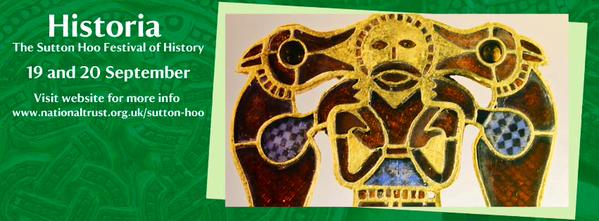
Historia: The Sutton Hoo Festival of History

19 and 20 September 2015, 10.30am - 5.00pm

A chance to explore the roots of English history at Sutton Hoo - England's 'Valley of the Kings'


In 1939 archaeologist Basil Brown excavated the largest mound of many in the cemetery of the Anglo-Saxon kings at Sutton Hoo and made one of the most spectacular archaeological discoveries of all time.

Inside the mound was the imprint of a twenty seven metre long ship with a ruined burial chamber at its centre adorned with gold jewellery, silverware and the famous burial mask or helmet, known collectively as the Sutton Hoo Treasure. The dead man was clearly a person of high status from the Anglo-Saxon kingdom of East Anglia, possibly a king.

The Suton Hoo burial mask
However, no trace of a body was found during the excavations of the ship burial. It seems to have totally decayed in the acidic conditions. Coins found inside the purse in the grave have been dated to around 610–635 AD providing an approximate date for the burial.

Rædwald the 7th-century king of East Anglia is the most favoured candidate for the occupant of the Sutton Hoo ship-burial. Rædwald reigned from around the end of the sixth century to his death in 624. Little detail has survived of his reign but he is remembered for a great victory of the Northumbrians at the Battle of the River Idle in 616.

"The Sutton Hoo ship burial provides remarkable insights into early Anglo-Saxon England. It reveals a place of exquisite craftsmanship and extensive international connections, spanning Europe and beyond. It also shows that the world of great halls, glittering treasures and formidable warriors described in Anglo-Saxon poetry was not a myth."

Mrs Edith Pretty, the landowner, donated the Sutton Hoo treasure to the British Museum in 1939 where it is today displayed in Room 41.

The ship burial
The National Trust has organised the Historia over the weekend 19 – 20 September to celebrate the history of Sutton Hoo and the Anglo-Saxon world. Expert speakers will deliver presentations  including Time Team's Dr Sam Newton and British Museum curator Dr Sue Brunning. Family activities have also been organised, including trails, treasure-handling, children's crafts, a Geology Walk and a display of the Sutton Hoo replica ship Sae Wylfing. Some activities are separately ticketed.

Historia Talks (£3 each) include:

19 September
Paul Jameson: The Battle of Hatfield
Does the archaeological discovery of hundreds of bodies solve the mystery of the fate of one of the great Anglo-Saxon kings?

Stephen Pollington: The Elder Gods
Who were the gods of early England and what legacy remains of the customs and beliefs of the Anglo-Saxons?

Dr Sam Lucy: Trumpington Bed Burial
The rare bed burial of a young woman with her pectoral cross provides a fascinating glimpse into the Anglo-Saxon world at a time of dramatic transition.

20 September
Paul Constantine: The Mound One Ship & Sae Wylfing
One of the greatest of the Sutton Hoo treasures - the Ship itself - rotted away in the soil over thirteen centuries. A new project asks if we can reconstruct this magnificent vessel.

Dr Sam Newton: Raedwald, the First King of England
Was Sutton Hoo the last resting place of King Rædwald of East Anglia? Rædwald lived, fought and died during one of the founding moments of English history.

Dr Richard Hoggett: Excavation & Experiment at West Stow
This year marks the 50th anniversary of the archaeological excavations at West Stow, which revealed the remains of an extensive Early Anglo-Saxon settlement in the Lark valley.

Dr Faye Minter: Anglo-Saxon Rendlesham
Recent archaeological work at Rendlesham, near Sutton Hoo, has revealed some fascinating new information about Anglo-Saxon East Anglia.

The Sutton Hoo cemetery
Great British Walk - Landscape, Archaeology & Geology of Sutton Hoo
As part of the Historia Festival of History, there will be the opportunity to explore the Sutton Hoo landscape from a new perspective when on Sunday 20th September National Trust Archaeologist Angus Wainwright leads a walk across the Sutton Hoo landscape, down to the River Deben, revealing multiple layers of geology, archaeology and history, through the Anglo-Saxons and into the prehistoric past.

Booking Essential!

The National Trust Visitor Centre at Sutton Hoo
Sutton Hoo, Tranmer House, Sutton Hoo, Woodbridge, Suffolk IP12 3DJ
Phone: 01394 389714.

See the National Trust website for further details.


* * *