On 9th December it was widely reported through the press that the
Holy Thorn of Glastonbury had been vandalised, hacked down during the night. The mindless vandalism of the Glastonbury Thorn must be the most baffling event of the year. Seen by many as an anti-Christian act the motives are beyond me in what is arguably the pagan capital of England where there is tolerance of all faiths.
There are other Holy Thorn trees in Glastonbury: the Chalice Well Gardens, another in the grounds of Glastonbury Abbey, and the churchyard of St John's Church in the high street. These and the one on Wearyall Hill are all claimed to be descendants of The Holy Thorn associated with the Legend of Joseph of Arimathea, the uncle of Jesus. On arriving in Britain by boat after the crucifixion, Joseph landed on the Isle of Avalon and having climbed Wearyall Hill, thrust his wooden staff into the ground where it took root and grew into the Glastonbury Holy Thorn, nearly 2,000 years ago.

This tree (
Crataegus monogyna ‘Biflora’) is not native to Britain but originates from the Middle East. Its biennial flowering with white blossoms and red berries at Easter and Christmas time is a source of wonder to many. Every year for the last one hundred years a flowering sprig has been cut from the Glastonbury Thorn at St John's Church and sent to the Monarch. This year, just hours after the sprig was cut for the Queen’s Christmas table the tree on Wearyall Hill was attacked. All of the branches were hacked off and left in a pile around the base of the tree with only the base of the trunk now remaining.
The original thorn tree was cut down during the English civil war and this tree had been replanted in 1951. Oliver Cromwell’s Roundheads felled the tree whilst waging a vicious war against the Crown. However, locals salvaged the roots of the original tree, hiding it in secret locations around Glastonbury, later replanting it on the hill. Other cuttings were also grown and placed around the town.
While this is one of the many holy thorns at Glastonbury it is believed to be one of the most important symbols of Christianity because it is on the site that Joseph of Arimathea, thrust his staff into the Glastonbury earth. Some claim he also brought the Holy Grail to Britain, but wherever, or whatever, the whereabouts of the Grail, the Holy Thorn is certainly linked to the origins of Christianity in England.
The site is visited by thousands every year and those visiting shortly after the vandalism were reduced to tears; regarded as sacred it has become a pilgrimage site for many and holds a special significance for Christians across the world. It is hoped that the thorn tree on Wearyall Hill should sprout again from the stump.
Sadly 2010 has also been a year of great loss of some the great Arthurian writers who have put forward original theories on the legendary king.
Laurence Gardner, born in Hackney, London on 17th May 1943, passed away on 12 August 2010. Gardner's first book
Bloodline of the Holy Grail was published in 1996. The book was serialized in the Daily Mail and very quickly became a best seller. He used his books to propose several theories, including a belief that Jesus and Mary Magdalene had married and had children, whose descendants included King Arthur and the House Of Stuart.
Peter Clement Bartrum, renowned Welsh scholar, although an Englishman, died on 14 August 2008 at age 100. His books included
A Welsh Classical Dictionary and
Early Welsh Genealogical Tracts, must-haves for every Arthurian and Early Medieval Welsh literature enthusiast.
 C. Scott Littleton
, co-author with Linda Malcor of From
Scythia to Camelot, passed away in Pasadena, California, on 25 November 2010. This ground-breaking book proposed that the core of the Arthurian and Holy Grail traditions derived not from Celtic mythology, but rather from the folklore of the peoples of ancient Scythia, that is, the western portion of the great "
sea of grass" that stretches from the Altai Mountains to the Hungarian Plain, lands that are now the South Russian and Ukrainian steppes.
Rachel Bromwich, passed away on 15th December. The depth of her knowledge was absolutely stunning;
The Triads of the Island of Britain (Trioedd Ynys Prydein) bears testament to this, a truly monumental work.
I can't think of any notable Arthurian movies that have been released on the silverscreen this year, which after the last
King Arthur film starring Clive Owen and Keira Knightley (2004) is probably no bad thing. July saw the first television screening of
King Arthur's Round Table Revealed on the
History Channel. Historians, on the program led by Christopher Gidlow, believe that they may have pinpointed the exact location of the famous Round Table inside the former Roman amphitheatre at Chester, claiming that the 'table' was in fact the circular space inside Chester Amphitheatre and that this was indeed the site of Nennius' 9th Battle,
The City of the Legion.Gidlow claimed the “
clincher” was the discovery of a Christian shrine within the amphitheatre, a wooden structure over the gladiatorial hitching stone; but archaeologists who had led the excavations at the site attempted to distance themselves from the sensationalism of the television program. These were not new discoveries and there is absolutely no evidence of a shrine within the amphitheatre. See:
The Round Table Revealed?
New Arthurian books this year have seen the publication of Christopher Gidlow's second Arthurian book
Revealing King Arthur was published in May by the History Press. Gidlow's earlier work
The Reign of Arthur: From History to Legend (The History Press, 2004) discussed how a Dark Age historical figure became the substance of legend in the later sources such as the Mabinogi, Geoffrey of Monmouth and the Saints' Lives. Much of the theme of Revealing King Arthur is aimed at scholarship of the last thirty years which has declared that the enigmatic Arthur should be banished from our history books altogether. Here Gidlow attempts to redress the balance and argues for a historical Arthur.
In much of a similar vein is the second edition of
King Arthur: Shadows in the Mist by August Hunt his second Arthurian book of the year. In reality little more than an updated edition of the 2006 Hayloft publication
Shadows in the Mist: The Life and Death of King Arthur in which the author set out to try to reverse the current academic trend of what we might call '
Arthur denial', the apparently increasing tendency by scholars to question the historical existence of either Arthur or even an Arthur-type figure. In this 2010 edition, Hunt claims to re-consider the source material with a new and original approach, exploring the historical evidence, looking at place names and local folklore, to provide a challenging argument for the actual existence of King Arthur.
After reading Hunt's online articles on
Faces of Arthur, through the
Vortigern Studies website, I looked forward to his first publication of 2010 which claimed to be an introduction to
Arthurian Druidism, whatever that is? Published on the 1st May and entitled
The Secrets of Avalon the book claims to set out to illuminate the connections between the traditions of both Arthur and Druidsm, but left me in the dark.

Whereas
The Secrets of Avalon wallows in Celtic mythology
The Druids and King Arthur by Robin Melrose looks at the subject from a more historical and factual perspective. This book examines the role the Druids may have played in the story of King Arthur and the founding of Britain. In exploring the beliefs and origins of the Druids, the author sets out to explain how the Druids originated in eastern Europe around 850 B.C., bringing to early Britain a cult of an underworld deity, a belief in reincarnation, and a keen interest in astronomy. Concluding that Arthur was originally a cult figure of the Druids whose descendants may have founded the Anglo-Saxon kingdom of Wessex but in reality provides very little detail on either the Druids or Arthur. For those sceptical of a viewpoint like Melrose who see everything coming out of the east the next item may be of interest.
Although not directly Arthurian but certainly of interest to Celtic scholars and anyone interested in Arthurian origins, perhaps the most important book of 2010 is
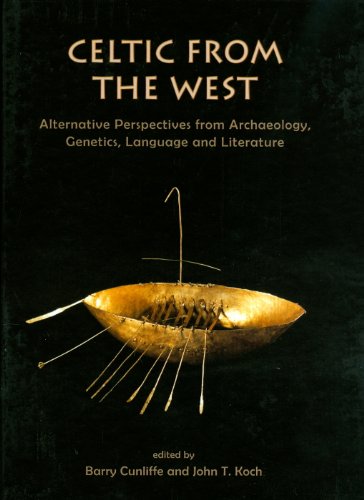
Celtic from the West: Alternative Perspectives from Archaeology, Genetics, Language and Literature 
edited by John Koch and Barry Cunliffe. The book explores the new idea that the Celtic languages originated in the Atlantic Zone during the Bronze Age, approached from various perspectives of pro and con, archaeology, genetics, and philology. This Celtic Atlantic Bronze Age theory represents a major departure from the long-established, but increasingly problematical scenario in which the story of the Ancient Celtic languages and that of peoples called Keltoí Celts are closely bound up with the archaeology of the Hallstatt and La Tène cultures of Iron Age west-central Europe. The
Celtic from the West proposal was first presented in Barry Cunliffe's
Facing the Ocean (2001) and has subsequently found resonance amongst geneticists. It provoked controversy on the part of some linguists, though is significantly in accord with John Koch's findings in
Tartessian: Celtic in the South-West at the Dawn of History (2009).
Born out of a multidisciplinary conference held at the National Library of Wales in Aberystwyth in December 2008, Celtic from the West presents a collection of articles intended to pursue the question further in order to determine whether this earlier and more westerly starting point might now be developed as a more robust foundation for Celtic studies. Fascinating stuff.
Best wishes for the New Year.
* * *