Showing posts with label Vortigern. Show all posts

Wednesday, 27 December 2017

On the Trail of the Dragons of Emrys

Top Ten Arthurian Locations: No 5

The Legend of Dinas Emrys
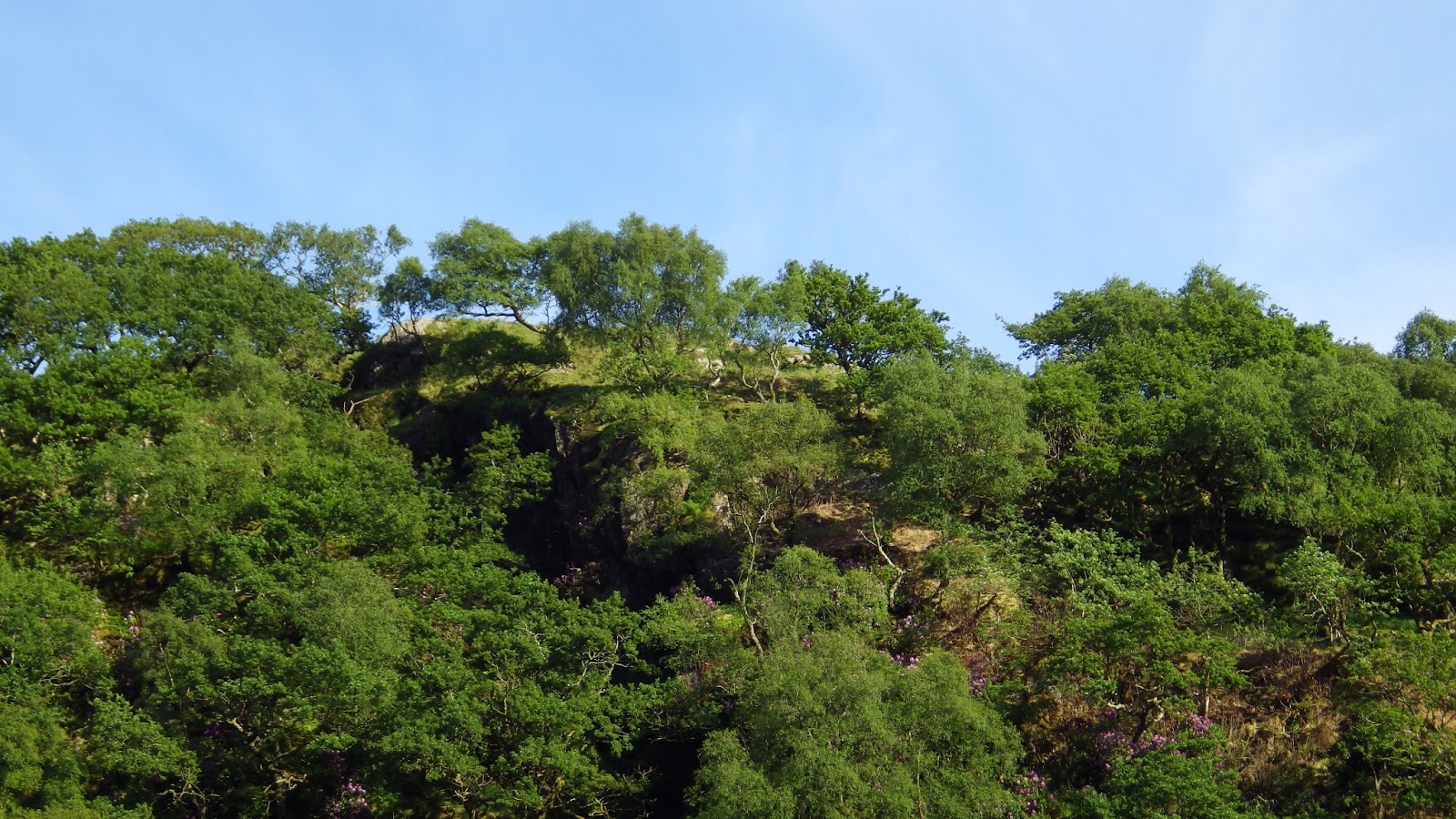
Dinas Emrys  (the fortress of Ambrose) is a rocky outcrop 250 feet above Llyn Dinas in the Nantgwynant valley.  According to legend, this is the site that the tyrant Vortigern chose to build his fortress but it kept collapsing leading to the first literary appearance of the young Merlin (Myrddin in Welsh) as the boy Ambrose. This is said to be where the white dragon of England fought and lost to the red dragon of Wales.

“Fleeing Anglo-Saxon invaders Vortigen came to Wales and chose the hillfort as his retreat. However all efforts at building on the site failed, with workers returning daily to find collapsed masonry. Vortigern was counselled to seek the help of a young boy born of a virgin mother; a suitable boy was found named Myrddin Emrys (Merlin Ambrosius). Vortigern’s plan to kill Myrddin to appease the supernatural powers preventing him from building his fortress was scorned by Myrddin who instead explained that the fort could not stand due to a hidden pool containing two dragons. The White Dragon – he explained – of the Saxons would in time be defeated by the British Red Dragon. After Vortigern’s downfall the fort was given to Emrys Wledig (Ambrosius Aurelianus) from which it takes its name.”

The story of 'Lludd and  Lleflys' from the Mabinogion tells how Lludd captured the dragons in a vat containing ale. The dragons were buried at the safest place in Britain that later became known as Dinas Emrys.

Another legend tells of Myrddin's treasure hidden in a cave at Dinas Emrys.

Information board at the Craflwyn centre

Archaeology of Dinas Emrys

Today little remains above ground, however n 1910 and 1954-56 archaeologists excavated the site of Llywelyn's castle at Dinas Emrys and have identified several periods of habitation; the earliest dating to perhaps the 1st or 2nd century. They also found the cellar of the castle and the foundations of the tower. A cistern inside the structure has been identified which may have been the hidden pool and have some connection with the legendary tale of Vortigern and the dragons.

Follow the path past Craflwyn Hall to the waterfall at Merlin's Pool
From the information board at the Craflwyn centre:

"Dinas Emrys commands a strategic position in the valley of Nantgwynant, one of the main routes through Snowonia. A hillfort once stood on the site, shown today by an impressive gateway and stone ramparts around the summit. Excavations have revealed that Dinas Emrys was occupied from the late Roman period (3rd-4th centuries AD) until the 6th century. Pottery from the eastern Mediterranean and southern France has also been found there.

Dinas Emrys - our destination
"Other evidence shows this was an important site for many centuries. A medieval cistern supplied valuable fresh water to the hillfort's inhabitants, and plays an important part in the Dinas Emrys legend. On the rocky outcrop's summit, the stone base of a 12th-century tower survives. Traditionally associated with Llywelyn the Great, it was probably built by one of his feuding rivals before Llywelyn secured the kingdon in 1201.

Follow the path with the wall on your right until you reach a style where you cross into the woods
"Charcoal in the tower's base suggests it may have been burnt down deliberately, possibly by Llywelyn, as a 13th-century poem implies. the tower may have been built of stone, or partly of timber; we do not know its height. These reconstructions are based on the archaeological evidence we do have, including other castles built by Llywelyn.

Keep on through a wooded area
"In 1201 Llywelyn granted the Nantgwynant Valley, including Dinas Emrys, to the Cistercian monks of Aberconwy Abbey. The valley became a monastic grange, and land divisions today still reflect these ancient boundaries."

Go through a cleft in the rocks
The Gwyedd Princes
The Gwynedd Princes Project traces the Welsh Princes from Maelgwn Gwynedd to Llywelyn the Great across 30 heritage sites in North Wales, from the castles the princes built to the royal courts where they ruled, to tell the unique story of the longest and most successful dynasty in medieval Wales.

Scramble up on to the summit
The project was launched in October 2013 at Dinas Emrys visitor centre at Craflwyn, beneath the hillfort, near the Snowdonia village of Beddgelert, said to be named after Gelert, Llywelyn's favourite dog.

The base of Llywelyn's tower on the summit of Dinas Emrys

On the Trail of the Two Dragons
There is an excellent walk to the summit of Dinas Emrys with breath-taking views of Snowdonia.

Park at the National Trust car park at the Craflwyn centre one mile north of Beddgelert  on the A498. The Sherpa Bus Service goes also through Nantgwynant.

The Dinas Emrys trail
Although a short walk, less than 2.5 miles, it is described as 'moderate' - there is a short scramble toward the summit over mossy rocks that can be very slippery when wet.

For full walk instructions see: The legendary trail of Dinas Emrys


Photographs of the walk copyright © Edward Watson
http://clasmerdin.blogspot.co.uk/


* * *


Friday, 24 November 2017

The Fire of the Sons of Constantine


Little Doward Hillfort
The ancient fortress at Little Doward occupies a substantial hill, peaking at 724ft at the north west corner of the ramparts, an outlier to the Great Doward and Lord's Wood massif on the north bank of the River Wye, some 2 miles from Monmouth in Herefordshire. The single rampart hillfort was constructed in the Iron Age but the history of the Doward's goes back many years beforehand.

In Post-Roman days this area was known as Erging (or Ercing) centred on the Roman town of Ariconium. Later the English called the region Archenfield. Today, the area of western Herefordshire sits in the shadow of the Black Mountains hosting a number of Arthurian sites such as the prehistoric Arthur's Stone and the tomb of Arthur's son, Amr.

Little Doward Hillfort (British History online)
Several limestone caves in the area have yielded prehistoric remains, such as giant elk, hyena, mammoths, woolly rhino, cave bear and lion, including tools from the Palaeolithic period which ended around 10,000 years ago. Finds suggest the caves have been used through the Bronze Age to the Romano-British Iron Age. 19th century claims that a Roman coin hoard dating to 267 AD was unearthed here are unfounded, with no apparent evidence of a Roman presence at the hillfort. Mounds across the summit have been interpreted as artificial rabbit warrens constructed in the post-medieval period. Traces of iron mining date to the same period. At the foot of the cliff on a platform directly below the south eastern corner of the hill fort is King Arthur's Hall, or Cave.

King Arthur's Cave
Situated at the foot of a low cliff at the north-western end of Lord's Wood on the hill of Great Doward at Whitchurch near the River Wye, King Arthur's Cave is one of the most well known of the limestone caves located at the Doward, near Symonds Yat in the Forest of Dean. King Arthur's Cave was occupied by man during the upper Palaeolithic making the cave the oldest location associated with the legendary King.

King Arthur's Cave
The Arthurian association with this cave is unlike others which claim the King lies sleeping with his knights deep within beyond a secret doorway that can not be found in normal circumstances. The Little Doward cave legend claims that King Arthur hid all his treasures here, then Merlin cast a spell over the cave so that it couldn't be found. The cave is also said to be the site of a legendary underground passage; perhaps Arthur lies sleeping beyond that?

To find the caves take the Symonds Yat West exit from the A40 and follow the signs for the Doward, parking at a lay-by just before reaching the camp site and follow the track down into the woods, past the old quarry.

During the 19th century Richard Blakemore carried out extensive landscaping of Little Doward, apparently cutting away the top of the rampart to make a walkway, and substantially altering the entrance to King Arthur's Cave.

It is not known when the name of “King Arthur” name became attached to locations in the Wye valley, however from the 19th century “King Arthur's Cave” had become equated with the name “King Arthur's Hall”. On an 1805 map of Herefordshire “King Arthur's Hall” is shown between Little and Great Doward, roughly the location of King Arthur's Cave. However, in 1871, Rev William Symonds described King Arthur's Hall as the summit of Little Doward hillfort with the cave on the western slope.

Around the year 1700 the skeleton of a very large man, accompanied by a brass-headed spear, was discovered in the cave. The gigantic bones were presented to a surgeon in Bristol by the name of Pye, who took them with him on a sea voyage to Jamaica, but they were lost when the ship sank. Some link this discovery to the naming of the cave with Arthur.

Caer Guorthegirn 
Frederick John Snell considered the old hill fort at Little Doward to be a potential site for Arthur's eighth battle at Guinnion. However, not many commentators would agree with him today, preferring the Roman fort of Vinovium at Binchester, constructed to guard the crossing of the River Wear by Dere Street, the main Roman artery linking Hadrian's Wall to the city of the Legions at York.

In Arthurian times, according to Geoffrey of Monmouth's Historia Regum Britanniae (The History of the Kings of Britain), Vortigern, the high king of Britain infamous for inviting the Saxon's into the country, died by burning in his stronghold. Sure enough Caer Guorthegirn (Fortress of Vortigern) has been identified as Little Doward. However, other stories locate Vortigern's death at other locations across the country, such as Old Carlisle, Cumbria, Salisbury (Stonehenge) and Craig Gwrtheyrn, Llandysul, Dyfed.

The Historia Brittonum (History of the Britons, aka Nennius) describes Caer Guorthegirn as one of the 28 cities of Britain, being located in the region of Gueneri, or Guenessi, usually considered to be in Gwent:

“Then the king assigned him that city, with all the western provinces of Britain; and departing with his wise men to the sinistral district, he arrived in the region named Gueneri, where he built a city which, according to his name, was called Cair Guorthegirn.”

The Triads of the Island of Britain (Trioedd Ynys Prydein) recorded in the Red Book of Hergest, (Llyfr Coch Hergest, c.1425), recall Vortigern as one of the Three Dishonoured Men of the Island of Britain:

“.... the second is Gwrtheyrn [Vortigern] the Thin, who first gave land to the Saxons in this Island, and was the first to enter into an alliance with them. He.......... exiled the two brothers Emrys Wledig and Uthur Penndragon from this Island to Armorica, and deceitfully took the crown and the kingdom into his own possession. And in the end Uthur and Emrys burned Gwrtheyrn in Castell Gwerthrynyawn beside the Wye......”

Vortigern besieged in the tower
This late Triad may well have been influenced by Geoffrey of Monmouth who uses the name 'Cloartius' as a scribal error for ‘Doartius’, i.e. 'cl' for 'd', from the Latin name for Little Doward hill.

Geoffrey's story says that, impressed after Merlin delivered his prophecies (HRB, BOOK VII), Vortigern asks about his own fate. Merlin advises the king to flee the fire of the sons of Constantine, the two brothers, Aurelius Ambrosius and Uther Pendragon, who have set sail from the Armorican shore heading for Britain to seek revenge for their father who Vortigern betrayed and then invited the Saxons into the island. On landing at Totnes, Merlin continues, they will subdue the Saxons; but first they will burn Vortigern besieged in his tower.

And so it happened; on arrival in Britain the Sons of Constantine (Ambrosius and Uther) marched into Cambria, to the town of Genoreu, where Vortigern had fled for refuge. Geoffrey says that town was in the country of Hergin (Ercing), upon the river Gania (Wye), in the mountain called Cloarius:

“Immediately, therefore, they set their engines to work, and laboured to beat down the walls. But at last, when all other attempts failed, they had recourse to fire, which meeting with proper fuel, ceased not to rage, till it had burned down the tower and Vortigern in it.” (HRB, BOOK VIII)

Whereas Geoffrey used the name 'Cloartius' as an incorrect form of the Latin 'Doartius' which is found in most manuscripts with reference to the Doward, in the Brut, the Welsh version of Geoffrey's Historia, we find the hill of the site of Vortigern's fortress called Mynyd Denarth, or Deu Arth, which may have led to the connection of the cave with Arthur.

Vortigern's Grave
The location of the Herefordshire village Ganarew (Genoreu - from old Welsh: Genau rhiw translates as ‘Pass of the hill, or situated between two hills’) only separated from the Doward by the A40 road would affirm the location beside the Wye as the correct site of Vortigern's final stand at Caer Guorthegirn. This is barely a couple of miles from Geoffrey's native town of Monmouth; no doubt he knew the hillfort and may have even visited the site.

Church of St Swithin, Ganerew - the site of Vortigern's grave?
A local tradition claims Vortigern's charred remains where buried under Ganarew church situated in the col overlooking Little Doward. The current church at Ganarew, dedicated to St. Swithin, is said to have been built over the foundations of a much older church. In the 12th century it was known as ‘the Chapel of St Thomas at Gueneru’, yet the earliest known dedication appears to have been to St Gwynnog in the 6th century.


Copyright © 2017 Edward Watson
http://clasmerdin.blogspot.co.uk/


Sources:
Mary Andere, Arthurian Links in Herefordshire, Logaston Press, 1995.
Geoffrey of Monmouth: History of the Kings of Britain, ed & trans. Lewis Thorpe, Penguin Classics, 1977.
Rachel Bromwich, Trioedd Ynys Prydein, University of Wales Press; 3rd edition, 2006.
Nennius: History of the Britons, ed. John Morris (Arthurian Period Sources, Volume 8), Phillimore, 1979.
F J Snell, King Arthur's Country, Dent, 1926.
The Cities of Vortigern – Robert Vermaat's Vortigern Studies.
The Welsh Triads from The Red Book of Hergest, Mary Jones, Celtic Literature Collective.


* * *


Sunday, 21 June 2009

Warlords and Tyrants


“..... a land fertile in tyrants.”


The period in British history immediately following the ending of Roman rule has been variously labelled The Dark Ages, Sub-Roman or Post-Roman Britain, none of which seems to adequately describe the existence of Britain as a successful independent state during the turmoil created by the mass movements of peoples throughout Europe. Roman scribes were ejected along with the officials which has left historians with little or at best vague sources for the period leading to the assumption of a ‘dark age’. The term ‘sub-roman’ implies an inferior state, originally a term coined by archaeologists to define the standard of pottery finds from this time; a more suitable term ‘post-roman’ defines the period following the Roman ejection from this Island prior to Anglo-Saxon domination, from this we can deduce an independent British state in existence from 409 AD – c.596 AD which therefore must have had powerful leaders which, according to Gildas, “BRITAIN has kings, but they are tyrants.

The lack of sources from this period in British history has left the way open to many authors putting forward their thesis of a conjectured history. Two books focusing on this period have been published recently; Arthur and the Fall of Roman Britain: A Narrative History for Fifth Century Britain by Edwin Pace in October 2008 and Warlords: The Struggle for Power in Post-Roman Britain by Stuart Laycock, April 2009.

Although the world’s bookcases bow under the strain of the myriad of books on the elusive Dux Bellorum, the fascination obsessive and eternal, you may be screaming “no more!”, but new books focusing on the enigmatic post-roman period are always of interest to the Arthurian aficionado. Before we can determine who or what, or if, Arthur was, we must establish the setting and both of these authors delve into the shadowy period with fresh enthusiasm. This being a subjective period owing the limitations of the sources, not all readers will agree with the proposals in these two books.

The Proud Tyrant

Arthur and the Fall of Roman Britain
A Narrative History for Fifth Century Britain

by Edwin Pace

Paperback: 358 pages
Published by Invermark Books (1 Oct 2008)
ISBN-10: 0955420148

From the Back cover:

An evocative recreation of a vanished world, this is the first genuine narrative history for 5th Century Britain. The author demonstrates that the only plausible explanation for the extant evidence is that a powerful military ruler known as the Dux Bellorum dominated Post-Roman Britain for two decades. Known variously as the ‘Proud Tyrant’, Arthur and Riothmanus, his reign would be a major turning point in British History. A new and controversial narrative history for fifth century Britain. A serious history that places Arthur firmly back in the frame as an historical figure and a major one at that. A compelling story of a nation in crisis.

Table of Contents:

Acknowledgements
Foreword
Introduction
1. Conflict with Their Cruel Enemies
2. Cavalry by land and Mariners by Sea
3. Left Without a Shepherd
4. The proud Tyrant
5. The Romans Therefore Left the Country
6. Forty Years of Fear
7. They Left Their Cities
8. They Overthrew Their Enemies
9. A Protection to Their Country
10. To Fight in Favour of the Island
11. Kings Were Anointed
12. A Most Extraordinary Plenty
13. A Humble Man
14. Most Kingly
15. By Way of Ocean
16. The Fire of Vengeance
Epilogue
Appendix I – A Chronology for Late Antique Britain
Appendix II – Happy Birthday Gildas!
Appendix III – Historia and Chronicle
Maps
References
Bibliography
Index

Arthur and the Fall of Roman Britain claims to be like no previous book on Post-Roman Britain, aiming to demonstrate that the current image of 'Arthur' as a Dark Age chieftain fighting a last-ditch battle against Saxon invaders is very much a myth. Pace argues that this leader of the British was much earlier than previously suspected, far from being a Dark Age warlord, he continued Roman military and naval strategies to secure Britain, uniting the people in a series of battles in all corners of the island using alliances with various foreign mercenaries to bring about two decades of peace. Pace constructs his thesis on the argument that the earliest sources derive from the same basic fifth century series of events in Britain and Europe.

Pace reconstructs a history of Post-Roman Britain based on the earliest available sources; Gildas, Historia Brittonum and the Anglo Saxon Chronicle. Unfortunately none of these can be seen as particularly reliable for re-constructing history, but we have little else; Gildas was delivering a sermon loaded with religious rhetoric; The Historia Brittonum contains much fable and was produced to suit the politics of Gwynedd; the Chronicle was written some time after events in an attempt to provide the Germanic settlers a foundation myth in Britain and legibility to kingship. Personally, I’m not convinced there was an Anglo-Saxon invasion en masse, if at all, furthermore, only one of these sources mentions Arthur by name and only two mention the Battle of Badon; could the site of this battle really have been so far west (Bath?) at such an early date? It is rarely talked off in comparison to the location of the second Battle of Badon.

Unfortunately we do not have much else to construct our Post-Roman histories thereby leaving the path open to conjecture and leaps of faith. This is not meant as criticism of Pace but observed frustrations of the period. This was an exciting time in British history and Pace writes a good book which is essentially an account of Vortigern, generally agreed upon as the Proud Tyrant of Gildas’ rant, which the author proposes as the identity of the Dux Bellorum and constructs a thought-provoking chronology for the legendary Arthur based on this association.

Vortigern is of course infamous for inviting Saxon mercenaries to guard Britain, a practice adopted from the Romans, against Pict and Irish raiders, “wolves into the sheep-fold”. For this reason Vortigern fell from grace whereas Arthur was and is remembered as a hero, the saviour of the Britons.

Pace argues that Vortigern is synonymous with Riothamus both names meaning the same; “great king” or “overlord.” Gildas informs us, albeit it indirectly, that the British leader at Badon was Ambrosius and the Historia Brittonum recounts Badon as one of Arthur’s battles. Therefore we could deduce from the sources that Ambrosius is Arthur, but according to Pace, Ambrosius may have been Arthur’s (Vortigern’s) son, which certainly would require a new chronology and a change in colours, as Ambrosius is generally considered to have followed Vortigern by a generation and they would appear to be from different factions. In the final chapter Pace discusses the Battle of Camlann and identifies yet another British warlord having a name synonymous with the Dux Bellorum.

The author claims to have presented a comprehensive hypotheses for all of the earliest sources for fifth century Britain using evidence that was declared “inadmissable” by a certain scholar over thirty years ago, stating that the time for a re-examination of this data is long overdue, but in doing so his claims that Arthur is represented by four characters known by four different names throughout the sources is unconvincing.

>> The Author’s website


The Warlords

Stuart Laycock may be familiar to Post-Roman Britain enthusiasts through his previous work Britannia - the Failed State, nominated for Book of the Year 2009 by Current Archaeology, in which he argues that at its height Britain was wealthy Roman state, but by the end of the 4th and beginning of the 5th centuries AD, the province was at the point of collapse and it was soon replaced by an Anglo-Saxon culture which had migrated across the North Sea.

Laycock studied Classics at Cambridge, and has worked as an aid worker in Bosnia and Kosovo where he had first-hand experience of tribal conflicts. Using original research, analysing Roman Britain and providing an insight into the missing pieces of the complex jigsaw of the beginnings of British Dark Age history, he brings a unique perspective to the subject. During his studies of late Roman zoomorphic buckles he has built up one of the largest private collections in Britain.


Warlords
The Struggle for Power in Post-Roman Britain
by Stuart Laycock

Paperback: 192 pages
Published by The History Press Ltd (1 April 2009)
ISBN-10: 0752447963

From the Back cover:

An exciting and fresh approach that sees the Britons not as victims, but active players in the foundation of Anglo-Saxon England”- Dr Kevin Leahy

“The centuries after the end of Roman control of Britain in AD 410 are some of the most vital in Britain’s history – yet some of the least understood. ‘Warlords’ brings to life a world of ambition, brutality and violence in a politically fragmented land, providing a compelling new history of an age that would transform Britain.

By comparing the archaeology against the available historical sources for the period, 'Warlords' presents a coherent picture of the political and military machinations of the fifth and sixth centuries that laid the foundations of English and Welsh history. Included are the warring personalities of the local leaders and a look at the enigma of King Arthur. Some warlords sought power within the old Roman framework; some used an alternative British approach; and, others exploited the emerging Anglo-Saxon system - but for all warlords, the struggle was for power.”

Table of Contents:

Introduction
1. Gerontius
2. Vortigern
3. Hengest
4. Ambrosius
5. Riothamus
6. Aelle
7. The Five Warlords of Gildas
8. Arthur
9. Cerdic
10. Edwin, Cadwallon and Penda
After Post-Roman Britain
Notes
Bibliography
Index

Warlords follows on from Laycock’s previous work Britannia - The Failed State: Tribal Conflict and the End of Roman Britain, and it is recommended to read the earlier book before this so that one gets the full background of his thesis that the Iron Age tribal units and their internal struggles persisted through into the 5th century. In Warlords Laycock sets out to trace the development of these minor kingdoms and produces evidence of a land of British warlords with fertile ambitions in their pursuit of power since the days of Cassivellaunus, who led the British against Caesar’s second invasion of Britain in 54 BC.

Laycock uses each chapter to introduce to the reader to a figure from the sources, starting with little known Gerontius. According to most commentators it is the usurper Constantine III that ejected the Romans from Britain in 409 AD, disastrously crossing to the continent in pursuit of furthering his power of the Western Empire, following previous usurpers from this island like Magnus Maximus, but Laycock suggests it is his general, the British Gerontius that is the driving force behind his ambitions.

Hengest, and his brother Horsa, are usually dismissed as mythical characters from the Anglo-Saxon Chronicle, the names meaning stallion and horse. I would agree with this and do not give much credence to the early accounts of the Anglo-Saxon foundation myth as contained within the pages of Bede, Nennius and the Chronicle, who put quill to parchment several hundred years after the supposed events but Laycock discusses Hengest as an historical character presenting his claim on context and geography without presenting any contemporary evidence to substantiate his claims. He states “it is possible he is mythical, but on balance it looks more likely that he was a real historical figure around whom more poetic and mythical stories layer clustered”.

The following chapters on Ambrosius and Riothamus predictably make the inevitable connection that they could be one and the same person, he concedes that the historical evidence for Arthur is decidedly thin, but cannot resist making the claim that if he was a historical character, then he may have been a Germanic warlord fighting on behalf of the British Catuvallaunian leaders, which he states would explain why he doesn’t get a mention by Gildas. Laycock provides a good chapter on Cerdic, the often neglected British leader, probably because he just doesn’t fit with the generally accepted Anglo-Saxon invasion theory – a Briton creating the great Anglo-Saxon kingdom of Wessex, surely not!

Following the ejection of the Romans, Laycock takes the British back to their pre-roman tribal boundaries; Vortigern leader of the Dobunni; Ambrosius an Atrebate; Riothamus a Dumnonian, citing often neglected Dark Age earth works as evidence of boundary markers.

Laycock makes good use of the available sources for the period in attempting to construct a possible scenario for Post-Roman Britain but the vagueness of those sources demands a fair amount of conjecture on the author’s part to complete such a work. His main source of archaeological evidence is, not surprisingly taken from his previous studies, late roman belt buckles. However, we must exercise caution in assuming every find of this particular item denotes the presence of a Germanic warrior.

more from Stuart Laycock:

>> Late Roman Buckles

>> Ditches, Buckles & a Bosnian End to Roman Britain
Article from Wansdyke Project 21, part of the Vortigern Studies group of websites, edited by Robert M. Vermaat, a unique web-based study which focuses on the enigmatic, least-known Dark Ages earthwork, known as Wansdyke.

* * *