Tuesday, 19 August 2014

The Grail: A Holy Thing?

[Grail]...….(in medieval legend) the cup or platter used by Christ at the Last Supper, and in which Joseph of Arimathea received Christ's blood at the Cross. Quests for it undertaken by medieval knights are described in versions of the Arthurian legends written from the early 13th century onward. 

The Story of the Grail
Today we see the Holy Grail as a legendary sacred vessel used by Christ at the Last Supper, identified with the chalice of the Eucharist. Three of the four Gospels of the New Testament specifically mention a cup or platter at the Last Supper when Christ poured wine into a cup and urged the Disciples to drink of his blood.

This same vessel is said to have been the dish used by Joseph of Arimathea to gather the Precious Blood of Christ at the deposition. But none of the Gospels mention a vessel used by Joseph of Arimathea, or anyone else, to collect the Blood of Christ while on the Cross.

The Last Supper
As much as Celtic scholars have endeavoured to find the origins of the Grail story in Celtic mythology, locating cauldrons of plenty and lances dripping blood, they have failed to find an exemplar text for the story of Perceval. The main accounts of the Grail come from the mediaeval Romances, the majority of which were written between 1180 and 1240 AD during a flurry of literary activity. Three key texts have had significant influence on the object we today regard as the Holy Grail.

The story of the Grail commences with Chrétien de Troyes and was entitled Perceval, le Conte du Graal (Perceval, or the Story of the Grail), written between 1180 and 1190 AD. No extant manuscript containing Chrétien’s romances is contemporary with the author himself. Chrétien fails to describe the Grail in any great detail, and refers to it as simply “a grail” (un graal) as if his readers would be familiar with this term. An alternative argument suggests  Chrétien did not himself understand what the 'Grail' actually was. Chrétien writes of the Grail in only 25 of some 9,000 lines of the Conte du Graal. However, the grail was not the main subject of Chrétien's work; he wrote about Perceval's adventures and then Gawain who took up the quest.

In Chrétien's tale, Perceval witnesses a procession when he stays the night at the Fisher King's castle. Leading the procession is a squire carrying a white lance that drips blood from its tip. The procession continues with candelabras and then a maiden brings a "grail” that is so radiant it appears to dim the light from the candles. Perceval fails to ask what the lance or the grail are. The next morning the castle appears deserted and he leaves.

After wondering for five full years Perceval eventually meets a hermit, who is also his uncle, and is rebuked for bearing arms on Good Friday. The hermit explains that the Grail is a “holy thing” which sustains the Fisher King's father, the Grail King, by serving a single mass wafer. The passage bears extensive reference to the Passion and holds deep Christian feeling but oddly contains an exceptionally bitter mention of the Jews “who should be killed like dogs”. This passage has been described as untypical of Chrétien who normally writes in an unemotional and tolerant manner. Consequently the passage has been identified as an addition to the original manuscript by a later hand.

Chrétien's story then switches to Gawain who goes in search of the bleeding lance for one year. A vassal foretells that the lance will one day destroy the kingdom of Logres (England). Unfortunately Chrétien's account breaks off virtually mid-sentence and was left incomplete. This has led to a multitude of tales following Chrétien that have attempted to fill in the gaps with divergent interpretations and, notably, the description of the Grail.

A series of Continuations and Prologues (The Elucidation) of the Conte du Graal, composed c.1200-1230, added another 40,000 lines in an attempt to bring Chrétien's tale to a satisfactory conclusion with Gawain finally attaining the Holy Grail, but in reality confused the matter even further mixing pagan Celtic themes with further Christianisation of the Grail. In the First Continuation the bleeding lance is identified as the spear used by Longinus to pierce Christ's side when he hung on the cross. There had been much interest in the lance since it was discovered in Antioch in 1098 during the First Crusade.

Inspired by the equation of Chrétien's lance with that of the crucifixion, the addition of the Grail as a second relic of the Passion soon followed. A passage identified as a clear interpolation into some manuscript copies of the First Continuation tells how the Grail was the vessel in which Christ's blood was caught by Joseph of Arimathea who subsequently brought it to England where it has been ever since in the safe keeping of one of his descendants. The interpolator seems to hold a preoccupation with the circumstances of the Passion and the part played by the Jews; the passage in the First Continuation bears a strong resemblance to the hermit passage in the Conte du Graal and we can justifiably suspect the same hand as being responsible. But it remains unanswered as to what inspired the interpolator of Conte du Graal to Christianise the objects of Chrétien's grail procession into relics of Christ's Crucifixion?

Thus, the Christian mysticism of the Grail begins with with the First Continuator - not Chrétien, who's original work never links the grail with the chalice of the Last Supper; it is probable that he had something else in mind. We have no record of Chrétien's death; perhaps he purposefully left his work unfinished as a master stroke to puzzle us still 800 years later? If so it certainly worked. But it also left the Grail open to the interpretations of a multitude of other writers.

The Damsel of the Holy Grail
Dante Gabriel Rossetti (1874)
The next Grail Romance, entitled Parzival, was penned by Wolfram von Eschenbach in the first quarter of the 13th century. In Parzival, the Grail is described as a green stone, lapsit exillis, that fell from the Heavens. Wolfram claims that Chrétien's tale failed to do the subject justice and cited his source as a poet from Provence named Kyot. Some scholars believe Wolfram might have meant Guiot de Provins, a French troubadour from the Champagne area.

According to Wolfram, Kyot had uncovered a forgotten Arabic manuscript written by Flegetanis, a Muslim astronomer who had found the secrets of the Grail written in the stars. However, many sceptics believe Kyot the Provençal was simply a literary device invented by Wolfram to permit his deviations from the Conte du Graal, but as with  Chrétien, Wolfram does not link the Grail with the Chalice of the Last Supper. Significantly the first two medieval romances to feature the Grail do not link it with a relic of the Passion.

Robert de Boron was the first author to give the Holy Grail myth an explicitly Christian dimension when it became the 'Holy Grail' the vessel used by Christ at the Last Supper. Boron was author of two surviving poems, the Joseph d'Arimathe and the Merlin, thought to have been part of an intended trilogy along with the Perceval which has not survived.

Relics of the Passion
In de Boron's account the emphasis was placed firmly on the history of the Grail as a Holy relic, whereas Chrétien's focus was firmly on the adventures of Perceval and then Gawain. Chrétien's simple serving dish, “un graal,” had now developed into the Holy Grail, a Christian relic of the Passion brought back from the Holy Land. Clearly, de Boron had something quite different in mind to Chrétien and Wolfram.

According to Boron, writing between 1200 to 1210 AD, relying heavily on apocryphal texts omitted from the official version of the Bible such as the Gospel of Nicodemus, Joseph of Arimathea used the Grail to catch the last drops of blood from Christ's body as he hung on the cross. Joseph's family brought the Grail to the vaus d'Avaron, in the west, which later poets identified with Avalon at Glastonbury. These ideas seem to have been inspired by the patrons of the Grail Romances on returning from the Holy Land.

At the end of the Joseph d'Arimathe de Boron states he is in the service of Gautier of "Mont Belyal", identified as Gautier de Montbéliard who departed on the Fourth Crusade in 1202 AD and died in the Holy Land. Robert is said to have been originally from the village of Boron in the district of Montbéliard.

Philip of Alsace, count of Flanders from 1168 to 1191 AD, was the man said to be the patron of Chrétien's last romance, Conte du Graal. In the opening lines, Chrétien honours Philip with praise for providing him with the book he adapted into the "best tale ever told in a royal court". Philip's father was Thierry of Alsace, also  known as Diederik van den Elzas, Count of Flanders from 1128 to 1168 AD, who joined the Second Crusade in 1147 AD.

According to tradition, Thierry returned to his capital Bruges on 7th April, 1150 AD, with the relic of the “Precious Blood” a cloth that Joseph of Arimathea used to wipe blood from the body of Christ after the Crucifixion. The Basilica of the Holy Blood was built between 1134 and 1157 AD as the chapel of the residence of the Count of Flanders, to house the venerated relic of the Holy Blood. However, this cannot be verified until 1256 AD and we cannot dismiss the possibility that it was a later invention.

However,  as we have seen above, the writers of the Continuations, clearly felt that Chrétien's tale was meant to conclude with the relics of the Passion.

The Early History of the Grail
The earliest accounts of the Grail appear to have formed their roots from contact with the Holy Land during the Crusades. Many claimants to the Holy Grail are cited as relics brought back from the Holy Land during this period; perhaps we should not be surprised as the recovery of Christian relics was the stimulus for the Crusades; Pope Urban II delivered his “call to arms” speech at the Council of Clermont on 27 November 1095 to liberate the eastern churches.

Before Robert de Boron and the Continuations of Chrétien's Conte du Graal produced these literary renditions of the Holy Grail there were stories of relics from the Passion. Relics claiming to be the Holy Lance, Holy Sponge, Holy Chalice, the Crown of Thorns and nails from the cross were all venerated well before 1,000 AD.

Writing around 1200 AD, the first reference outside of the Bible to the dish of the Last Supper, the Cistercian chronicler Helinandus recorded that in 717 AD a hermit was shown a vision of the dish of the Last Supper. This learned hermit then wrote a book in Latin, entitled Gradale, the medieval Latin for ‘dish’; in English it was the 'Grail'.

But the earliest account of the Chalice and Lance to be recorded appears in the account of Arculf, a pilgrim who travelled from the British Isles to Palestine in the 7th century, and claimed he saw both the Chalice of the Last Supper and the Holy Lance that pierced the side of Christ when he hung on the cross.

On his return from a pilgrimage to the Holy Land (c. 680), Arculf was driven by storm to Scotland and so arrived at the Hebridean island of Iona, where he related his experiences to his host, Abbot St. Adamnan. Adamnan’s narrative of Arculf’s journey, De locis sanctis (Concerning Sacred Places), was noted by Bede, who inserted a brief summary of it in his Ecclesiastical History of the English People.

Arculf claimed he touched and kissed the silver chalice, which had the measure of a Gaulish pint and two handles on either side, through an opening of the perforated lid of the reliquary in a chapel between the basilica of Golgotha and the Martyrium, near Jerusalem. He saw the Holy Lance in the porch of the basilica of Constantine. This is the earliest mention of the Chalice of the Last Supper in the Holy Land and the only account that claims it is made of silver. Nothing is heard of it again.

Ecclesia 
Perhaps the earliest depiction of the "Holy Grail" is found in the 9th century in a psalter showing a figure at the Crucifixion collecting Christ's blood in a chalice. A miniature from the mid-9th century Utrecht Psalter shows an unidentified figure with a halo at the foot of the cross with a chalice into which Christ's blood flows. This figure is usually described as Ecclesia.

Ecclesia appears with a female Jewish partner (Church and Synagogue) in several pieces of later Carolingian art featuring the Crucifixion dating from c.870 AD and commonly appearing in miniatures and various small works until the 10th century. Ecclesia first appears in a Crucifixion scene in the Drogo Sacramentary of c.830 AD.
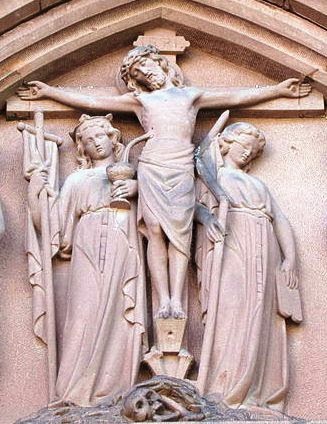
Crucifixion with Ecclesia and Synagoga, Notre-Dame des Douleurs, Marienthal, Alsace

Ecclesia and Synagoga are often found standing on either side of the cross in scenes of the Crucifixion, especially in Romanesque art. Ecclesia is generally adorned with a crown, chalice and cross-topped staff, while Synagoga is blindfolded and looking down, carrying a broken lance with Law Tablets that appear to be slipping from her grasp. The lance is often seen as an allusion to the Holy Lance used to pierce Christ's side at the Crucifixion. Ecclesia is often holding a chalice that catches the blood flowing from the wound, said to represent the Christian Eucharist. The pair are interpreted as the new church of Christianity and the old Jewish faith that turned its back on the Crucifixion.

Significantly, illuminated Gospel manuscripts always depict the figures at the side of the Crucifixion as Ecclesia and Synagoga, with Ecclesia always collecting the blood of Christ in a chalice. Whereas de Boron's Joseph of Arimathea and Nicodemus only appear in Crucifixion scenes in Medieval Grail manuscripts with one exception. An illuminated manuscript at Weingarten Abbey in Germany is illustrated with a Crucifixion scene showing what appears to be Joseph and Nicodemus removing Christ's body from the cross and an unidentified figure holding a chalice collecting the Holy blood. This manuscript pre-dates Robert de Boron's history of the Grail by a hundred years, suggesting the story was in circulation well before de Boron penned his account. Significantly, Wiengarten houses the Holy relic of the Precious Blood said to have been caught in a leaden box from the wound inflicted in Christ's side by Longinus.The box was buried at Mantua in Lombardy, Italy, and miraculously discovered in 804 AD.

In Christiain iconography the personification of Ecclesia preceded her coupling with Synagoga by several centuries, where she is depicted as the Bride of Christ, the church was in this context conflated with the Virgin, leading to the concept of Maria Ecclesia, or Mary as the church.

Is the depiction of Ecclesia bearing the chalice containing Christ's blood the origin of the Grail Maiden? There is evidence, pre-dating the first Grail Romance of Chrétien, suggesting that this is indeed the case.


Copyright © 2014 Edward Watson
http://clasmerdin.blogspot.co.uk


Notes & References
DDR Owen, The Evolution of the Grail Legend, University of St Andrews, 1968.
Richard Barber, The Holy Grail: Imagination and Belief, Allen Lane, 2004.


* * *

Monday, 11 August 2014

The Chalice of Doña Urraca: Is this the Holy Grail?

There are reputedly an estimated 200 different cups and chalices across Europe claiming to be the Holy Grail. Earlier this year another was added to the list.

The Chalice of Doña Urraca
Visitors flocked to the museum of the San Isidoro basilica in Leon after Spanish historians Margarita Torres and José Ortega del Río claimed to have discovered the Holy Grail. In their new book “The Kings of the Grail” Torres and del Río identify part of the Chalice of Doña Urraca, held in a church in León in northern Spain, as the legendary a 2,000-year-old vessel that Jesus supposedly drank from at the Last Supper.

After three years studying the history of the chalice Torres and del Río published their book at the end of March earlier this year. The news, released suspiciously close to All Fool's Day, immediately went viral on the net, and was dismissed by some as just another hoax along with the many stories released at this time that included archaeologists from Nottingham had found Robin Hood’s bones, Boudicca’s grave was finally located under King’s Cross station and plans were revealed to rebuild Hadrian’s Wall to its full height, should Scotland gain independence. And some.

The Chalice of Dona Urraca
Torres and del Río claim an onyx chalice was originally lined with gold and concealed within another antique vessel known as the Chalice of Doña Urraca located in León’s basilica of Saint Isidore where it has been there since the 11th century. Oddly the curators of the church's collection seem to have been totally oblivious to the proposal and have never marketed the Chalice of Doña Urraca as the “true” Holy Grail.

The chalice is said to have been constructed in the 10th century from two antique onyx cups combined by a frame made out of gold and embellished with stones and jewels. Detailed study has revealed the two onyx cups are indeed two Roman cups dating from around the 1st century. Comparable conversions of Classical onyx vessels into chalices had been accomplished for the emperor Romanus in Constantinople in the 10th century.

The chalice bears an inscription made in beaded gold letters recording that it was presented as a gift from Urraca to the palace church in Léon. Doña Urraca (1032 -1101 AD) was the eldest daughter of Ferdinand I and sister to Alfonso VI, King of Castile-Leon. Doña and her sister Elvira were in charge of the monasteries of the realm. A chronicle records that she “adorned sacred altars and the vestments of the clergy with gold, silver and precious stones”.

The materials and techniques employed for the Urraca chalice have their closest parallels in the products of the German imperial workshops of the middle of the 11th century. Similar German influence can be seen in the work of the reliquary of Saint Isidore presented to the treasury of San Isidoro as a gift of Ferdinand I, king of Castile-Léon (1015 – 1065 AD) and his wife Sancha, who granted a host of objects to the new palatine church in 1063 on the occasion of the arrival there of the relics of Saint Isidore of Seville.

The kingdom of León encompassed the north-west corner of the Iberian Peninsula. It had begun as the kingdom of the Asturias, a narrow strip of land behind a range of mountains that after the invasion served as an effective barrier to Islamic occupation, the first Christian political entity established following the conquest of the Visigothic kingdom by the Islamic Umayyad Caliphate in the first quarter of the 8th century. The Kingdom received its name early in the 10th century when Fruela II became king and moved the royal court south from Oviedo to León, a city whose name reflected its origin as the headquarters of a Roman legion in the first century. Under King Ferdinand I the city developed as a much more important capital.

Under Ferdinand I, during the second half of the 11th century, appropriated objects of Islamic manufacture were joined in the San Isidoro treasury by sumptuous liturgical arts that had become increasingly Germanic in character. An entire collection of Islamic boxes, most of which carry Arabic Inscriptions, can be found in the treasury of San Isidoro and among the items enumerated in the extraordinary charter of 1063 were a number of textiles designated specifically as Islamic in manufacture.

Torres told the Irish Times that while they had been researching the history of some Islamic remains in the Saint Isidoro basilica they discovered two medieval Egyptian documents that mentioned the Chalice of Christ.

The parchments told of how Muslims took a sacred cup from the Christian community in Jerusalem to Cairo. It was then given as a diplomatic gift to “Ferdinand, emir of Léon” on Spain’s Mediterranean coast in return for help he gave to Egyptians who were suffering a famine. Later Doña Urraca, his daughter, had the onyx cups mounted in a gold frame and presented it to the palace church in Léon, later to become the Cathedral of San Isidoro.

Torres and del Río's claims have been supported by scientific dating, which estimates that the onyx cup was made between 200 BC - 100 AD. Yet Medieval experts doubt the dramatic claims insisting the existence of the Grail is a myth, nothing more than a literary invention of the 12th century and not a real drinking vessel.

However, Torres and del Río do not actually claim that the chalice is the Holy Grail; they argue that they simply found early traces of a community who believed that it was. The Spanish historians admit it would now be impossible to prove the chalice was actually the origin of the Eucharist, the cup used by Christ at the Last Supper, as the first 400 years of the cup’s history are unknown and remain a total mystery. Yet Torres and del Río insist there is no doubt that this is the cup that early Christians revered as the chalice used by Christ at the Last Supper which made the journey to Cairo and then from Cairo to León.

I guess it all depends on what one means by the Holy Grail?


Copyright © 2014 Edward Watson
http://clasmerdin.blogspot.co.uk


Los Reyes del Grial
By Margarita Torres Sevilla y José Miguel Ortega del Río
Reino de Cordelia 2014
ISBN-10: 8415973292
ISBN-13: 978-8415973294


The book is currently only available in Spanish.


*UPDATE APRIL 2015

The Kings of the Grail by Margarita Torres Sevilla and Jose Miguel Ortega del Rio was published in English on 2nd April 2015 by Michael O'Mara Books.

J Matthews review on Amazon:

"......The most interesting part of the book is the material from Islamic sources, which have been largely ignored by researchers in the past. It is possible to see evidence of a vessel which seems to gave been carried from the Holy Land to Spain, but the date is late ( 11th century) and there is not enough evidence of its whereabouts before this. The argument that this relic was kept in the treasury of the Kings of Leon for hundreds of years, during which time they never once spoke it it, seems tenuous at best......In all, those who continue to seek out the history of the many Grails found around the world, would find this interesting, but it does not convince."


* * *

Thursday, 31 July 2014

The Trail of the Mercian Saints

Across Europe figures for church-going continue to decline while the numbers embarking on routes tracing the footsteps of the saints is enjoying a revival. Popular pilgrimage routes in Britain include St Cuthbert’s Way which follows the steps of the Anglo-Saxon saint for 62 miles from Melrose Abbey in the Scottish borders to Lindisfarne in Northumberland and the 120 mile Pilgrim’s Way from Canterbury to Winchester. The trail of the Mercian saints can be traced through the heart of Staffordshire in which pilgrims can get an insight into life in Mercia 1,300 years ago.

The lives of the Mercian Saints Chad and Werburga can be traced through Staffordshire to Cheshire exploring the area’s links with Mercian legends. The two Saxon saints are credited with bringing Christianity to the ancient kingdom of Mercia in the 7th century. The market town of Stone in Staffordshire  is situated at the centre with its story of the Saxon princes Wulfad and Rufin whose legend is told on the iron railings sculpture at Granville Square at the top of the High Street.

The tale of Wulfad and Rufin involves both St Chad and St Werburga. In addition to the various sites in Stone itself, there were other places in the Trent Valley situated between Trentham and Salt that have connections with the legend, such as the hill fort at Bury Bank, celebrated Royal Palace of the Mercian king Wulfhere, St Rufin’s Chapel at Burston and the site of Trentham Priory.


St Werburga's Shrine, Chester Cathedral
 (Wikimedia Commons)
The shrines of St Chad at Lichfield and St Werburga at Chester have been popular destinations for pilgrims since medieval times. Local legend claims Werburga spent her last days at Trentham Priory before her remains where moved to Hanbury. Finally her relics where moved to Chester in safe-keeping from the Danes. Æthelflæd, the Lady of the Mercians and founder of the county town of Stafford, is suspected of this final translation and establishing her cult there.

The shrines at Lichfield and Chester became places of pilgrimage because of their saintly associations with healing miracles reported to have happened there. A flourishing pilgrimage to St Chad’s shrine in Lichfield Cathedral is recorded by Bede in the 8th century. In the other direction, pilgrims made their way to Chester, passing through Stone on route. Evidence for this is found in the name of Newgate, the gate pilgrims would have entered Chester from the south-east, which was once called 'St Wulfad’s Gate'. Therefore, it seemed very apt to extend the route from Stone southwards through Cannock Chase to Lichfield and northwards to Chester and the shrine of St Werburga.

The trail of the Mercian Saints starts can be traced from the shrine of St Werburga at Chester Cathedral then, walking south, follows the Trent Valley from north Staffordshire through the market town of Stone, passing near the site of Aston Hall where St Chad's bones were found in 1839 and past St Rufin's Well at Burston before reaching the county town of Stafford with its patron saint Bertelin, said to be a Mercian prince, St Chad's church, the 'hidden gem' of Stafford in Greengate Street, opposite the Swan Hotel, is one of thirty-three ancient churches dedicated to the saint. The exact date when St. Chad’s was built is not known but believed to be around the year 1100 AD, said to be the oldest building in the county town, displaying architecture and sculpture that place it amongst the finest examples of Norman architecture in the Midlands. The stone carvings at St Chad’s include both Christian and Pagan associations with animal and human figures, abstract patterns and of course the ubiquitous ‘Green Man’ without which no Christian church would be complete. Local legends tell of Saracen stone masons at work in Staffordshire who may have been employed at St Chad's; there are certainly similarities to carvings on the pilgrimage route to Santiago de Compostela in north-western Spain, where architectural historians see Moorish influence.

The precise date of St. Chad's may be uncertain, but we do know something about its founder, a Crusader Knight. Carved on the capital of the north-east pillar of the tower is the Latin inscription ‘Orm Vocatur Que Me Condidit’, which is translated as ‘the man who established me is called Orm’. This is thought to be the signature of the master mason who supervised the building of St. Chad's Church in Stafford at least eight centuries ago and said to have employed Saracen masons captured during the Crusades.

From Stafford the Mercian Saints can be traced across Cannock Chase to Lichfield and the pilgrim sites at the Cathedral and the shrine of St Chad. After visiting Lichfield Cathedral the trail comes to an end at the nearby Church of St Chad. This is claimed to be the site of the church he founded and a small monastery dedicated to St Mary. When he died in 672 AD he was buried nearby and the church rededicated to him. The first Cathedral was built some thirty years later and his relics were moved to a shrine within.

St Chad's Well
 (Wikimedia Commons)
It is said that when St Chad first came to Lichfield he settled in a secluded place near a spring of water where he baptised his followers. Nothing remains of the original Saxon church today but the Holy Well is still there by the Church of St Chad at Lichfield.


Copyright © 2014 Edward Watson
http://clasmerdin.blogspot.co.uk


Further info:
On the trail of the Mercian Anglo-Saxon saints

St Chad's Church, Stafford
St Chad
St Chad's Well Lichfield
Chester Cathedral
Chester City Walls
St Werburgh and the Goose

* * *


Monday, 28 July 2014

St Chad's Bones

After the death of Penda, King of The Mercians, in November 655 AD at the battle of the Winwaed, Oswiu of Northumbria came to rule Mercia. In the aftermath of the battle Mercia was divided into north and south, bisected by the Trent. Oswiu set up Penda's son Peada, king of the Middle Angles, as a subject king to rule the southern Mercians. This reward from his father-in-law suggests an allegiance to Oswiu at the Winwaed where Peada may have betrayed his own father.

Less than a year later in the following spring Peada was dead; according to Bede, "wickedly killed, by the treachery, as is said, of his wife during the very time of celebrating Easter." Peada had married Oswiu's daughter Princess Alchflaed on conditon that he received baptism into the Christain Church. Alchflaed's fate after the death of Peada is unknown. However, if Peada had betrayed the Mercians at the Winwaed, as is suspected, it is unlikely she was under any immediate threat in the Midlands.

On Peada's death Oswiu took control of all Mercia. But Oswiu's unchallenged domination of Britain was shortlived. Bede tells us that three years after the death of Penda, the generals of the Mercians rebelled against Oswiu, and installed their own king, Wulfhere, the youthful son of Penda and rightful heir, whom they had kept concealed. Wulfhere was the first Christian king of all of Mercia and ruled for seventeen years and installed four bishops succeeding each other. The third of these Mercian bishops was Chad, one of four brothers all active in the Anglo-Saxon church. According to Bede Chad is credited, together with his brother Cedd, with introducing Christianity to the Mercian kingdom.

The site of Wulhere's royal palace 'Wulfcesetre' has never been firmly identified but Bury Bank, commanding the north Trent, near Stone in Staffordshire, has a traditional claim. It must be beyond coincidence that Chad also features in the tradition of the The Trent Valley in Staffordshire legend.

One of the most famous legends of Anglo-Saxon times is the foundation of the mid-Staffordshire town of Stone. It is told that King Wulfhere, whose royal residence was at Bury Bank on Tittensor Chase, was horrified when his two sons, Wulfad and Rufin, converted to Christianity. The story goes that the two boys followed a white stag into the forest where they met St Chad, who persuaded them to become Christians. The story is told on the railings in Granville Square in Stone and at the Roman Catholic Church of the Immaculate Conception and St Dominic where there is a martyrs altar showing the baptism of Wulfad and Rufin.

St Rufin's Chapel, Burston
The 19th century church in the village of Burston, on the bank of the Trent near Stone, is dedicated to St Rufin. The original chapel dedicated to St Rufin was south west of the village and said to mark the spot where he fell. It was known to have been in use in Tudor times but what remained of it was destroyed when the canal was built through here in the 18th century. A Holy Well on the east side of the canal nearby is called St Rufin’s Well, or alternatively known as St Chad's Well.

A short journey further south along the valley of the Trent, following the corridor of the modern A51 road, is a cave on the sandstone escarpment south of the village of Salt, west of Stafford, is said to be where St Chad lived at a hermit. It is here that Wulfad and Rufin followed the white stag and first met Chad and often visited him and took religious instruction. But St Chad's association with the area has a peculiar twist to it.

King Wulfhere asked Archbishop Theodore to appoint Chad as his new Bishop. Previous Bishops of Mercia had lived at Repton, but Chad chose Lichfield. This may seem an odd choice as the name 'Licetfield' was then thought to translate as "Field of the Dead" because one thousand British Christians were said to have been slaughtered there. Bede tells us that he came "to dwell by St Mary's Church". Where exactly that Church was in Lichfield is argued; some scholars say St Mary's church was on the site of the present St Chad's Church, others claim that Bishop Jaruman's church, on the site of the present Cathedral, was originally dedicated to St Mary.

Wulfhere gave Chad the land of fifty families upon which to build a monastery, at the place called Ad Barve (At the Wood) in Lindsey, thought to be at Barton-on-Humber, where the ancient Saxon church still stands. He is also said to have founded a monastery at Lichfield. However, by this time plague had broke out in Lastingham, claiming his brother Cedd, and Chad was forced to return to look after the monks there. In 699 AD Chad took up his position in Mercia but three short years later he died on 2nd March 672 AD. According to Bede, Chad was venerated as a saint immediately after his death.

Some places mentioned in the text
The Cult of St Chad
Bede writes that Chad was first buried by St. Mary's Church. Bede described his first shrine as 'a wooden coffin in the shape of a little house with an aperture in the side through which pilgrims could , as Bede says, "....put in their hand and take out some of the dust, which they put into water and give to sick cattle or men to drink, upon which they are presently eased of their infirmity, and restored to health."

So many pilgrims began to visit Chad's tomb at Lichfield that by 700 AD Bishop Hedda built a second church on the site, originally dedicated to St Peter, and moved Chad's bones into it. As the numbers of pilgrims to St Chad's shrine continued to increase that church was replaced by first, an 11th century Norman cathedral, and then the present Gothic building begun in 1195. In these times on the saint's feast day, 2nd March, the building was covered in colourful banners and the bones of St Chad taken out in procession so that pilgrims and the local people could celebrate their saint.

The number of pilgrims visiting the Cathedral grew at such a rate that by the 13th century they were disrupting normal worship. The Lady Chapel was then built to hold the shrine. He remained the centre of an important cult, focussed on healing, throughout the Middle Ages. St Chad's cult had two items of focus: his tomb, in the apse, directly behind the high altar of the Cathedral; and his skull, kept in a special Head Chapel, above the south aisle.

At the Reformation, despite special pleading by Bishop Rowland Lee to Henry VIII, the shrine was destroyed in 1538 and the bones dispersed. In February 2003, an 8th century sculpted panel of the Archangel Gabriel was discovered under the nave of Lichfield Cathedral. The sculpture was originally part of a stone chest thought to have contained the relics of St Chad. Traces of red pigment found on the Angel correspond closely to those of the Lichfield Gospels which have been dated to around 730 AD.

At the dissolution of the Shrine,  Arthur Dudley, a senior member of clergy of Lichfield Cathedral, removed a box containing some of St Chad’s bones from the Head Chapel. These were eventually passed to his nieces, Bridget and Katherine Dudley, of Russells Hall, for safe-keeping. They in turn passed them on to two brothers, Henry and William Hodgetts, who lived at Woodsetton Farm at Sedgley near Wolverhampton. They divided the bones between them. When William died in 1649 his widow passed his share of the bones to Henry. Two years later in 1651 when Henry was on his death-bed he kept praying to St Chad and received the Last Rites from a Jesuit priest, Fr Turner. When the priest heard his last confession he asked him why he called upon St Chad. Henry replied, "because his bones are in the head of my bed". He instructed his wife to give the relics to the priest.

Fr Turner then had his statement witnessed by two other Jesuit priests and they had a new casket made to hold the relics. The Jesuits kept the bones for some time at St Omer in France, but eventually gave them to Basil Fitzherbert of Swynnerton Hall, in Staffordshire,for safekeeping, oddly just two miles west of Bury Bank, the alleged site of Wulfhere's royal palace. Fitzherbert died in 1797 and his widow and young son moved to Aston, near Stone, across the Trent to the village of Burston where Wulfhere's son Rufin was martyred, taking the relics with them. A chapel was built at Aston Hall to serve the district in which St Chad's bones were housed in the altar. However, the Fitzherbert family moved back to Swynnerton and the chapel at Aston was closed, with the relics, now forgotten, left behind.

The chapel at  Aston was reopened in 1839 by Fr Benjamin Hulme who rediscovered the relics in a chest beneath the altar. The chest contained six bones wrapped in silk along with Fr Turner’s statement of what Henry Hodgetts had told him on his death-bed. The bones were taken to the Roman Catholic seminary at Oscott, Birmingham, and examined by Bishops Thomas Walsh and Nicholas Wiseman who made a report that was sent to the Vatican. Pope Gregory XVI confirmed that the bones were indeed the relics of St Chad, although of course in those days there was no scientific technique available to prove the bones actually dated from Chad's time.

The reliquary containing the bones of St Chad in front of the altar at the
Metropolitan Cathedral and Basilica of St Chad, Birmingham,
on the Solemnity of St Chad, 2 March
.
In the autumn of 1839 Bishop Walsh laid the foundation stone of a new Cathedral in Birmingham and when the building was consecrated on 21st June, 1841, some long bones declared by the Roman Catholic church as St Chad’s relics, were placed in a new shrine above the High Altar of St Chad's Cathedral which was designed based on the Venerable Bede’s description of the original at Lichfield.

A hundred and fifty years later in 1995 the relics in the Birmingham Cathedral were examined by the Oxford Archaeological Laboratory. By carbon dating techniques all but one of the bones, a third femur which could not have come from the same person, were dated to the 7th century, and were authenticated as St Chad's 'true relics' by the Vatican for the second time.

The examination concluded that one of the bones is 8th century and cannot have belonged to St Chad. The the other five bones are all of mid-7th century date; two of which are left femurs and therefore must be from different individuals. It is therefore reasonably certain that at least one and possibly three of the bones are those of St Chad. Archbishop Couve de Murville issued a Decree in 1997 which demands that the bones be kept together and venerated collectively.


Copyright © 2014 Edward Watson
http://clasmerdin.blogspot.co.uk


* * *


Thursday, 24 July 2014

The Legend of Wulfad and Rufin

Saints in Stone
Situated mid-way between Stafford and Stoke-on-Trent on the A34 in north Staffordshire is the old market town of Stone. Said to have been the early capital of the origin of the Mercian kingdom on the east bank of the Trent; locals will argue that Stone was the first royal seat of Mercia, not Tamworth. On the west bank is Walton, centred on the ancient hundred of Pirehill, perhaps the settlement of the Britons in this area. Stone is named from the Old English 'stān' (stone).

About a mile north of the town nestled in the junction of the A51 with the A34 at Meaford opposite the Darlaston Inn is the massive bivallate hillfort of Bury Bank with views commanding the Trent. Known locally as "the Rings" it is said to have been the Royal Mansion of Wulfhere, king of the Mercians (657-674 AD), son of Penda, and the most powerful monarch south of the Humber. Indeed, old maps name the whole earthwork as “Wulferecestre”. This classic Iron Age defended settlement has two barrows within the interior, one a large low mound possibly of early Saxon date rather than prehistoric; excavation in 1860 found pieces of bones and ashes but there was absence of a main burial with inconclusive results. Half a mile north west from the hillfort is the site of a mound on Tittensor Chase known as Saxons' Lowe. Could this be the burial place of the Saxon King? The word ‘Low’ in the name of a hill indicates a tumulus or burial mound but it is now argued that this mound is a natural feature.


According to legend, the town of Stone owes its origin to the murder of two Saxon Princes, Rufin and Wulfad, the sons of Wulfhere. The story is told in the high street railings.

Wulfere, like his father Penda, was a pagan but converted to Christianity on his marriage to Ermenilda, a Saxon princess of the Royal and Christian house of Kent. Wulfhere and Ermenilda had three children, two sons  named Wulfad and Rufin and a daughter, Werburga.  However when he brought Ermenilda back to Wulpherecestre he soon reverted to paganism and refused to allow his two sons to be brought up in the Christian faith.

The story goes that as the boys grew up they became very fond of hunting. One day Wulfad was pursuing a white stag. As he was about to shoot, his hand was stayed by a hermit standing by a cave where he was living. The hermit was Chad, the man who brought Christianity to Mercia, later canonized as Saint Chad. Wulfad and Rufin often returned to the cave and as a result of Chad's teaching, were converted to Christianity and baptised.

Meanwhile, Werebode, King Wulfhere's general, desired to marry Werburga. Wulfhere gave his consent, but Werburga refused as Werebode was a pagan and she, through her faith, was determined to be married to Christ only.

Disgruntled and seeking revenge for this insult, Werebode decided to follow Rufin and Wulfad one day and spied them in conversation with Chad. He quickly reported back to King Wulfhere that the boys had become Christians and added his own elaboration that they were plotting to overthrow him. Wulfhere was so incensed by their betrayal that he ordered the boys to be killed. As they returned to the palace, the boys got wind of their fate and fled the way they had come. Wulfhere chased and caught them killing both with his own hands. Wulfad was killed first at what is now Stone and then Rufin was slain at what is now Burston. Other versions of the story claim that Wulfhere put his sons to the sword in the very cell where they had been baptised by St Chad.

St Rufin's Chapel, Burston
Their mother Ermenilda and sister Werburga gathered up their bodies and  interred them, as was the Saxon way, “under a great sepulchre of stones” around the year 670 AD. Thus, it is claimed, the settlement of Stone received its name.  Soon after this, Wulfhere was filled with remorse for his dreadful deed and sought and received absolution from St Chad. On this occasion he genuinely renounced his pagan beliefs and became the first Christian King of Mercia and filled with remorse he allowed Ermenilda to build a priory on the site of their sons' grave which soon became a centre of pilgrimage. 

The priory grew and prospered until it was destroyed by the Danes and the canons dispersed. It was re-established as a secular college and Benedictine nunnery before 1066, but was abandoned before 1135. Re-founded as an Augustinian monastery of St Mary, St Wulfad and St Michael in 1135, populated with canons from Kenilworth, of which it was a dependency. In 1260 it became Independent and remained so until it was suppressed in 1537 along with other lesser Monasteries during the first phase of Henry VIII’s Dissolution of the Monasteries and the site and properties sold in 1538. The 12th century Priory Church remained and continued as a place of worship until 1749 when, in a dreadful state of repair, it finally collapsed; the present church was built as a replacement. Little remains of the priory buildings today, the site of the priory, on Lichfield Street, now houses St. Michael's church which was built in 1758 on the site of the twelfth century Priory Church of St. Mary and St. Wulfad using stone from the priory after its collapse. An undercroft survives incorporated in the 19th century former rectory, now `The Priory'.


Facts and Fictions in Mercia
Wulfhere was in fact already a Christian when he became king of Mercia, and the story on which the two Saxon princes is probably based is set by Bede in another part of the country over ten years after Wulfhere's death.1

After his death Wulfhere was succeeded as King of Mercia by his brother, Æthelred. In 704 AD, Æthelred abdicated in favour of Cenred, Wulfhere's son, to become a monk. Ermenilda ended her days as first Abbess of Minster-in-Sheppey then Ely.  Werburga also 'took the veil' when Wulfhere died in 674 AD, retiring with her mother to Ely. King Æthelred, her uncle, recalled Werburga to Mercia and gave her charge of several nunneries in the Midlands. Werburga is said to have converted Weedon, once the site of Wulphere's royal palace, into a nunnery, however, the Danes destroyed the edifice; but Werburga's memory was preserved in a chapel there. Werburga is also credited with founding, or reforming, Hanbury (Staffordshire) and Threckingham (Lincolnshire) where she died.

Her remains were conveyed to Hanbury for interment at her own request, but nine years later her relics were translated to Chester owing to the threat from Danish invaders, then wintering at Repton. By the year 708 AD her brother Cenred had succeeded as king of Mercia. He made the decision  to move his sister's remains to a more conspicuous place within the church at Hanbury. Her body was found to be miraculously intact. This was considered to be a sign of divine favour, and her shrine became an object of veneration and a centre for pilgrimage. Cenred is said to have been so affected by this miracle that he decided to abdicate and enter holy orders himself


The date at which her relics reached Chester is uncertain; the Chester Annals claim the late 9th  century However, the minster at Chester was reformed in the early 10th century by King Alfred's daughter  Æthelfleda, the lady of the Mercians who is strongly suspected of translating the Saxon Princess's relics and establishing her cult in the Cheshire town.2

An alternative tradition claims Werburga was originally buried at Trentham seven miles north of Stone. Trentham Priory is said to have originally been the site of an Anglian nunnery, built in the early years of Royal Christianity in Mercia at 'Tricengeham' (Trentham) on the east bank of the Trent. It was founded by King Æthelred and given into the care of his niece Werburga where she died on 3rd February 699 AD. However, no trace of the original site remains or even knowledge of its exact location. The remains of a stepped base for a Saxon stone cross can be seen today in the churchyard at St. Mary and All Saints at Trentham, but it is not known if this is authentic. There was also a claim that some large stones, uncovered during drainage works at the church in 1858 were the foundation stones of the original nunnery.

The Staffordshire tradition appears to be based on nothing more than a confusion of the names of  'Threckingham' (Lincs.) and 'Tricengeham' (Trentham) and rejected by historians.

It is possible that the passion of Wulfad and Rufin was invented by the 12th century canons as a foundation legend. However, it seems likely that the regular canons at Stone were preceded by another religious community. It is believed that when the priory founded by Erminilda was destroyed by the Danes in the 9th century the canons and nuns went to live on the Priory Farm at Walton. The Domesday book records a gift of land at Walton to a community of nuns.3

But the connection with Kent and Wulfhere's daughter Werburga appears genuine enough; in August 2011 a 13th-century bronze seal from the priory, was found in a field in Cobham, Surrey. Its inscription reads "S’ecc Sce Marie et Sci W(v)lfadi Martiris de Stanis" ("the seal of the church of Saint Mary and Saint Wulfad, Martyr of Stone").

It's all legend of course, which at many points contradicts the known facts. Werburga seems genuine enough but there is no historical account of Wulfhere having two sons named Wulfad and Rufin. He had one son named Cenred and it is possible he had another son, Berhtwald, mentioned by William of Malmesbury in Gesta Pontificum Anglorum (The History of the English Bishops).

But the question remains whether or not there were martyrs of these names at Stone, unknown outside traditional accounts, that were given a respectable pedigree by the legend.4

Today, 24 July, is the feast day of the Saints Wulfad and Rufin, martyrs of Stone.


Copyright © 2014 Edward Watson
http://clasmerdin.blogspot.co.uk


Notes & References
1. M W Greenslade, R B Pugh (Editors), A History of the County of Stafford: Volume 3, Victoria County History.
2. John Crook, English Medieval Shrines, The Boydell Press, 2011.
3. M W Greenslade, R B Pugh.
4. David Farmer, Oxford Dictionary of the Saints, Oxford University Press, 5th Edition, 2011.


* * *


Sunday, 20 July 2014

Maentwrog: Burial Place of Pryderi?

Rising in the hills to the north of Ffestiniog, the Afon Dwyryd runs past the village of Maentwrog, on its journey westwards into the sea into Tremadog Bay where it merges with the Afon Glaslyn. About a mile to the north the river is joined by the Afon Cynfael which flows down a deep wooded gorge with the spectacular waterfalls of Rhaeadr Cynfael (the waterfalls of Afon Cynfael), near Llan Ffestiniog. It is on the banks of Afon Cynfael where Goronwy Pebyr was slain by Lleu Llaw Gyffes in the Fourth Branch of the Mabinogi, the tale of Math son of Mathonwy.

Maentwrog stands on the line of the Roman road of Sarn Helen (now classified as the B4410), in the Vale of Ffestiniog just below Blaenau Ffestiniog, within the Snowdonia National Park. The village lies on the A496 between Harlech and Blaenau Ffestiniog, at the junction with the A487 from Porthmadog, and the A470, Trawsfynydd to Dolgellau road.

The original Medieval church, situated on the west side of the A496 in the centre of the village, was rebuilt in 1814 and the nave of the present building is said to be built on the foundations of the earlier church. The church is dedicated to St. Twrog and St. Mary. Standing outside the west end of the church is a rounded sandstone pillar just over a metre tall known as Maen Twrog providing the village with its name.

Twrog's “stone" ('maen' in Welsh) has attracted three stories; it was thrown by a giant; it was thrown by St Twrog from a hill; the stone marks the grave of Pryderi from the Mabinogion.

According to legend, a giant called Twrog threw the stone, which still bears his thumb and finger marks, from the top of Moelwyn Bach down into the settlement destroying a pagan altar. It seems likely the stone throwing episode at Maen Twrog is a confusion of one and the same event.

“To the west of Ffestiniog can be seen the mountain that Twrog Gawr levelled in order to build himself a court at Traeth Mawr, and near the top of this he threw a stone that is at the portal of the church Maentwrog, on which his thumb and fingerprints are still today.”1

Some monumental deeds of the saints are often related to the work of giants; megalithic constructions for example, are often claimed to be either the work of St Samson or a giant, such as Carreg Samson.

“Y Garreg Wen (The White Rock) stands in the corner of a field Brenan near Croessffordd Rhydygolwg on the northern side of the road that leads from Penuwch to New Cross. This is a huge stone. Attempts were made to move it many times. Traditions says that silver or some treasure is hidden beneath it.....It is said, according to an old tale or other tradition, that Bishop Samson of Llanbadarn was ploughing in the field and the white rock suddenly got stuck in his clog (shoe), and when he got hold of it he threw it to the side of the ditch and there it is until this very day.”2

St. Twrog, a 6th-century Welsh saint, is said to have founded the church there. It is said that Twrog was the son of Ithel Hael o Lydaw of Brittany and the brother of Saint Tanwg of Llandanwg whose medieval church containing two 6th century inscribed stones, is situated in the sand dunes on the coast between Llanbedr and Harlech, close to the village of Llanfair.

The Fourth Branch of the Mabinogi claims that the stone marks the grave of Pryderi who was killed at the Glaslyn estuary by Gwydion who defeated him by magic in single combat following the theft of some magic pigs that Pryderi had obtained from Annwn. After Gwydion has stolen the supernatural swine from Dyfed in south Wales by trickery Pryderi pursues him north into Gwynedd. Math son of Mathonwy and Pryderi engage in battle between two fortresses Maynawr Bennard and Maynawr Coet Alun.

“Pryderi advanced towards them there, and there the battle was. There was great slaughter on both sides, and the men of the South had to retreat. The place to which they retreated up to was a place that is still called 'Nant Call', and they were harried as far as there. Then there was an immeasurable conflict. They then retreated to a place called Dol Penmaen. Then they rallied and sought to make a truce - and Pryderi gave hostages [in return] for peace. This is who he gave: Gwrgi Gwasta and twenty-three sons of noblemen.”3

They appear to have been following the line of an old trackway leading from Nantcall (probably modern Nant Cyll north of Porthmadog) through Dolbenmaen to Maentwrog, roughly along the line of a possible Roman road, the A487 to Caernarfon.

“After that, they went in peace as far as Traeth Mawr; and as they came up to Felen Rhyd together, the foot soldiers could not be stopped from firing at each other. Messengers were sent from Pryderi to ask for the two war-bands to be called off, and to ask for it to be left between himself and Gwydion son of Don.”4

The Traeth Mawr ('big sands') is a a low-lying tract of land formerly the tidal estuary of the Afon Glaslyn at  Porthmadog. Around 1798, William Madocks bought the Tan-yr-Allt estate near Penmorfa Marsh. He reclaimed an area of sand from the sea by building a bank from Clog-y-Berth to Portreuddyn, where he built the village Tremadog. Between 1808-11 Madocks constructed an embankment, the Afon Glaslyn causeway, called "the Cob" from the island of Ynys Towyn (now part of Porthmadog) near the Caernarfonshire shore to Boston Lodge on the Meirionnydd shore, diverting the Glaslyn, in order to cut off the estuary from the sea.

The quality of Welsh slate has been recognised since Roman times; Roman forts in North Wales were using slates from 77 AD; it was being exported from medieval times with the industry reaching its peak during the industrial revolution. Madocks developed Porthmadog (Port Madoc) as a deep sea port to transport Welsh slate from Blaenau Ffestiniog. The Ffestiniog Railway line was constructed between 1833 and 1836 to link the quarries of Blaenau Ffestiniog to Porthmadog where it was loaded onto ships. It is here that the battle of the Fourth Branch of the Mabinogi continued:

“Those men were set apart and the equipping of them begun, and they fought. And by dint of strength and valour and by magic and enchantment Gwydion conquered, and Pryderi was slain. And at Maen Tyriawg, above Y Felenrhyd, was he buried, and his grave is there.”5

The Maentwrog stone
The place of Pryderi's burial is given in the MSS. as Maen Tyuyawc but was amended to Maen Tyryawc (Maentwrog in Ardudwy) by Lady Charlotte Guest in her collection of tales known as The Mabinogion and accepted by later Welsh scholars. Yet, the exact location of the grave is something of a mystery. The Englynion y Beddau (The Stanzas of the Graves) records Pryderi's grave at the confluence of the Gwenoli:

"In Abergenoli is the grave of Pryderi,
Where the waves beat against the shore."6

Aber Gwenoli is where the little stream Gwenoli, rising near Llyn Tecwyn, flows into the river of the Felenrhyd near Ivy Bridge about a mile south-west of Maentwrog.7 However, there is no sign of an ancient grave here today.

Perhaps we should expect to find a prehistoric grave here like that of Branwen at Anglesey. The Second Branch of the Mabinogi tells us that after landing at Anglesey Branwen dies of grief after so much destruction had been caused on her account,“Then she uttered a loud groan, and there broke her heart. And they made her a four-sided grave, and buried her upon the banks of the Alaw.”

A ruined ringcairn named Bedd Branwen has a small standing stone in the middle, close to a cist. Several Bronze Age urns and a cremation were found during excavations in the 1960s.

There is a mound of unknown date situated on the banks of the Afon Dwyryd. On the road from Llandecwyn to Maentwrog is a mound known as Bedd Dorti, which has never been excavated. Dorti lived in the Llandecwyn area during the 17th century and it is said that she would always have a black cat on her shoulder and  popularly claimed to be a witch. Local lore claims that Dorti was killed when she was put in a cask and thrown off the high rocks above Llyn Tecwyn. Dorti was buried at the spot the cask landed in the Vale below.

The mound is covered with white stones, and the local tradition is that unless the passer-by adds a white stone to the heap he will die within a year.8 The mound is still visible but was damaged by vehicles which exposed a section showing the mound itself to probably be a natural feature topped by a small cairn of white quartz stones. The use of quartz  in the construction of prehistoric funerary monuments is well known, which may indicate that Bedd Dorti was an ancient tumulus.


Copyright © 2014 Edward Watson
http://clasmerdin.blogspot.co.uk


Notes & References
1 Chris Grooms, Cewri Cymru – The Giants of Wales, Edwin Mellen Press, 1993.
2 Ibid.
3. Will Parker, The Fourth Branch of the Mabinogi, in The Four Branches of the Mabinogi, Bardic Press, 2005.
4. Ibid.
5. Ibid.
6.Mary Jones, The Stanzas of the Graves, Collective Literature Collective.
7. A Welsh Classical Dictionary, entry for 'Pryderi'. The National Library of Wales.
8. Leslie Grinsell, Folklore of Prehistoric Sites, David & Charles, 1976.


* * *


Monday, 14 July 2014

The Assembly of the Wondrous Head

Following the slaughter of the war in Ireland, when five and seven-score districts came to revenge the beating of Branwen, the army of the Island of the Mighty are reduced to seven men with their god-king decapitated at his own instruction. Bendigeidfran (Brân), having been mortally wounded in the foot with a poisoned spear, orders his head to be cut off by his own men, which is then to be taken to London.

While the seven survivors are accompanied by Bendigeidfran’s living head they are in an apparent state of suspension between life and death, feasting and drinking in a magical island abode, where time has stopped for four score years and seven, divorced from the real world.

And yet Bendigeidfran’s head lives on after its removal from his body; it is talking and as good company as it ever was during this Otherworld adventure experienced by the seven on their journey towards the White Hill, where the head is to be buried on the site where the Tower of London would be later built.

Thus, in a subdued and Otherworldly atmosphere, ends the Second Branch of the Mabinogi, one of the most moving tales from insular Celtic literature, which tells of “the Beating of Branwen (one of the Three Grievous Beatings of this Island); and of the Assembly of Bran, and about the feasting in Harlech for seven years; and (about) the Singing of the Birds of Rhiannon; and about the Assembly of the Head for four-score years.”1

The Birds of Rhiannon
The seven survivors from the Island of the Mighty arrive back in Harlech with Bendigeidfran's severed living head and began a seven-year feast:

“And [as soon as]they began to eat and drink there came three birds, which began to sing a kind of song to them; and when they heard that song, every other [tune] seemed unlovely beside it. It seemed a distant sight, what they could see far above the ocean yet it was as clear as if they had been right next to them. And they were at that feast for seven years.”

In the Arthurian tale of ‘How Culhwch won Olwen', included in Guest's Mabinogion collection,
Culhwch is set forty difficult, or impossible tasks, anoethau, to complete as the price for the giant Ysbaddaden's daughter in marriage.  For one task the chief-giant demands that Culhwch obtains “the birds of Rhiannon” (Adar Rhiannon) whose singing could “wake the dead, and ease the living to sleep”.

Rhiannon is a classic figure in Celtic mythology, often associated with Epona the Gaulish horse goddess, and appears prominently in the First and Third Branches of the Mabinogi. Her name is derived from the Brittonic form Rigantona, meaning Divine Queen. As the seven survivors of the war with Ireland are subjected to the presence of the Birds of Rhiannon at Harlech, where the adventures of the Second Branch began, it is clear that they have crossed over to the Otherside; the seven have entered a realm which bears all the characteristics of the Celtic Island Otherworld tradition.

Although we are not told that the Otherworldly Birds of Rhiannon have accompanied the seven to Gwales in Penfro (possibly Grassholm, off the South West Coast of Pembrokeshire) for a further feast  that will last four-score years, it is clear they are still in the supernatural realm of the Otherworld with Bendigeidfran's living head as good a company as ever it was. They arrive at a kingly hall, high above the ocean and see two open doors but a third is closed; this is the door facing Aber Henvelen (probably the mouth of the Severn in the Bristol Channel) on the side facing Cornwall; opening this door is forbidden and to do so will bring their sojourn in the Otherworld to an end.

While in Gwales the seven are lacking nothing and completely free of care, with no memory of any grief that they had experienced or any of the sorrow in the world. They have no concept of time, having no idea how long it has been since they arrived on this island. And all the time they are accompanied with Bendigeidfran's uncorrupted head. This is The Assembly of The Wondrous Head. At this magico-religious feast even the effects of ageing and tiring of one another's company appear to be in some form of supernatural suspension. In the Second Branch of the Mabinogi the concept of the Otherworld island is totally compatible with that described in the Voyage of Bran (Immram Brain):

Without grief, without sorrow, without death,
Without any sickness, without debility,2

In The Voyage of Bran, and in other Irish texts, we are given several names for the Otherworld Islands: The Voyage of Máel Dúin lists some forty islands; The Voyage of Saint Brendan lists even more. After visiting the various Otherworld islands in the Voyage of Bran he returns to Ireland only to find that he had been away for hundreds of years. These islands are extremely difficult to access; one only reaches these islands through the invitation of Manannan or his daughters.3 Significantly, in Irish myth, these islands are ruled by Manannan mac Lír, who as we have seen above, is cognate to Manawydan fab Llŷr of Welsh mythology. Llŷr, the father of The Children of Llŷr, was a sea god. From this we can be certain that The Assembly of The Wondrous Head is a supernatural feast in the presence of the ancestors in the realm of the gods; they have crossed over to the Otherside as Bendigeidfran prophesied. 

The Cult of the Head
The motif of the severed head can be found throughout all Celtic lands. Cases have been recorded of skulls decked with gold and used as ceremonial drinking vessels, or embalmed in cedar oil, stored in chests and exhibited by Celtic chieftains to strangers to demonstrate military prowess.4 In the Celtic tradition the human head was regarded as a symbol of divinity and supernatural powers; a cult practice which although prominent among the Celts was certainly not unique to them.

The veneration of the head is indeed ancient and goes back beyond the Iron Age Celts. Special rites in connection with the head since prehistoric times include severing the head from the body after death and decorating it. Since man's earliest spiritual awareness the head has been given first place among religious symbols.5

A group of Mesolithic skulls discovered in Bavaria has been interpreted as displaying evidence for veneration of the human head; the skulls were severed from the bodies post-mortem and arranged in two groups of twenty-seven and six (the significance of the numbers is not known to us) with the skull-caps decorated with ochre and shells. Skulls from Jericho were found similarly decorated with pebbles and shells. However ancient, the cult seems to have been practised by Celtic peoples since the early Bronze Age in Europe. Human heads are found on each of the four sides of the 4th - 5th century BC Pfalzfeld stone pillar in Germany. The cult is further attested through the many sculptured representations of severed heads in La Tene carvings.6

The custom of removing an enemy’s head and then displaying it as a trophy was practised by many peoples around the world. Severing part of an enemy’s body to display as a trophy to display the prowess of a warrior is a widespread custom. Classical historians report on the collection of the heads of the slain being strung around the victor's horses then impaled on stakes around the houses of fortresses of the chieftains and placed in their temples.

The Romans were apparently disturbed by the Celts’ post-battle ritual of head collecting. After a victory the Gauls would use their swords to decapitate the enemy casualties, and would take heads as part of the victory spoils. Yet, the Romans too would take heads as battle trophies. Trajan's Column was built to commemorate the Roman Emperor Trajan's campaigns and eventual conquering of Dacia (modern Romania), during the wars of 101–102 AD and 105–106 AD. One scene on the column shows the severed head of a Dacian warrior held in the teeth of a Roman soldier as he fights on. A later scene shows Dacian heads impaled on spikes as Roman soldiers build a camp and further still severed heads are shown being presented to the Emperor. We cannot be certain the scenes on Trajan's Column attest actual events or if they were simply part of the Roman propaganda machine.


But the Celts were not mere head hunters collecting battle trophies as the accounts of the classical historians might have us believe, but no doubt possessing the severed head of an enemy, honourably reaped in battle, would add prestige to the warrior's reputation. It is often suggested that the Celts regarded the head is the seat of the soul and possession of the head allowed the owner to control the spirit of the deceased.

Veneration of the head is found throughout the Celtic lands, indicative that the head was clearly more than just a battle trophy to these people. At least two surviving pre-Roman Celtic temples, one in Britain, the other in southern Gaul, have their shrines decorated with skulls carved at their entrances.

Around 125 BC when the Roman army routed the Celtic tribe known as the Salii  (or Saluvii) at Entremont in Gaul they found a shrine with assorted statues. One pillar was found to display mouthless faces with closed eyes, a typical motif for ancient sculptures of the dead. Several adult male heads had been cut from their dried bodies, some still displaying curly head, others bearing the nails with which they had first been fixed to wooden posts elsewhere. By the mouth of the River Rhône at Roquepertuse stone pillars beneath a lintel contained skulls and severed heads of men in the prime of life, perhaps warriors, victims of battle, as one had a spear head embedded.

By decorating their homes and temples with the image attests the head was venerated as a continuing source of spiritual power. Yet there appears to be superstitious beliefs attached to the supernatural power of the head. Instances have been found in Roman cemeteries where the head has been removed after death and placed between the legs of the corpse, perhaps a similar rite as the post-mortem breaking of legs found in many Romano-British cemeteries, practised to prevent malevolent spirits walking the earth?

Recent research suggests the decapitated remains of 39 young Roman men were found in a Walbrook stream in London in 1989 are likely to represent the victims of Roman “headhunting”. The Wallbrook skulls have been interpreted as evidence of of Geoffrey of Monmouth's account of a mass beheading on the banks of the Walbrook, or evidence of the Boudiccan rebellion of 60-61 AD when, according to the Roman historian Tacitus, 70,000 perished in the three cities of Camulodunum (Colchester), Verulamium (St Albans) and Londinium.

The 39 skulls, buried between 160 and 120 AD, have been interpreted as the first ritual burial of its kind to be discovered in the city; the ages and evidence of weapon trauma suggest the Roman-era remains once belonged to gladiators, executed criminals or war captives. The Wallbrook has long been regarded as a sacred river; the remains of over 100 ceramic face-pots, one of the largest groups in the country, have been found in the Upper Walbrook valley, a reflection of the concentration of human skulls in this area, and a Mithraeum was discovered on the east bank in the 1950s.

Most of the complete face-pots from London have been found in the Walbrook valley and from local shrines as ritual deposits were mainly manufactured in the Verulamium (St Albans) area. It would appear these pots have nothing to do with food storage, but are connected to funerary activity as some have been found in cemeteries and with cremation burials.

Evidence for the Cult of the Head is found in the bog bodies of north-west England. In 1958 the severed head of what is believed to be a Romano-British Celt thought to have lived around 100 AD, was discovered near Worsley in the eastern part of Chat moss, a large expanse of bog that makes up some 30 per cent of the City of Salford, in Greater Manchester, England. 'Worsley Man' was bludgeoned over the head, garrotted then beheaded, perhaps a victim of the classic Celtic triple death. He was probably already dead when decapitated. The rest of the body has not been found. Further analysis of the CT scan results at the University of Manchester has revealed a sharp, pointed object hidden deep within his neck confirming that this Iron Age victim was ritually sacrificed. Worsley Man shares chilling similarities with the famous Lindow Man found in a nearby Cheshire peat bog.

A curious feature of a body from La Tène is the apparent defleshing of the skull, which bore a number of knife marks. At Rennibister in Orkney skulls were defleshed and displayed with apparent pride and respect. The purpose of defleshing appears to be linked to a sacrificial ritual and rejected as evidence of cannibalism.7

Recent analyses have demonstrated that the 'cut and scrape' marks created by the defleshing of the dead are quite different from bones butchered for meat. Evidence for defleshing seems to go as far back as the mid-Upper Palaeolithic, about 27,000 years ago, when individual skulls were heavily ochred and separately buried. This defleshing took place possibly after a period of excarnation, and prior to burial.

The same treatment appears to have been given to the head of a young boy, 15-18 years old, found at the bottom of a pit associated with a ritual enclosure containing a Romano-Celtic temple at Folly Lane, St Albans. Six other pits were found to contain face-pots lying face down with the face deliberately cut out. In three other pits animal skulls had been carefully placed on the bottom layer. The boy's skull showed injuries to the living bone but some 90 cut-marks to the skull made by a fine-bladed knife indicate it had been scalped and defleshed after death. Were the face-pots deliberately damaged to mirror the defleshing of the boy? Damage at the base of the boy's skull suggests it was displayed on a pole. The absence of weathering to the skull suggests it was present at ceremonial assemblies within the temple.

The special treatment given to these heads augments the evidence for the symbolic importance attached to the human head in Iron Age Europe.

Celtic Mythology
Evidence to demonstrate that to the Celtic peoples the Cult of the Head went beyond mere trophy collection is attested in the surviving Celtic mythology documented in Irish and Welsh sources, such as the Second Branch of the Mabinogi.

Irish literature is a particularly rich source for the Cult of the Head. In the tales of the Ulster Cycle, the mythological warrior Cú Chulainn is described as returning from his first battle with a collection of severed heads; three heads attached to his chariot, nine heads in one hand and ten in the other. In the epic The Cattle Raid of Cooley (Taín Bo Cualinge) after cutting off twelve of his opponents heads Cú Chulainn is said to have planted twelve stones for them in the ground and set a head on each stone. In the story of Garb of Glen Rigel Cuchulainn meets the two-headed Garb in single combat. Cú Chulainn cuts Garb's double head from his neck and impales it on a stake.

In the early tale known as Bricriu's Feast (Fled Bricrenn) Bricriu invites three heroes, Cú Chulainn, Conall Cernach and Lóegaire Búadach, to compete for the champion's portion. In a  series of tests Cú Chulainn repeatedly comes out top, but neither Conall nor Lóegaire accept the result. Cú Roí mac Dáire of Munster settles it by visiting each of them disguised as a hideous churl and challenges them to behead him, then allow him to return the blow and behead him. Both Conall and Lóegaire behead Cú Roí, who picks up his head and departs. But when it comes for Cú Roí to return and deliver his blow of the axe they flee. Only Cú Chulainn keeps to his word and submits himself to Cú Roí's axe; Cú Roí spares him and he is declared champion. This beheading challenge appears in later literature, most notably in the Middle English poem Sir Gawain and the Green Knight when the green giant picks up his talking head and walks away. The theme continued into 13th century Arthurian Romance in the Life of Caradoc included in the First Continuation of Chrétien de Troyes's Perceval, the Story of the Grail. Caradoc Strong Arm (Caradoc Vreichvras) is a well known character from Welsh mythology; significantly he is called the son of Llyr Marini in the Dream of Rhonabwy. In this tale from the Mabinogion Caradoc is Arthur's chief counsellor and his first cousin. Llyr Marini is a clear reference to the sea god and father of The Children of Llŷr.

Further accounts are found throughout Irish mytholoy, such as The Destruction of Da Derga’s Hostel, in which Conaire Mor is beheaded by an enemy warrior, but his head retains the ability to speak after the battle. An oblique reference is made to the Assembly of the Wondrous Head in the Irish story  of The Battle of Allen (Cath Almaine) preserved in the 11th-century Yellow Book of Lecan. The Leinstermen fight a battle against Fergal Mac Maile Duin, who is slain. Fergal is beheaded and his head is taken to Cathal who honours it, washed it and braided and combed smooth, and a cloth of silk to be put about it, with seven oxen, seven wethers and seven pigs cooked and placed before Fergal's head.

Then there is the moving tale, also from Cath Almaine, of the Head of Donn Bo, a young man famed for his sweet singing who was slain at the battle and decapitated. Donn Bo had promised to sing that night for his lord Fergal no matter where they should be. One of the victorious Leinstermen goes out onto the battlefield in order to take a head back to the feasting-place as a trophy. As he approaches, he hears the severed heads entertaining the dead king on the field. The voice of Donn Bo is sweeter than the voice of any other head. When the warrior approaches to lift his head, the head checks him, and says it is pledged to sing for Fergal alone that night. Nevertheless he lifts the head, and taking it back to the building, places it on a pillar. It is asked to sing. It turns its face to the wall so that it is in darkness and sings so sweetly that all weep. It is finally taken back to the battlefield.

The story of Lomna's Head is a further example of a severed head speaking at a feast. Lomna was Finn's fool. By chance he came upon Finn's wife in the act of committing adultery with a warrior called Coirpre. Finn's wife begs Lomna not to betray her, but he remains faithful to his master, and refuses. Coirpre decapitates Lomna in revenge for the betrayal and takes the head away with him. Finn finds the body, and placing his finger in his mouth, divines that it belongs to Lomna. He sets out to find the head and comes upon Coirpre cooking salmon and Lomna's head is stuck on a pole beside him. Coirpre, when dividing out the fish, omits to offer any to the head. The head speaks. This happens twice and the head is put outside the door. Finally, a third distribution is made and the head speaks from outside.

And Fothad Canainne never sat down to a feast without decapitated heads before him. Fothad's decapitated head sings a long poem to Ailill's wife after she lifts up the head.

The illustrations given above is not exhaustive of the literary evidence by any means and we have not even touched on the huge repository of literature detailing the association of severed heads with sacred waters. The Head of Conaire Mor, legendary king of Ireland, is a fine example; when water is poured into the mouth of the severed head it speaks. And then there are the sacred wells that spring up at the place where many saints were beheaded, but that as they say is another story.

The Assembly of the Wondrous Head
The tale of Bran's severed head in the Second Branch of the Mabinogi is unique in verifying the representations of the Cult of the Head as seen in the literary representations above. It is a remarkable survival of an ancient cult into Medieval literature. As Anne Ross puts it, “the head of the god is  divine and has apotropaic qualities, keeping evil and ill-will at bay, it is prophetic and presides  over a divine feast.”

Rachel Bromwich argues that the decapitation of Bran is probably a later rationalisation of an original cult legend about a wonderful supernatural head. In this head are combined all the powers with which the human head was accredited by the Celts; it is apotropaic (averting danger of invasion); it is prophetic (revealing future events); it is divine (presiding over the Otherworld feast at which the birds of Riannon sing). Evidently the archaic Celtic motif of the Living Head draws on elements from a distant pre-Christian past, yet Bromwich adds that the name Bendigeidfran, Blessed Raven, carries a later Christian connotation; “It is probable that originally the element Pen was present, the original name being Bran the . . . Head.”8

Ross argues that the iconographic evidence, supported by the vernacular tradition, points unequivocally to the Cult of the Head as an object of worship, as a symbol of divinity and regenerative power, and as a focus of superstitious belief in the period just prior to and during the Roman occupation of Britain.9

The head was certainly venerated by the Celts but the feasting of the Assembly of the Wondrous Head is more than simple ceremonial worship. There appears to be some significance, although not always explicitly stated, to the raising up of the  severed head from the battle field or being placed on a pillar or pole and the ability to deliver oracular speech. The presence of the severed head appears to form a link with the Otherside, permitting the crossing of boundaries into the realm of the gods and the ancestors, perhaps in a similar role to the shaman as opener of the ways. The presence of Bendigeidfran's head transports the seven survivors of the army of the Island of the Mighty into a time and place between worlds, a spellbound liminal zone from which exit is only made when the door facing Aber Henvelen is opened and thus breaks the spell and ends the feast.10

In conclusion, “the image of the human head appears to stand for a kind of gatekeeper of the threshold, or even a guide to, the Otherworld regions. The motif therefore also offers a clue to the pagan and superstitious conception of where the Otherworld may be contacted...."11


See: Brân - Celtic god of Hades


Copyright © 2014 Edward Watson
http://clasmerdin.blogspot.co.uk


Notes & References
1. Quotations are from The Second Branch of the Mabinogi, Branwen Daughter of Llyr by Will Parker, The Four Branches of the Mabinogi, Bardic Press, 2005.
2. The Voyage of Bran Mac Febal from Mary Jones Celtic Literature Collective. Source: Kuno Meyer - The Voyage of Bran, (translation), London David Nutt,1895.
3. The Otherworld from Mary Jones's Celtic Encyclopedia.
4. Anne Ross, The Cult of the Head, pp.154-175, in Pagan Celtic Britain, Chicago, 1967.
5. Ibid.
6. Ibid.
7. Miranda Green, Humans as Ritual Victims in the Later Prehistory of Western Europe, Oxford Journal of Archaeology, Volume 17, Issue 2, pp.169–189, July 1998.
8. Rachel Bromwich quoted in Anne Ross, The Human Head In Insular Pagan Celtic Religion. Proceedings Of The Society, 1957-58.
9. Ibid.
10. John Billingsley, Stony Gaze, Capall Bann, 1998
11. Ibid.


** Update: 13 February 2018 **

8,000-Year-Old Heads on Stakes Found in Mysterious Underwater Grave
The discovery of a burial containing 8,000-year-old battered human skulls, including two that still have pointed wooden stakes through them, has left archaeologists baffled, according to a new study from Sweden. During the Stone Age, the grave would have sat at the bottom of a small lake, meaning that the skulls would have been placed underwater. 

See: Live Science - Ancient Heads on Stakes


* * *