Monday, 20 June 2022

BOOK REVIEW: The Roman King Arthur? by Tony Sullivan

The Roman King Arthur?
Lucius Artorius Castus
By Tony Sullivan

Pen & Sword Military, Hardback, 240 pages
ISBN: 9781399084024
Published: 8th June 2022

There are many theories as to the true identity of the legendary King Arthur, most preserve the fifth to sixth century Post Roman era, but can be located in all geographic locations across the UK and sometimes beyond. One oddly-popular theory places the origin of Arthur way out-of-time by several hundred years, and places him in Roman Britain. This theory proposes that the Arthur of the Post-Roman period (c.480-520) has his origin in a Roman Officer named Lucius Artorius Castus stationed in Britain in the late second or early third century. 

The connection was first suggested nearly a hundred years ago by Kemp Malone in 1924, based largely on the etymology of the Latin name 'Artorius' which could certainly evolve into 'Arthur' in Welsh. As the only known figure in Britain of this name it is unsurprising that Lucius Artorius Castus should attract attention.

The theory drew little attention for the next fifty years but was revived and advanced by Helmut Nickel in the 1970s who argued that Artorius was the original Arthur and that a group of Sarmatian cavalry posted to Roman Britain in the late second century serving under him inspired the tales of the Knights of the Round Table.

C Scott Littleton, along with Anne C Thomas and later Linda Malcor, expanded this further, arguing that in addition to Artorius being in contact with these Sarmatians, many elements of the Arthurian legend actually derive from Caucasian mythology, which the Sarmatians brought to Britain in the second century, finding parallels for key features of the Arthurian legend such as the Sword in the Stone, the Holy Grail, and the return of Arthur's sword to a lake. This has become known as the Sarmatian Connection. 

In The Roman King Arthur? author Tony Sullivan provides the first historical study detailing the military and civilian career of Lucius Artorius Castus and investigates the links claimed by proponents of the Artorius - Arthur theory that:

  •  Lucius Artorius Castus was a legionary commander in the north of Britain;
  •  He was governor during the reign of Commodus;
  •  Following defeat in AD 175, 5,500 Sarmatians were posted to Britain bringing their families with them, numbering around 20,000 in total;
  •  These Sarmatians remained in Britain throughout the centuries leaving an archaeological signature;
  • The legends of 'swords in stones', 'magical cups' and ‘red dragon banners’ can be traced back to the Sarmatians;
  • Lucius Artorius Castus fought and led these Sarmatians in battle;
  • Lucius Artorius Castus career can be dated accurately;
  • An inscription on a memorial to Lucius Artorius Castus can only be interpreted as 'ARMATOS' (armed men).
  • He was leader (Dux) of the three British legions against armed men?

In the first chapter the author commences his investigation by examining the two inscriptions on the funerary stones from the Roman province of Dalmatia, in modern Croatia, discovered in the nineteenth century; the first from a sarcophagus was discovered in the wall of a churchyard, the other nearby. Both the stones are eroded and broken leading to much speculation and debate with regard to the exact lettering. 

The first inscription details the career history of Lucius Artorius Castus and forms the essence of the 'Artorius - Arthur' theory, indeed a full and interesting military career in its own merit. But, as Tony Sullivan point out, there is not a single reference to Artorius from our Roman sources from the second to the fifth centuries. It appears that all the evidence we have for Artorius is on the two memorial stones from Croatia and possibly a third inscription on a ring.

Tony Sullivan dissects the inscription in forensic detail and provides clear definitions, explaining the debate over Artorius’s adversaries as either ‘Armenia’, ‘Armatos’ or ‘Armorica’ and discusses possible timeframes, which is critical for the correct interpretation. 

For many years the missing letters were interpreted as giving AMORICANOS (Brittany) suggesting that Castus led Legions from Britain to Gaul in an attempt to fit the campaign to the Gallic expedition of King Arthur in Geoffrey of Monmouth's Historia regum Britanniae, c.1136. 

However, the AMORICANOS interpretation has largely been discredited as the best candidate for an expedition to Gaul was Clodius Albinus who took three legions from Britain there in 196 but was defeated by the Emperor Septimius Severus at Lugdunum (modern Lyon) the following January. There is no evidence whatsoever to link Lucius Artorius Castus to this campaign; we must also question why anyone would want to commemorate such a disaster on their tombstone? Furthermore, the wording does not appear on any other known Roman inscription. 

From the epigraghic evidence historians now favour ARMENIANS as Castus’s enemy. If the inscription does refer to the The Roman–Parthian War of 161–166 it has a devastating impact on the Artorius = Arthur theory, in other words, Castus had left Britain before the Sarmatians arrived in AD 175. Therefore proponents of the theory have now opted for ‘ARMATOS’ as the missing word, meaning ‘armed men’ which could mean any armed adversary in just about any country in any suitable timeframe.

From this scant career history on a tombstone in Croatia fantastic stories have developed claiming Artortius led a force of Sarmatian knights in the north of Britain in response to Cassius Dio's commentary on the northern tribes crossing Hadrian's Wall and slaying a general (AD 180-184). This episode has been used in an imaginative reconstruction of Castus and his team of Sarmatian knights fighting along The Wall to provide an original account of the Arthurian battle list in the ninth century Historia Britonnum [See: Malcor, Heroic Age 1999b, & Appendix to From Scythia to Camelot, Revised Edition, 2000], when all we know from Dio is the northern tribes crossed the Wall - he certainly does not describe a series of battles. When something is just too fantastic to be true it usually isn't.

The dating of Castus’s posting to Britain now becomes critical; as we have seen above for the Arthorius-Arthur theory to work, they have claimed he was in Britain during 181-184, the time of the uprising of the northern tribes according to Cassius Dio.

Supporters of the Artorius – Arthur theory claim that in 181 Castus was sent to Britain as praefectus of an auxiliary unit stationed at Brementennacum (Ribchester, Lancashire) where there is evidence for Samatian cavalry in the third century.  Yet, the longer inscription shows quite clearly that Castus was actually ‘prefect of legion VI Victrix’ and does NOT mention Brementennacum. He was undoubtedly camp prefect at York where legion VI Victrix was stationed.

Supporters of the Artorius – Arthur theory then claim that in 185 Castus was appointed Dux (Duci) , a term they consider equivalent to governor of Britain, and led three legions against the ARMATOS (armed men). The following year he was Procurator of Liburnia where he finished his military career.

Much significance is placed on the word 'Duci' on the inscription, the dative form of ‘dux’, in a further attempt to link to Arthur who was of course described in the Historia Brittonum as 'Dux Bellorum' (leader of battles). Duci was a temporary position held by Castus to lead three legions (or more likely parts of) from Britain (probably to Armenia c.161) and there is absolutely no reason to link this position to the title given to Arthur in the ninth century.

The inscription is difficult to date securely. Tony Sullivan says the style of the inscription is suggesting it was Antonine yet the wording leans toward the Severan period. 

He provides four options for dating the period the three legions were led from Britain by Lucius Artorius Castus :

1. The Armenian campaign of AD 161-6
2. Campaign against mutineers in Britain or Gaul AD 184-7
3. The civil war between Clodius Albinus and Septimus Severus AD 197
4. The Armenia campaign of Caracalla AD 215.

The first option is the one most widely accepted by the majority of historians (see Higham, 2018:135) who see Castus stationed in Britain c.160 - which means he had left Britain many years before the Sarmatians had arrived in AD 175.

Surprisingly, Tony Sullivan opts for a late date seeing Castus into the third century, but credits Higham’s early timeline as probably the most likely.

Chapter 2 recaps on the Arthurian legend from the ninth century Historia Brittonum, Saints' Lives,  through the twelfth century and Geoffrey of Monmouth, to later French Romances and Welsh Tradition. 

The next chapter looks at Artorius's place in the history of Rome between AD 150-250, discussing ranks and responsibilities, before providing an overview of Roman Britain. At the end of this chapter (Table 9) the author provides an analytical assessment of the Artorius - Arthur theory; from a possible 13 points riased by the theory only 3 provide any possible evidence for the points mentioned above; the rest are negative indicators with no evidence. This is quite a persuasive result leaving the reader little alternative than to agree with the author's conclusion that the theory has performed very poorly against the evidence and should be rejected.

The Sarmatians are examined next to find evidence of their contact with Artorius. Again, summarised in a table at the end of the chapter there seems to be a distinct lack of evidence for the 5,500 Sarmatians bringing their families with them to Britain in AD 175 (totalling 20,000 people) and certainly no evidence of Artorius leading a Sarmatian cavalry unit. 

It is claimed that the tales of the Narts have been handed down orally through many centuries, but were not written down until the nineteenth century. Alarm bells should now be ringing! The theory claims these tales can be traced back to Sarmatians in the second century - this is pure speculation in large piles. Tony Sullivan says that we are asked to compare these legends with the Arthurian legends, themselves written down 600 years or more after any historical Arthur could have lived, which is of course several hundred years before the Nart Sagas were written down. The historical Arthur of the ninth century bears little resemblance to the Arthur of the Romances written down from the twelfth and thirteenth centuries; to attempt to link the Nart Sagas back to this is just not credible.

However, first and foremost, it must be demonstrable that there is a direct link between Artorius and the Sarmatians and the Arthurian legends must also be traceable back to the second century Sarmatians. Further, the later legends and tales which evolved between our earliest Arthurian reference in the ninth century to the later middle ages must possess a link back to the Roman era. Thus, we should have something linking Artorius in the second century to a Post-Roman leader of battles named Arthur of the fifth/sixth century. Tony Sullivan is unable to present any evidence these can be traced back to the Sarmatians or influenced Arthurian legend.

Conclusion
In The Roman King Arthur? author Tony Sullivan presents a convincing case that the Artorius - Arthur theory does not stand up to scrutiny; with little evidence the imagnative theory rests heavily on huge amounts speculation and wishful thinking. Sullivan reveals that there is nothing linking the second century Roman officer named Artorius to a Post-Roman Arthur as recorded in the ninth century, or to the Arthurian legends written down from the twelfth-thirteenth centuries and concludes that there is no Sarmatian Connection; it is a modern myth.

The Roman King Arthur? is a fascinating, comprehensive and important contribution to the Arthurian debate.


Copy received from the publisher in return for posting a review without obligation.


Further Reading:
Kemp Malone, "Artorius". Modern Philology. University of Chicago Press, 1925, 22 (4): pp.367–374.
Helmut Nickel (1975). The Dawn of Chivalry -From the Lands of the Scythians: Ancient Treasures from the Museums of the U.S.S.R., 3000 B.C – 100 B.C. published by The Metropolitan Museum of Art Bulletin, pp.150-152.
Helmut Nickel, "The Last Days of Britain and the Origins of the Arthurian Legends", cited in Matthews, 2019.
C. Scott Littleton and Ann C. Thomas, The Sarmatian Connection: New Light on the Origin of the Arthurian and Holy Grail Legends, The Journal of American Folklore, Vol. 91, No. 359 (Jan. - Mar., 1978), pp. 513-527.
C. Scott Littleton, Linda A. Malcor, From Scythia to Camelot, Routledge, 1st Edition, 1994 (Revised edition 2000) Appendix.
Linda Malcor, “Lucius Artorius Castus, Part 1: An Officer and an Equestrian”, 1999a, Heroic Age, 1 (Spring/Summer).
Linda Malcor, “Lucius Artorius Castus, Part 2: The Battles in Britain”, 1999b, Heroic Age, 2 (Fall/Winter).
John Matthews, King Arthur of the Romans: Lucius Artorius Castus and the Sarmatians in Britain, BCM Hallowquest, 2019.
Nicholas J. Higham, King Arthur: The Making of a Legend, Yale University Press 2018.


Edited 22/06/22 - and several times since

* * *

Sunday, 12 June 2022

Book Review: The Battles of King Arthur by Tony Sullivan

The Battles of King Arthur
By Tony Sullivan
Pen & Sword, Hardback, 288 pages + 32 illustrations
ISBN: 9781399015301
Published: 26th May 2022

This is Tony Sullivan’s second Arthurian book from publisher Pen & Sword, the first outing being King Arthur: Man or Myth? (2020) an investigation of the evidence for King Arthur based on the earliest written sources, weighing the possibility of Arthur as an historical figure or purely a creation of fiction.

Many recent works by a new generation of authors has become tedious in their pursuit of identifying a specific person in a particular location as the legendary king. This is fuelled by the limited reliable information available and the vagueness of Arthur’s battles as recorded in the ninth century Historia Brittonum allowing poetic licence to run a mock.

Refreshingly, KingArthur: Man or Myth? examined a list of possible suspects without bias toward identify a particular figure as King Arthur and is therefore the best starting point for anyone new to Arthurian studies.

The Battles of King Arthur continues with the author’s unbiased approach, focusing on Arthur’s battles in the Historia Brittonum, but making two assumptions: firstly that Arthur was a historical figure; and secondly, that this battle list is genuine. Not all will agree with these assumptions as this is a contentious subject, but these assumptions are essential for a study of Arthur’s battles; otherwise the page remains pretty much blank.

Tied to these two assumptions the author sets out the case for the most likely locations of Arthur’s battles using archaeological evidence and historical sources to place Arthur and his battles in the correct political, cultural and military context. To this end the book focuses on three broad hypotheses: firstly, that there is a reasonable amount of evidence to estimate the political, cultural and military context; secondly, some of Arthur’s battles can be located on the balance of probabilities; and finally, the proposed locations will make sense in the context of the political and military situation and the archaeological and literary evidence.

We start with a brief look at historical events leading up to the time when Arthur fought, from Roman Britain to Post-Roman Britain AD410-450. Next we move on to examine the Anglo Saxons, investigating the archaeological and literary evidence to understand the Germanic migration and the possible meaning of Gildas’s “partition” before examining how regional polities evolved from civitas to Kingdoms. It quickly becomes clear that this was a far more complex picture than what we are often told; it seems there is not one single scenario that comfortably fits all.

Using contemporary accounts of fifth and sixth century battles (such as Y Gododdin for example) the next chapter on weapons and warfare sets the scene for how these battles must have been fought discussing sizes of armies, battle formations and tactics.

The author acknowledges that having laid out the historical background in great detail, a complex picture has emerged. A fragmenting political and civilian structure in addition to changes in cultural identities across a range of different groups: aristocratic elites; townsfolk; peasants; military and mercenary groups; and a heterogeneous group of Germanic settlers. Into this pressure cooker of economic, religious and social frictions he places Arthur within a time-frame of c.450-520.

We now move to the climax of the book, Chapter 7, The Thirteen Battles of Arthur, a solid forty pages. Here the author discusses all twelve battles from the Historia Brittonum with the addition of Arthur’s apparent final battle at Camlann from the Annals Cambriae. Each battle is discussed in depth in turn with a map to show the location as identified against the balance of probabilities. The locations of Arthur’s battles is another contentious issue, and not everyone will agree with these conclusions, yet Tony Sullivan provides the best fit for a historical Arthur in the context of the timeframe.

This is weighty volume, packed with detailed information, but the author’s writing style makes for a very easy read that moves on at a fair pace. This is an important addition to the Arthurian debate and so refreshing when the genre is polluted these days with whacky theories claiming to identify King Arthur as whoever you like.

In The Battles of King Arthur author Tony Sullivan has taken popular Arthurian studies to a new level. Highly recommended.


Copy received from the publisher in return for posting a review without obligation.


* * *


Sunday, 17 April 2022

The Location of the burh at Scergeat

In response to Viking raiding up the Severn, Æthelred and Æthelflæd, the Lord and Lady of the Mercians, built a series of fortified settlements, known as burhs, to control he movement of the Norse raiding parties. The Vikings would come up the Severn again, this time in 910, resulting in the Battle of Tettenhall. The battle was a resounding victory for the Anglo-Saxons.

Æthelflæd's burhs

The Mercian Register, from the Anglo Saxon Chronicle 'C' version, records a series of burhs constructed, in all likelihood in response to Tettenhall, mainly by Æthelflæd alone after Æthelred's death in 911, which included the restoration of Chester (907), Bremesburh (910), Scergeat and Bridgnorth (912), Tamworth and Stafford (913), Eddisbury and Warwick (914), Weardbyrig, Chirbury and Runcorn (915):

912 - "Here, on the eve of The Invention of the Holy Cross, Æthelflæd, the Lady of the Mercians, came to Scergeat and built the burh there, and in the same year that at Brycge." - The Mercian Register (The Annals of Aethelflaed)

The entry in the Mercian Register appears to be the earliest mention of the burh at Scergeat and all later sources are likley to have derived from it. It was clearly a site known to the Mercians and possibly the name changed shortly after construction. We are informed that the name "scergeat" in Old English means something like "boundary gap" or "boundary route" indicating that the burh was sited near an access point in the Mercian frontier. 

David Horovitz (Æthelflæd: Lady of the Mercians, 2017, pp.148-49) writes that in "scergeat"  the element "scer" can be found in variant forms, scear, scier, scir, suggesting the Old English 'scir' for 'shire' = 'an administrative district, a county; bright, clear'. Other possible interpretations include Old English 'scearu', 'scaru' = 'a share, a shearing, district boundary', and 'something which cuts off'.

The second element, Old English "geat" = 'a gate, a gap, an opening, a ravine or pass', according to Horovitz, often used for physical gaps in earthworks or walls, or entrances to parks or enclosures with a similar meaning to Old English 'sceard', 'scard', 'scerde' = 'an incision, a notch, notched, a cleft, a gap; gashed, mutilated'. 

There could be many sites identified as gaps or access points in the boundary of Aethelflaed's Mercia; perhaps a natural pass through the uplands, or a break in a linear earthwork. For example, Jane Wolfe (Æthelflæd; Royal Lady, War Lady, 2001) suggested that the location of the burh may have been constructed to defend the gap between Offa's Dyke and Wat's Dyke, proposing the Iron Age hillfort at Old Oswestry as a possibility.

A typical Anglo Saxon burh

When the Lady of the Mercians constructed two burhs in the same year it is likely that they were in close vicinity, such as in 913 at Stafford and Tamworth, in this case just 30 miles apart. From this it is reasonable to speculate that Scergeat was near Brycge. 

The identification of Brycge, "the Bridge", is generally accepted as Bridgnorth a crossing point on the river Severn in Shropshire. 

Can we expect Scergeat to be somewhere along the Severn, within perhaps 30 miles of Brycge, where a natural or manmade feature provides access into Mercia? 

Recognising the strategic importance of the site, in the 12th century the Normans constructed a motte and bailey on the hill overlooking the crossing point, the site thought to mark the site of Aethelflaed's burh, but no trace of the Anglo-Saxon construction has yet been found there. With this doubt cast on the confidence of Bridgnorth as the site of the burh at Brycge alternatives have been sought. 

In 895 a Viking army camped at "Cwatbrycge" while raiding along the river Severn. This has been identified as the village of Quatford, barely a couple of miles south of Bridgnorth. If Quatford is correctly identified as the burh at 'Brycge' then it is likely that 'Scergeat' is within 30 miles distance. 


Note:
Posted in response to a recent email asking about the interpretation of Scergeat as "boundary gap". The sender thinks he may have the answer to the location of the burh of Scergeat. We await his response.


* * *


Monday, 21 February 2022

Arthur’s Battles according to Geoffrey of Monmouth

Geoffrey of Monmouth provides the first full length account of the story of King Arthur's career, as such it can be stated that Arthurian literature begins with the Historia regum Britanniae (De gestis Britonum), c.1138. 

Arthur occupies more than one fifth of Geoffrey's History of the Kings of Britain; out of eleven books Arthur’s career spreads across four, making his entrance toward the end of Book Eight, his exploits completely fill Books Nine and Ten, and his exit is set at the beginning of Book Eleven. His reign is without doubt the pinnacle of Geoffrey's work on the Kings of Britain.


Narrative

Liber VIII. Book Eight of the Historia regum Britanniae closes with Arthur's conception at Tintagel through Merlin's magic and swiftly moves on to his father Uther Pendragon's death at St Albans after being poisoned by the Saxons. 

Liber IX. Following the death of Uther Book Nine begins with his son Arthur invested as king. No sooner than he is crowned than Arthur set off to fight Saxons, Picts and Scots by the river Duglas near York. The enemy retreated into the city where Arthur subjected them to a siege. The Saxons awaited the arrival of Chelricus from Germany. When Chelricus arrived with six hundred ships of pagan warriors Arthur called off the siege and withdrew to London. Arthur then sent for assistance from his nephew Hoelus and the Armorican Britons. When Hoelus arrived with fifteen thousand men they immediately went to Kaerluidcoit, which Geoffrey tells us is also named Lincoln in the province of Lindsey, which was under siege from the Saxons. Once battle commenced six thousand Saxons fell, the rest abandoned the siege and quickly fled to the forest of Celidon. Arthur surrounded them and after three days the Saxons requested to leave and return to Germany, they left hostages and promised to pay tribute.

On the return voyage, breaking their promise, the Saxons turned back and landed at Totnes, ravaging the land as far as the Severn estuary and subjected the town of Bath to a siege. Hearing of this Arthur abandoned his expedition against the Scots and Picts who were besieging his nephew Hoelus who had been taken ill in the city of Dumbarton. Arthur headed south to the region of Bath. So great is Arthur's victory that many of the Saxons under Chelricus fled. Following his success Arthur immediately hurried back to Scotland and ordered Cador, Duke of Cornwall to pursue the Saxons. Cador caught up with them at Thanet and inflicted great slaughter, killing Chelricus.

Cador then went north to assist Arthur against the Scots and Picts who were now blockaded at Loch Lomond after fighting three battles against Arthur. Gillamuris, King of Ireland, came to the aid of the Scots with a fleet of ships but Arthur abandoned the blockade and turned on them who, after heavy losses, were forced to sail home. He then turned his attention back to the Scots and Picts who Geoffrey says he wiped out with utter ruthlessness.


Arthur then turned his attention to the islands and conquered Ireland and then Iceland. The kings of Gotland and the Orkneys submitted and paid tribute to Arthur. He then set off for Norway and Denmark. After accepting their submissions he sailed for Gaul and engaged with the Roman tribune Frollo who ruled there on behalf of Emperor Leo.

After some of Frollo's men, the best of the Gallic knights, moved across to join Arthur, Frollo withdrew to Paris. Arthur besieged the city which prompted Frollo to come out and fight Arthur in single combat to end the suffering of the citizens. Arthur defeats Frollo by cleaving his head in two with his sword Caliburnus. Then the city opened its gates and surrendered to Arthur. He now divided his forces in two with Hoelus subduing Aquitaine and Gascony while Arthur dealt with the other provinces. 

Having spent nine years subduing all the regions of Gaul, Arthur then returned to Britain. During the following Whitsun celebrations at Caerleon Arthur received a delegation from Lucius Hiberius, procurator of the Roman republic. They presented a letter that demanded tribute from the Britons for taking the Roman province of Gaul. Cador, Duke of Cornwall, states that the Britons have been at peace for five years without being tried in war, and claimed that God had set the Romans on course to allow them to recover their old virtue.

Arthur, with unanimous support from his recently acquired empire, ordered his armies to meet him at the harbour of Barfleur on the first day of August from where they would advance into the land of the Burgundians. Meanwhile, Arthur sent a letter to the Romans stating that he would never pay tribute nor would he be going to Rome to face their sentence, but demanded from them what they had demanded from him.

Liber X. The entire contents of Book Ten of the Historia regum Britanniae is dedicated to Arthur's second Gallic campaign and its finale at the Battle of Siesia.

Before leaving Britain, Arthur charged his nephew Modred and Queen Guanhumara with the governance of the country in his absence. After departing from Southampton Arthur had a dream during the crossing of a Bear and a Dragon. He men saw this as a good omen but Arthur believed this was relevant to his own fate.

On landing Arthur fought with the giant of Mont-St-Michel and then retold the story of his victory over Ritho the giant who made a cloak from the beards of kings.

Giants defeated, Arthur headed for Autun where he expected to find Lucius Hiberius. Arriving at the river Aube he discovered that Lucius was camped not far away. He sent a delegation, including his nephew Gawain, to tell Lucius to leave France or advance the following day. After some minor skirmishes the senator Petreius Cocta advanced with 10,000 men but he was captured by Arthur's men and taken to Paris with other prisoners.

At this point Lucius was undecided if he should push on and engage with Arthur or retreat to Autun and wait for help from emperor Leo. He entered Langres intending to march to Autun that night. When Arthur heard of this he resolved to cut him off that same night, leaving the city he occupied a valley called Siesia, through which Lucius would pass. 

Having learnt of the planned ambush Lucius abandoned his intentions to go to Autun and decided to attack the Britons in the same valley. A great battle ensued when the two armies met with many casualties on both sides in which Lucius was struck down by an unknown lance, and Arthur was victorious. Lucius's body was sent to Rome with a message that this was the only tribute that Britain needed to pay.

Arthur then decided to March on Rome but turned back when he heard that his nephew Modred had usurped the crown and was in union with Queen Guanhumara.

Liber XI. The beginning of Book Eleven details the final battle at Camblam (Camlann). On hearing of Modred taking the crown Arthur hurried back to Britain accompanied only by the kings of the islands and their troops leaving Hoelus, Duke of Brittany, with his forces to maintain peace in Gaul.

Modred had sent the Saxon leader Chelricus back to Germany to gather as many men as he could and return to Britain immediately. In return Modred promised him all of the island from the river Humber to Scotland and the territory of Kent held by Hengist and Horsa in Vortigern's time. Chelricus quickly returned with eight hundred ships of warriors. Modred also called on Arthur's sworn enemies the Picts, Scots and Irish to join his forces. Geoffrey tells us that Modred's total force numbered some eighty thousand fighting men.

Modred attacked Arthur as soon as he landed at Richborough, with Gawain killed in the fighting. Modred pulled his forces back to Winchester. After burying his dead, Arthur pursued him with great slaughter on both sides. Modred took ship and fled to Cornwall where Arthur followed him to the river Camblam where the final conflict unfolded.

Modred was killed in the battle and Arthur being mortally wounded was taken to the Isle of Avallon to be healed of his wounds. He handed the crown of Britain to his relative Constantius, son of Cador Duke of Cornwall.

Source:
Geoffrey of Monmouth: The History of the Kings of Britain (An edition and translation of the De gestis Britonum),
Latin text edited by Michael D Reeve, trans. Neil Wright, Boydell Press, 2009.


Commentary
With Arthur’s victory over the Romans in Gaul, Geoffrey reached the climax of the Historia regum Britannia. This simple fact is often overlooked as it does not fit with the image of Arthur when reconstructed as a “historical” Dark Age warlord leading the native resistance against the advancing Anglo-Saxons in a post-Roman Britain.

It is known that Geoffrey used Gildas, Bede and the Historia Brittonum (Nennius) and no doubt pulled the theme of Arthur’s battles from the latter. It is evident that here Geoffrey departed from his sources as he only briefly follows the Nennian battle list and his source for Arthur’s Gallic campaign has never been found. Consequently, Arthur’s exploits in Gaul are often dismissed as pure invention or, at the other extreme, used in imaginative reconstructions by today’s popular authors claiming to have found the king’s true identity producing vivid accounts of a total European conquest in which Arthur even became known as the “King of Greece”.


Geoffrey certainly pulled names and places from various sources disregarding any set chronology to make it fit the sequence in his story. He fails to adhere to the list of twelve battles fought by Arthur as recorded in the 9th century Historia Brittonum; only three of Geoffrey’s battles can be reconciled with this list. He ignores Nennius’s first battle on the river Glein and concentrates Arthur’s earliest battles on the river Duglas near York, then moves to a siege of the city. Geoffrey’s “Duglas” is clearly intended to be the river Dubglas were Arthur fought his second, third, fourth and fifth battles according to the Historia Brittonum. Geoffrey ignores the sixth battle on the river Bassa. According to Geoffrey, after Duglas, Arthur then besieged the Saxons at York but withdrew to London when Chelricus arrived from Germany with six hundred ships. When Hoelus of the Armoricans arrived with fifteen thousand men, he and Arthur immediately made for Kaerluidcoit which was under siege from the Saxons, presumably by the same group from York. Geoffrey tells us this place is also named Lincoln in the province of Lindsey, the region identified as part of Lincolnshire.

In the Historia Brittonum the four battles on the river Dubglas are said to be in the “region of Linnius” which is equated with Lindsey, so here Geoffrey maintains the general location, he seems to be locating the Duglas somewhere south of York. After breaking the siege at Lincoln the Saxons withdraw to the forest of Celidon, which Geoffrey takes from the seventh battle of the Historia Brittonum in the “Caledonian Forest, that is, the Battle of Celidon Coit”. Most commentators see this as meaning Scotland but clearly to Geoffrey it was not far from York and therefore in Northern England.

The Historia Brittonum records Arthur’s ninth battle as in the “City of the Legion” (Urbe Legionis). Perhaps Geoffrey identified York as the City of the Legions, or he may have meant Lincoln? Both were significant legionary fortresses in their day and Geoffrey would probably have been aware of their Roman remains. However, Lincoln was never recorded as “Kaerluidcoit” which Geoffrey provides as an alternative name. The Historia Brittonum listed 28 cities in Britain, the twenty-eighth is recorded as “cair-luit-coit” (Fortress in the Grey Wood) which is identified as Wall-by-Lichfield in Staffordshire; Lincoln is notably absent from the list of cities. However, “The City of the Legion” is generally considered as either Caerleon or Chester by most attempting to decipher the battle list.

Geoffrey does not include the Historia Brittonum’s eighth battle at Guinnion fort, the tenth on the bank of the river Tribruit (Tryfrwyd) nor the eleventh battle on the hill called Agned (named as Breguoin in some manuscripts). Geoffrey tells us that Mons Agned was one of cities built by Ebraucus which he identifies as Edinburgh but he does not mention a battle fought there. 

Geoffrey includes Arthur’s twelfth and final battle from the Historia Brittonum at Badon which he identifies at Bath Hill. Badon is undoubtedly Arthur’s greatest victory over the advancing Saxons, the culmination of a series of battles reflecting Gildas’s account of Ambrosius rallying the Britons leading up to that point.

It is likely that Geoffrey simply ignored the battle sites that he could not identify. Indeed, many of the locations of the battles listed in the Historia Brittonum have defied positive identification since being recorded over a thousand years ago. 

Significantly none of Arthur’s battles in the Historia Brittonum have been positively identified in Gaul. Yet after the victory at Badon, and immediately heading north to defeat the Picts and Scots at Dumbarton (Alcud), Moray and Loch Lomond, Geoffrey takes Arthur on a conquest of north-west Europe. As detailed in Book Nine, Geoffrey has Arthur conquer Ireland, Iceland, Gotland, the Orkneys, Norway and Denmark before heading for Gaul for the first time and defeats Frollo, the Roman Tribune. After coming back to Britain, Arthur returns to Gaul when the Romans demand tribute from him for his previous incursion into their province.

Following Arthur’s second successful campaign in Gaul, this time defeating Lucius Hiberius, he is about to march on Rome but before he crosses the Alps he receives news of Modred’s usurpation and returns to Britain. He pursues Modred across southern Britain which ultimately leads to his final battle at Camblam (Camlann) in Cornwall. Modred’s treachery and love triangle with  Guanhumara (Gwenhwyfar/Guinevere) is unknown before Geoffrey. Modred (Medraut) is included in the Welsh Annals as falling along with Arthur at Camlann but there is nothing in this entry to suggest he was Arthur’s nemesis, indeed in early Welsh tradition he was noted for his valour and virtue.

Oddly, Geoffrey has Modred travel from land-locked Winchester to Cornwall by ship. He must have imagined he travelled southward from Winchester to Southampton then travelled along the coast. Camlann is not far from Tintagel and perhaps Geoffrey had it in mind to take Arthur’s journey full circle and place his death near the place of his conception.

No pre-Galfridian source (literature that is generally agreed to date from before the Historia regum Britanniae, c.1138) recalls Arthur returning from Gaul as a prelude to fighting Modred at Camlann which again must be attributed to Geoffrey’s inventiveness. This creative gift of Geoffrey’s is again emphasised by characters from earlier in his tale that are used again at Camlann; Modred calls Chelricus from Germany, who was killed by Cador after Badon, and Cassibellanus from the 1st century BC suddenly appears from nowhere to be present at the battle at Camblam in the 6th century AD. There are many other examples, too many to mention here.

Geoffrey’s disregard for the original locations and sequence of the battle list included in the Historia Brittonum emphasises his “creative” talent. We can only positively identify three locations from that list: River Duglas, Forest of Celidon, Badon; for the rest he seems to have disregarded the original document and felt at liberty to select his own choice. There is certainly no record outside of Geoffrey that has Arthur travelling north to fight Picts and Scots immediately after Badon. Many commentators today consider Geoffrey took selective elements, people and placenames, from various sources and significantly embellished them to construct his own version of the story of Arthur. 

Without doubt Book Ten is the pinnacle of Arthur’s career and the climax of Geoffrey’s Historia regum Britanniae; the entire content is dedicated to Arthur's second Gallic campaign and its finale at the Battle of Siesia. This event was clearly a major inspiration for Geoffrey. Yet, there is no known source for Geoffrey’s Arthurian campaign in Gaul. A Breton source is often argued as providing Geoffrey with geographical knowledge of events in Gaul, but as yet a Breton source has never been uncovered that records Arthur’s Gallic war as detailed by Geoffrey. 

We can immediately disregard the Arthur of early Welsh tales that journeys to foreign lands to steal cauldrons and kill giants, witches and magical boars; these accounts are mythical in nature and here Arthur is dabbling in the supernatural. What’s more, in these early Welsh tales, Arthur always journeys west to Ireland or the Otherworld, never to Gaul. And never fights Romans.

We are left with the choice of either accepting Geoffrey’s account of Arthur as accurate and constructed from another source, now lost and totally unknown to us; or he simply invented much of it, heavily embellishing his source document.

It is often argued that Geoffrey used the accounts of either Riothamus or Magnus Maximus, two historical characters known to have led their forces to Gaul, as his inspiration for Arthur’s Gallic campaign. We will look at these next.


* * *


Tuesday, 1 February 2022

Geoffrey Ashe

It is with great sadness that we received the news of the passing of Geoffrey Ashe yesterday. 

A Fellow of the Royal Society of Literature, Honorary Freeman of Glastonbury, he was appointed a Member of the Order of the British Empire (MBE) in 2012 for services to Heritage, but most people visiting this blogsite will know Geoffrey Ashe as a great Arthurian. Indeed, for many of us it was Geoffrey’s books on King Arthur that sparked our endless fascination in the legendary king:

King Arthur's Avalon: The Story of Glastonbury (1957); The Quest For Arthur's Britain (1968); Camelot and the Vision of Albion (1971); Arthurian Britain: The Traveller's Guide (1980); Avalonian Quest (1982), The Discovery of King Arthur (1985); The Landscape of King Arthur (1988); Merlin: The Prophet and His History (2009); in addition to co-editor and contributor on standard Arthurian references works The Arthurian Encyclopedia and The Arthurian Handbook.

He wrote nearly thirty full books and endless articles but no matter what the subject matter it was always worth reading.

Geoffrey Ashe at Glastonbury Abbey

In his Preface to the fiftieth anniversary edition of King Arthur’s Avalon: The Story of Glastonbury (Sutton, 2007), Geoffrey said that if he were to write the book today he would say things differently. The original 1957 edition contained many guesses he added and some he was more happier with than others, but he thought far more were right than wrong and stressed that this new preface was a supplement not a recantation.

He goes on to mention that one of the wisest things he had heard on this topic was from the late Aelred Watkin, a monk of Downside Abbey, who said, “you only have to tell some crazy story in Glastonbury and in ten years’ time it will be an ancient Somerset legend”. Geoffrey agreed and admitted that he had seen a legend being born after just four years, not ten!

It was Geoffrey’s writing that first drew my attention to Glastonbury many years ago:

“The Abbey’s most famous legend grew around something that was perfectly real, a primitive-looking one-storey church on the present site of the Lady Chapel. Its dedication to the Blessed Virgin Mary may have been the earliest on this side of the Alps. By historical times it was so ancient that no one knew who had put it there, so it was known simply as the Old Church. Stories took shape around it, some giving it a supernatural origin, some a human but remarkable one.”

Then of course he comes to Arthur’s grave:

“The question of Arthur’s grave, allegedly discovered in the Abbey burial ground in 1190 or ‘91, can today be taken a little further. The notion of a pure fraud and fiction does not entirely work. It is untrue, for instance, that Arthur was never associated with Glastonbury before. He was. He was brought there by the Welsh hagiograpgher Caradoc of Llancarfan in his ‘Life’ of Gildas now assigned to 1130, or thereabouts…….. I continue to be impressed by the fact that the monks’ claim was not challenged.”

In 1965 Geoffrey Ashe was instrumental in forming The Camelot Research Committee with C A Ralegh Radford to investigate the possibility that an Arthur-type figure, a Post-Roman warlord, was once resident at the hillfort at South Cadbury Castle in Somerset. Excavations under the direction of Leslie Alcock 1966-70 revealed that the fort had indeed been re-fortified in post-Roman times, the classic Arthurian period. Alcock published his interpretation of his findings in the book 'By South Cadbury Is That Camelot' (Thames & Hudson, 1972). 

Geoffrey was the leading proponent of the existence of a historical King Arthur putting forward the theory, persuasively, in his book ‘The Discovery of King Arthur’ (1985). Using classical sources such as Sidonius Apollinaris, Gregory of Tours, and Jordanes, he argued that Riothamus, also known as the “King of the Britons”, was active along the Loire valley in northern Gaul supporting the Romans against the Visigoths around 470 AD which, he argued, could be the only explanation for Arthur’s Gallic campaign as told in Geoffrey of Monmouth’s History of the Kings of Britain.

However, Geoffrey was not just an Arthurian, he also had a fascination with prophecy, two of his best books on the subject are ‘The Book of Prophecy’ (1999) and ‘The Encyclopedia of Prophecy’ (2001).

“In its primary sense, prophecy means inspired utterance. A mortal is speaking with more than mortal knowledge or insight, perhaps of future events, but not necessarily.”

Geoffrey’s words will certainly be remembered as inspired utterance. 

Geoffrey Ashe
29 March 1923 - 30 January 2022

* * *

Wednesday, 6 October 2021

King Arthur and the Conquest of Gaul

The Tyrant Emperor
The usurpation of Magnus Maximus in 383 AD is well known; the withdrawal of much of the Roman garrison to support Maximus's imperial ambitions was a major contributory factor leading to the end of Roman rule in Britain by 410 AD.

Maximus is often accused of the final evacuation of Hadrian’s Wall but this view is no longer supported by the archaeological evidence. However, his expedition required the evacuation of many of the Roman forts of the Western Pennines and North Wales, including Legio XX from Chester, never to be reoccupied. The Seguntienses, said to be of the former garrison of Segontium (Caernarfon, Maximus’s seat in Welsh tradition), are recorded in the 4th century Notitia Dignitatum among the auxilia palatina in Illycrium, the province where Maximus’s troops had the final conflict with Theodosius I in 388 AD.1

Segontium Roman fort imposed on modern Caernarfon
(reconstruction CADW)

In his hostile summary of the usurpation of Maximus, Gildas clearly shows he held the man in contempt and did not approve of his rule. Gildas paints a vivid picture of the event:

“The island was still Roman in name, but not by law or custom. Rather, it cast forth a sprig of its own bitter planting, and sent Maximus to Gaul with a great retinue of hangers-on and even the imperial insignia, which he was never fit to bear: he had no legal claim to the title, but was raised to it like a tyrant by rebellious soldiery. Applying cunning rather than virtue, Maximus turned the neighbouring lands and provinces against Rome, and attached them to his kingdom of wickedness with the nets of his perjury and lying.”

“One of his wings he stretched to Spain, one to Italy: the throne of his wicked empire he placed in Trier, where he raged so madly against his masters that of the two legitimate emperors he drove one from Rome, the other from his life – which was a very holy one. Soon, though entrenched in these appalling acts of daring, he had his evil head cut off at Aquileia...”2

Gildas held Maximus responsible for stripping Britain of its military leaving the country defenceless against the onslaught of the barbarian hordes. He continues:

“After that Britain was despoiled of her whole army, her military resources, her governors, brutal as they were, her sturdy youth, who had followed in the tyrants footsteps, never to return home.”3

Gildas is delivering a sermon against a self-induced down turn in the fate of the Britons, punished for their sins by God with persistent raids by the Scots and Picts followed by settlement of the Saxons. It is clearly Maximus that Gildas holds responsible for severely depleting the countries defences and starting this decline although further Roman troops were withdrawn from Britannia by the Roman military commander Stilicho in 402 AD and the British usurper Constantine III in 407 AD. It has been suggested that it was Maximus who first settled Saxons in Britain, as foederati to fight for the country, and that he was the proud tyrant (superbus tyrannus) mentioned by Gildas in chapter 14 (above) that he comes back to in chapter 23.4

About three hundred years after Gildas wrote, another British text, the Historia Brittonum (History of the Britons), c.829/830 AD, states that Maximus was the sixth emperor to rule in Britain and he spoke with St Martin. This is verified in the Life of Saint Martin, in which the 4th century chronicler Sulpicius Severus writes of a meeting in 384 between the usurper-emperor Magnus Maximus and Martin of Tours.5

The very next chapter in the Historia Brittonum records the seventh emperor to reign in Britain was Maxim(ian)us who went from Britain with all her troops and killed Gratian and “held the Empire of all Europe.” According to this document, Maximianus refused to send the soldiers home to their wives and lands but settled them in Armorica. This is why, the text claims, “that Britain has been occupied by foreigners, and the citizens driven out.” This is clearly the same man as Maximus from the previous chapter who Gildas reprobates so sternly. Evidently, here Maximus is Maximianus and clearly there is an error between the number of Emperors to rule Britain recorded in the Historia Brittonum.6

The next chapter tells us how Maximianus was made Emperor in Britain by a mutiny, again echoing Gildas. He soon crossed to Gaul and overcame Gratian who was betrayed at Paris by his commander-in-chief, Merobaudes and fled. Gratian was captured at Lugdunum (Lyons) and executed. Maximus (note the name spelling changes back again) elevated his son Victor to Augustus of the Western Roman Empire making him effectively co-emperor. The text of the Historia Brittonum goes on, “After a long lapse of time Maximus was stopped by the consuls Valentinian and Theodosius at the third milestone from Aquileia. His son Victor was killed in Gaul in the same year  by Count Arbogast”.7

Arthur's Battles in the Historia Brittonum
(British Library Harley MS 3859)

The same 9th century manuscript of the Historia Brittonum (British Museum MS Harleian 3859) describes a series of battles attributed to a man named Arthur, dux bellorum, leader of battles.8 The location of these battles has been plotted all over Britain, rarely, but occasionally, on the European Continent. Arthur’s twelfth and final victory in this list is successfully leading the Britons against the Saxons at Badon. In the 6th century Gildas described this as the siege of Badon Hill, although he doesn’t name the leader of the Britons, it is accepted as a historical event that occurred within 10 years either side of 500 AD, thus, accepting the Historia Brittonum account, framing Arthur’s floruit. 

Three hundred years later Geoffrey of Monmouth produced the History of the Kings of Britain (Historia regum Britanniae, c.1138),9 the centrepiece being the first full biography of Arthur the soldier of the Historia Brittonum but now elevated to Emperor and conqueror of Europe. Geoffrey’s text produced a dramatic change to Arthur the soldier, much of the material found in no other source, that most regard the majority of its contents a product of the man’s imagination.

Geoffrey’s sources have been the subject of much debate for a number of years. Geoffrey certainly used the Historia Brittonum as part of his source material. Many of the stories contained therein he greatly expanded in his own way, confusing names and geography as he does. Notably, Geoffrey refers to the Roman usurper as Maximianus which he no doubt took from the Historia Brittonum, the name used as noted above. When Geoffrey writes of Maxim(ian)us he expands on the settlement of Armorica by troops from the British garrison. 

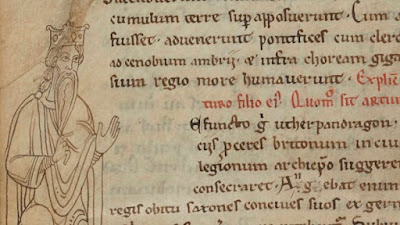
Illustration of King Arthur from Historia regum Brittannie

It is not until Geoffrey of Monmouth in the 12th century, some three hundred years after these battles are first described in the Historia Brittonum and some six hundred years after he is said to have lived, that Arthur is described as leading an expedition to Gaul. Geoffrey’s account is not by any means historical, it is literature, a fictional story, yet modern author’s continue to claim to reveal "the true story” behind Arthur’s European conquest based on Geoffrey’s work. 

Two potential candidates that campaigned in Gaul are popularly considered as being behind King Arthur’s Gallic invasion. A late 5th century British king named Riothamus, who took 12,000 men to Gaul “by way of ocean” and down the Loire valley, has been cited as the real event behind Arthur’s Gallic war.10 Then there is the Armorican campaign of the 2nd century Roman Officer Lucius Artorius Castus which is seen as the inspiration behind the Arthurian tale.11 Significantly Geoffrey doesn’t mention either. At least Riothamus is a candidate in the right time frame, but it is a far stretch to argue for the memory of a 2nd century Roman equestrian officer as the inspiration behind the legendary Arthurian battles as recorded in the Historia Brittonum some six hundred years later and then the Grail Romances of the 12th century and later.12

Do we really need a Roman Arthur, or an Arthur who fought the Romans? In the 16th century Polydore Vergil challenged the authenticity of Geoffrey of Monmouth’s account of Arthur fighting both Romans and Saxons; how could the same man fight enemies two hundred years apart?13

Yet, almost 900 years after Geoffrey wrote his Arthurian fables they continue to inspire today's Arthurian enthusiasts who claim to have unearthed new evidence and identified the real figure behind Arthur’s European conquest.14

Ultimately the problem lies in the vagueness of the source material and the lack of positive identification of the battle sites listed in the Historia Brittonum. By manipulating the chronology, relocating the geography and reinterpreting names then Arthur can be many things to many people. 

The most satisfactory explanation is to accept Geoffrey’s "Arthur" as purely a literary figure constructed with various elements taken from a range of historical heroes to produce a composite character. Recently it has been argued that Geoffrey modelled his Arthur on five different historical characters and produced a composite figure which concluded that the late 4th century Roman usurper Magnus Maximus was the primary source for Geoffrey’s story of the conquest of Gaul by Arthur.15 I believe there is certainly some merit to this suggestion and presents a perfectly rational argument that Geoffrey simply modelled Arthur’s European adventures on Maximus’s usurpation and brought them into Arthur’s time, i.e. the late 5th early 6th century. 

Yet, there are still those who insist that it was a true event that lies behind Geoffrey’s Arthurian European invasion. Taking this a stage further, and in response to Polydore Vergil’s criticism, it has been argued that the legendary King Arthur was actually two historical figures. Firstly, the man who fought the Romans in the 4th century was Magnus Maximus’s general Andragathius, the man behind the usurper’s conquest of Gaul and executioner of the Emperor Gratian, identified as Arthur I. It is claimed this man is identifiable as Maximus’s son in the genealogies of South Wales. Secondly, the later Arthur who fought the Saxons being a late 6th century petty king also from south Wales.16

This dual Arthur theory, characters two hundred years apart, was first proposed over thirty years ago but recently has been reproduced in a new work which claims the account of Maximus’s invasion of Gaul is so similar to Geoffrey’s account of King Arthur’s conquest of Europe that the author concludes that they must be describing the very same event.17

I reviewed this work in October last year and came in for some criticism that I had missed evidence for Arthur I of the 4th century and I was invited to revise my post. Gladly, I have accepted the opportunity to look at this again; a comparison of Geoffrey’s legendary history and Maximus’s invasion of Gaul to determine similarities of the two accounts follows.


 >> Next: Geoffrey of Monmouth's Gallic Invasions


Notes & References
1.  Sheppard Frere, Britannia: A History of Roman Britain, BCA, 1974, p.361.
2. Gildas: The Ruin of Britain and other documents (Arthurian Period Sources, Vol 7), edited and translated by Michael Winterbottom, Phillimore, 1978, chp 13.
3. Ibid., chp 14.
4. Guy Halsall argues that neither the written or excavated evidence supports Gildas's 5th century model of the Saxon settlement in Britain. He proposes an alternative scenario that Magnus Maximus settled Saxon troops in the late 4th century; this later evolved into the dramatic account of the mid-5th century adventus saxonum and (owing to Maximus's popularity in British tradition) transferred to Vortigern. [Halsall, 4.b]
a) Guy Halsall, Barbarians Migrations and the Roman West 376-568, Cambridge University Press, 2007. Appendix: Gildas’ Narrative and the identity of the ‘proud tyrant’.
b) Guy Halsall, Worlds of Arthur: Facts and Fictions of the Dark Ages, Oxford University Press, 2014, pp.214-216.
5. Nennius: British History and The Welsh Annals (Arthurian Period Sources, Vol 8) edited and translated by John Morris, Phillimore, 1980, chp 26.
6. Ibid., Chp 27.
7. Ibid., Chp 29.
8. Ibid., Chp 56.
9. Works consulted:
a) Geoffrey of Monmouth, The History of the Kings of Britain, Lewis Thorpe (Introduction, Translator), Penguin Classics, 1973;
b) The History of the Kings of Britain: An Edition and Translation of the de Gestis Britonum (Historia Regum Brittannie) by Geoffrey of Monmouth, Edited by Michael D. Reeve, translated by Neil Wright, Boydell Press (Arthurian Studies, 69), 2009;
c) The History of the Kings of Britain by Geoffrey of Monmouth, Translated and Edited by Michael A. Faletra, Broadview Press, 2007.
10. a) Geoffrey Ashe, The Discovery of King Arthur, Henry Holt & Company, 1987;
b) Marilyn Floyde, King Arthur's French Odyssey: Avallon in Burgundy, BSF Publishing; Revised edition, 2016.
11. The Armorican campaign is based on the inscription on Lucius Artorius Castus’s tombstone in Dalmatia (modern Croatia); however, the correct reading is almost certainly ‘Armenians’.
12. a) Malone, Kemp, Artorius, Modern Philology 23 (1924–1925): pp.367–74;
b) Linda Malcor, Lucius Artorius Castus, Part 1: An Officer and an Equestrian, Heroic Age, 1, 1999;
c) Linda Malcor, Lucius Artorius Castus, Part 2: The Battles in Britain, Heroic Age 2, 1999;
d) Scott C Littelton and Linda Malcor, From Scythia to Camelot, Routledge, 2000.
13. The publication of Polydore Vergil's Anglica Historia in 1534 sparked a debate over the veracity of Geoffrey of Monmouth's Historia regum Britanniae, a work which Vergil saw as largely Geoffrey's invention. See: James P. Carley, Polydore Vergil and John Leland on King Arthur: The Battle of the Books, Arthurian Interpretations, Vol. 15, No. 2, 1984, pp.86-100.
14. Paul Sire, King Arthur’s European Realm: New Evidence from Monmouth's Primary Sources, Mcfarland & Co., 2014.
15. Miles Russell, Arthur and the Kings of Britain, Amberley Publishing, 2018.
16. Blackett and Wilson, Artorius Rex Discovered, MTB, 1986.
17. Caleb Howells, King Arthur: The Man who conquered Europe, Amberley Publishing, 2019.


* * *


Friday, 6 August 2021

On the Trail of the Grey Hound Bitch

 In my previous post I proposed that the portal dolmen, or cromlech, known as Gwal-y-Filiast (Dolwilym, Bwrdd Arthur) usually translated as the “Lair of the Greyhound Bitch” should be interpreted as the 'Lair of the She-Wolf’ with its name associated with the hunting of the Twrch Trwyth in the Arthurian tale of Culhwch and Olwen.

Positioned on a secluded woodland ridge overlooking the River Taf about 3.5 miles south east of Crymych in Carmarthenshire, south-west Wales, it can be argued that this megalithic monument is on the trail of the giant boar Twrch Trwyth as it rampaged through south Wales. As one of the tasks set by Olwen’s father Ysbaddaden chief-giant for Culhwch to win her hand in marriage is to obtain the two whelps of the ‘gast Rhymi’(the Bitch of Rhymi), Gwyddrud and Gwyddneu Astrus. Arthur and his men find the gast Rhymi at Aber Deu Gleddyf where she is in the form of She-Wolf.

Gwal-y-filiast (Dolwilym)

Several cromlech’s in Wales share the "filiast" name, such as Twlc y Filiast, Gwal y Filiast (St Lythans) and Lletty'r y Filiast (Great Orme), but no satisfactory story has survived to explain it. The designation is often explained as an association with the witch Ceridwen who has transformed herself in to a greyhound bitch (milast) in her pursuit of Little Gwion (Bach) which started by Llyn Tegid (Bala Lake) in Gwynedd in the Tale of Taliesin and that these megalithic monuments were named in her honour as a canine symbol. 

Indeed Chris Barber recalls a comment from J Smith Jnr in The Archaeology of the Great Orme’s Head, North Wales (1875) in which he calls Lletty'r y Filiast “a cromlech in which the bones of the mythical hag Keridwen are supposed to be interred”.

Poor old Ceridwen, she really has suffered over the years, turned into an old hag and thrown into a dog’s kennel. This seems a very unlikely explanation, I just can’t see why Ceridwen would be confined in these megalithic kennels; there is certainly no surviving story to justify such a proposition.

My suggested interpretation as the 'Lair of the She-Wolf’ at least for several of the monuments in south Wales in relation the hunting of the Twrch Trwyth as told in the tale of Culhwch and Olwen is surely a more convincing explanation. In support of this it is worth noting that many of these megalithic sites bear a second name usually associated with Arthur, such as Coetan Arthur or Bwrdd Arthur. 

However, there are several sites in North Wales which also attract the “filiast” name, and yet there is no story to suggest the hunting of Twrch Trwyth or Ceridwen’s pursuit of Little Gwion was anywhere near to suggest an association. If not linked to the hunting of the Twrch Trwyth or Ceridwen’s chase could there be another explanation for the appellation of these northern Welsh sites? 

In discussing the cromlech at St Lythans Barber quotes Rev T Rees in A Topographical and Historical Description of South Wales (1815) who called it Lech-y-Filiast and states “that it has been conjected that it derived from the circumstances of the early Christians envincing their contempt for these vestiges of pagan worship by converting them into kennels for their dogs...”

Christian kennels for their dogs? This is another unbelievable explanation; I started to wonder if the greyhound names of these prehistoric burial chambers is the result of a totally random exercise - or is there some other reason?

Twlc y filiast

Other Lairs?
In addition to the burial chamber of Gwal y Filiast (Dolwilym, Bwrdd Arthur) near Crymych, previously discussed, there is another monument named as Twlc y Filiast, but also known as Arthur's Table or Ebenezer, sited near Carmarthen. As with the previous cromlech this is sited amongst trees by a babbling stream, which flows down to join the Afon Taf. Glynn Daniel describes three orthostats partially supporting the slipped capstone which now touches the ground which would have formerly enclosed a small rectangular chamber. He adds there are no traces of a mound at this site but later investigation by Hubert Savory found evidence of a 55ft long mound aligned to the axis of the valley with one sided now eroded by the stream. Savory suggested that a fallen slab had once formed an ante-chamber and located a series of ritual pits. Nothing was found in the chamber except a dark brown earth deposit and charcoal. In addition a flint scraper, a stone pendant and some unidentifiable pottery were found within the cairn. The stone pendant has been been said to be representative of a metal axe suggesting a possible Early Bronze Age date. Nash noted about seven stones that he considered may delineate a narrow passage and forecourt area, suggesting the ante-chamber could actually be part of the passage.

Moving east, at Mynydd Llangynderyrn, near Kidwelly in Carmarthenshire, there are twin burial chambers known as Gwal-y-Filiast and Bwrdd Arthur. Jointly these burial chambers are referred to as Bwrdd Arthur but individually the western chamber is known as Gwal-y-Filiast. These are the remains of two partially destroyed burial chambers imagined as a monument perhaps similar to the twin chambers of Dyffryn Ardudwy, but there is such a jumble of rock here they can be difficult to identify. The western group consists of a large capstone with a number of collapsed orthostats beneath. The eastern group is in worse condition yet Daniel is of little doubt they represent an authentic burial chamber, however George Nash remains silent and fails to mention the site, perhaps an indication that he views the authenticity of the site with some suspicion. 

St Lythans

Moving south-east from here into Glamorgan, near Barry there is the burial chamber known as St Lythans or Maes-y-Felin which also carries the alternative name of Gwal-y-Filiast. Maes-y-Felin seems to be a reference to the field in which this cromlech stands which is said to be known as the “Accursed Field” as it is claimed nothing will grow there. Three large orthostats supported a rectangular capstone measuring 14ft by 10ft which would have been covered over by a 50ft long mound orientated east-west, with the chamber set at the east end. There is a hole in the western slab said to release the spirts of the departed interred within. This monument is very similar in shape and design to those found in south-west England classified as the Cotswold-Severn type. As noted above, a local tale claims this was apparently where Christians kept their dogs.

Tinkinswood

The cromlech at St Lythans is often confused with Tinkinswood less than a mile away in the adjacent parish of St Nicholas. Tinkinswood is variously called Llech-y-Filiast, Maes-y-Filiast or Gwal-y-Filiast and well known for enclosing its burial chamber with the largest capstone in Wales, measuring 22ft in length and 3ft thick, estimated to weigh around 40 tons. According to Daniel this was covered by a 130ft long mound orientated east-west. Excavations during restoration in the early 20th century revealed the remains of at least 50 people in the chamber. Neolithic pottery from this site was typical to that uncovered at other  Cotswold-Severn type monuments. Artefacts dating to the Early Iron Age, Romano-British and medieval periods suggests that the monument may have been used a shelter during these periods. Nash observes that the monuments of Tinkinswood and Maes-y-Felin (St Lythans) are intervisible, i.e. each can be seen from the other.

Continuing on our travels in an easterly direction across South Wales we come to an 8 ft high standing stone that bears the name of Gwal y Filiast, also known as the Druidstone, at Risca, north-east of Cardiff. This appears to be a single standing stone (monolith) not part of another structure such as a burial chamber or a ruined stone circle. According to Leslie Grinsell (Folklore of Prehistoric Sites in Britain), when the cock crows at night the stone goes down to the River Rhymney to bathe. The Afon Rhymni cuts the Rhymney Valley between Monmouthshire and Glamorgan and the Twrch Trwyth must have crossed this waterway at some point before plunging into the Severn. In attracting the “filiast” name does this stone mark the route of Arthur’s boar hunt or is it simply a boundary marker with an odd name?

Llety'r Filiast

Moving on to the very top of North Wales we find Llety'r Filiast burial chamber on the Great Orme’s Head, Llandudno. Daniel writes that this was once an 85ft long barrow orientated east-west which incorporates a natural rock outcrop. All that remains today is a small polygonal chamber at the east end in very poor condition with a broken capstone that has collapsed at some point. The burial chamber is located very close to the famous Bronze Age Great Orme copper mine sitting in a marshy depression with restricted views which Frances Lynch sees a similarity with portal dolmens in Ireland. Vicki Cummings notes that owing to the massive alterations to the landscape here and the addition of modern housing it is difficult to determine the original landscape setting, however views to the north and south west are restricted with visibility limited to Great Orme’s Head to the north west and Llangernyw valley area to the east. As we have seen above, this was apparently the tomb of Ceridwen.

Moving further inland we find the cromlech of Cwrt y Filiast (Maen-y-Bardd) near the village of Ro-wen looking out over the wide valley of Afon Conwy on the north side of Caernarfon at an altitude of 1,000ft on an exposed plateau. Daniel records this monument as a simple chamber with four orthostats supporting a distinctive large capstone. It's a beauty. He found no traces of a mound of any sort. This monument is situated by Bronze Age and Roman routes leading to Tal-y-fan and the coast beyond.

Maen-y-Bardd

Nash sees some significance in the close siting of this monument, within 2 miles, of the Graig Lwyd Neolithic axe factory, which appears to have some association with later funerary activity in the area.  Graig Lwyd was the third largest prehistoric axe quarry in Britain, whose products have been found across England and Wales. Polished stone axes have often been discovered in burial chambers and two plaques made of stone from the Neolithic axe factory at Mynydd Rhiw were found within the burial chambers at Dyffryn Ardudwy.

Cummings writes of the impressive landscape setting of Maen-y-Bardd that is just 100yds from the monument of Ro-Wen East. Views to the east focus on the Afon Conwy and where it reaches the sea. Looking out from the chamber entrance there is a spectacular view across the Conwy valley to the left and mountains to the right. Cwrt y Filiast is placed in a very impressive setting, well worth the effort to get here. Which makes us realise that we don't really understand the true purpose of these megalithic structures in the Neolithic minds.

Alas, there is nothing here to link the two North Wales sites Llety'r Filiast and Cwrt y Filiast (Maen-y-Bardd) with the boar hunt as told in the tale of Culhwch and Olwen which may explain the association of the southern tombs with the She-Wolf, ‘gast Rhymi’. Furthermore,  I find the suggestion that these were used as dog kennels in their remote locations absurd. And there is no surviving story to link Ceridwen with these monuments. 

However, in North Wales there are two ancient hill top cairns which do appear to have been named after a Greyhound; these are not burial chambers or megalithic monuments as such but one is claimed to be a Bronze Age cairn.

1. Carnedd-y-Filiast (Glyderau) is 2694 ft high, the top identified by the small cairn. The highest point is known as Y Fronllwyd, also as Carnedd-y-Filiast North Top, overlooking Nant Ffrancon, the A5 pass though the mountains. This is an isolated mountain towards the Elidir Fawr end of the Glyder Ridge overlooking Bethesda and Anglesey to the north. Carnedd-y-Filiast is well known to climbers for the 'Atlantic Slab', a distinctively marked bedding plane of Cambrian Sandstone. The eyesore of Penrhyn Quarry can be seen from the summit, once the World’s largest quarry. Yet no story survives for why this summit cairn should be named after a greyhound.

Carned-y-Filiast (Cerrigydrudion)

2. Carnedd-y-Filiast (Cerrigydrudion) is a hill top cairn set upon the 2,195ft summit of part of the Arenig mountain range to the north of Llyn Celyn reservoir, circumscribed on its north side by the A4212 road from Bala to Trawsfynydd. This Bronze Age cairn at the summit is another prehistoric monument to have legendary associations with a greyhound, in this case, according to Archaeologia Cambrensis, (1887), a beast belonging to St Helen.

Elen and the Greyhound
The antiquarian Harold Bayley wrote of Elen in his book The Lost Language of London (1935). He said Elen was a lost goddess of London, claiming that the capital city was named for her. In his book Bayley claimed Elen was the patron goddess of the capital city based on the importance of the Helen in London legend and the prominence of the Priory and Church of St Helen in its early Christian history. In the late 16th century John Stow alluded to the tradition that Helen was responsible for encircling London with its first wall, which perhaps inspired Bayley to seek out Elen as the Goddess of London.

Bayley saw Elen as an ancient British deity associated with animals of the hunter-goddess, similar to Diana, such as the greyhound and the deer. Bayley saw her origin in Nouhalennia, or Nehalennia, a goddess found all over Europe, and in coastal areas of Britain including Lands End and the Scilly Isles.

Bayley cites four shrines or tablets illustrated to Nehalennia in which she is depicted undoubtedly with a dog, which he positively identifies as a greyhound. He then refers to a “table stone”, as he calls it, in North Wales that he says is known locally as “Llety-y-filiast or stone of the greyhound bitch”. He is certainly referring to the remains of the burial chamber on the Great Orme’s Head as discussed above.

Bayley sees the name of the burial chamber as an allusion to the British Cerres or Keridwen who was symbolized as the greyhound bitch. He argues that an animal which is unmistakeably a greyhound bitch appears on pre-Roman British coins and was probably a national emblem. According to Bayley it is therefore possible that Nehalennia of the Greyhound was a pre-Celtic Goddess, stating that the greyhound was not only a tribal emblem but also a Royal appendage not only in England but also in Ireland. He quotes the Celtic scholar Sir John Rhys who, owing to its persistence, surmised the dog was once a totem of the country.

The case for Elen/Helen seems remarkably confused; in early British legend Elen is said to be the daughter of King Cole and associated with road building along with Dunwal Molmutius and his son Belinus, which has led to her association with Ley Lines as identified by Alfred Watkins and the New Age earth mysteries movement instigated by John Michell.

The association with road building in straight lines from one end of the country to another is a clear echo from the Mabinogion tale The Dream of Mascen Wledig (Magnus Maximus, the 4th-Century Roman emperor) in which she appears as Elen Luyddog, Elen of the Hosts, remembered as a saint in Wales as St Helen of Caernarfon, feast day 22 May. The Roman road known as Sarn Helen running through Wales is named in her honour.

English chroniclers of the Middle Ages linked Elen to Helena of Constantinople, the mother of Constantine the Great, the lady said to have discovered the True Cross, claiming she was of British noble descent but there is no historical basis to support this. 

However, a Roman inscription from Holland clearly portrays Nehalennia as protectress of those travelling by sea. This would explain why she is often found in coastal areas across Europe and a far cry from a goddess of high places; an association with a greyhound does not necessarily define a hunter-goddess of the hill tops.

Although Bayley does not cite a reference for Elen of London as a hunter goddess we can discount him as the inventor of this story because the legend of (H)Elen and her greyhound was in circulation in the late 19th century at least.

The 1887 edition of The Journal of The Cambrian Archaeological Association states:

"Tradition, indeed, in the Hiraethog, still speaks of the Llwybr Elen (the road of the Empress Helen, mother of Constantine) as passing over the Carnedd y Filiast, where her favourite greyhound died, and where a great carnedd exist to this day to its memory..."

Here we finally have an explanation for the hill top burial cairn on Carnedd-y-filiast being named after the Greyhound Bitch. But this is one site only and there is no evidence that Sarn Helen or one of branches passed over this summit. However, by a strange coincidence this hill is not far from Bala where the story of Ceridwen and Gwion Bach is set. Perhaps we have come full circle? But one thing is certain; the origins of Elen requires further study.


Sources:
Christopher Thomas Barker, The Chambered Tombs of South-West Wales, Oxbow Monograph 14, 1992.
Chris Barber and John Godfrey Williams, The Ancient Stones of Wales, Blorenge Books, 1989.
Vicki Cummings and Alasdair Whittle, Places of Special Virtue: Megaliths in the Neollithic Landscapes of Wales, Oxbow Books, 2004.
Glynn E Daniel, The Prehistoric Chamber Tombs of England and Wales, Cambridge University Press 1950 (first paperback edition 2013).
George Nash, The Architecture of Death: Neolithic Chambered Tombs in Wales, Logaston Press, 2006.
George Nash and George Children, Neolithic Sites of Cardiganshire, Carmarthenshire & Pembrokeshire, Logaston Press, 2002.
Harold Bayley, Great St Helen, in John Matthews and Chesca Potter, editors, The Aquarian Guide to Legendary London, The Aquarian Press, 1990.
Caroline Wise, editor, Finding Elen: The Quest for Elen of the Ways, Eala Press, 2015.


* * *