Saturday, 26 February 2011

Shepherd's Monument Shugborough

The Shepherds Monument has been the centre of mystery for two hundred and fifty years. Now an historian claims to have solved the enigmatic inscription.

Enigmatic Inscription Solved?
Carved on the 18th-century Shepherd's Monument in the grounds of Shugborough Hall in Staffordshire, England, the ancestral home of the Earls of Lichfield, is the mysterious sequence of letters - O U O S V A V V, followed on the next line by the letters D and M. The inscription which has so far defied attempts to decipher it, appears below a mirror image of Nicolas Poussin's famous painting, The Shepherds of Arcadia.

Theories abound to the meaning of the enigmatic code which has defied a satisfactory explanation for two hundred and fifty years; attempts have been made since the 19th century, among them the great Victorians Dickens and Darwin. In 2004 a team of former code-breakers from Bletchley Park, Britain's famous main decryption establishment of World War II, failed to make a positive decipherment. The code-breakers revealed that they believe the cipher is a message from the Priory of Sion, which is likely to stand for "Jesus (As Deity) Defy", interpreted as belief that Jesus was an earthly prophet, not a divinity. Another of the Bletchley code-breakers suggested it was simply a love poem; "Optima Uxoris Optima Sororis Viduus Amantissimus Vovit Virtutibus", which translates as "Best wife, Best sister, Widower most loving vows virtuously", a phrase first suggested by archivist Morchard Bishop in letters to Margaret, Countess of Lichfield in the early 1950's. However they admitted that you need more than ten letters to break a code; consequently the inscription retains its secret.

Debate continues as to whether the Priory of Sion was invented as a 20th century hoax or has a genuine provenance in the 11th century as guardians of a secret bloodline of the Merovingian dynasty in France. In the controversial book “The Holy Blood and the Holy Grail” (1982), the authors Michael Baigent, Richard Leigh, and Henry Lincoln, perpetuated this theory, claiming that The Knights Templar, an order which captured Jerusalem during the Crusades, was the military branch of the Priory of Sion and they were both fronts of the same organisation.

The Knights Templar, or to give them their full title, The Poor Fellow-Soldiers of Christ and of the Temple of Solomon, were thought to be guardians of relics recovered from the Holy Land during the early Crusades, including the Holy Grail, the cup used by Jesus at the Last Supper. The secret society of the Priory of Sion succeeded the medieval Knights Templar, and were known as the keepers of the Holy Grail. This was subsequently claimed as fact in the preface of Dan Brown's bestselling novel “The Da Vinci Code” (2003).

The Grail was first introduced to medieval Arthurian romance by Chretien de Troyes in the late 12th century as a "graal" a serving dish or platter. It can be no coincidence that de Troyes composed his tale around the same time as the crusades were taking place and dedicated “ The Story of the Grail, or Perceval” to his patron and crusader, Philip, Count of Flanders. The French Cistercian Abbot Bernard of Clairvaux officiated at the Council of Troyes at which he traced the outlines of the Rule of the Knights Templar, who soon became the ideal of Christian nobility. Originally buried at Clairvaux Abbey, Bernard's remains were later moved to Troyes Cathedral.

Chretien de Troyes would appear to have had access to first hand information from the Crusader Knights and evidently his Arthurian tales contain much pagan material, infused with earlier Celtic themes. It was not until Robert de Boron, wrote his "Joseph d'Arimathie", and continued in the Vulgate's "Estoire del Saint Graal," that Chretien's "graal" was Christianised and transformed into "The Holy Grail" the vessel of the Last Supper.

To others, the concept of the Holy Grail as a bloodline descended from Jesus Christ persisted. In the The Holy Blood and the Holy Grail, Baigent, Leigh, and Lincoln, proposed the theory that Christ had staged his crucifixion, married Mary Magdalene and eventually sired the Merovingian dynasty. The book also claimed that Nicolas Poussin was a member of the the Priory of Sion, and suggested that his painting, The Shepherds of Arcadia, contains hidden meanings of great esoteric significance.

Interest in the Shepherd's Monument and its inscription exploded following Dan Brown's 2003 novel The Da Vinci Code, featuring the Priory of Sion at the centre of a conspiracy to cover up the Christ bloodline and loaded with esoteric symbolism. The Da Vinci Code finally led to the tomb of Mary Magdalene, the wife of Jesus, her womb depicted by Brown as the receptacle of the Holy Grail, the Christ bloodline, buried beneath the Rose Line in Paris. Many believe the Shepherd's Monument inscription, if deciphered, would reveal the location of the tomb of Jesus.

Shugborough Inscription Solved?
Recently, the Staffordshire Newsletter carried a small article on the 3rd February 2011, stating that an historian had solved the 250 year old riddle of the O.U.O.S.V.A.V.V. & D.M inscription on the Shepherd's Monument at Shugborough, claiming it has nothing to do with the Holy Grail and is nothing more than 18th century graffiti.

Historian A J Morton claims the letters were probably created in memorial of Viscount Anson and his mother Mary Vernon-Venables. Morton said: "Those seeking Grails and other trinkets are going to be disappointed. More than half the letters (S,V,A,V,V and M) match precisely the initials of Viscount Anson of Shugborough (1767 1818) and those of his mother Mary Venables-Vernon. Mary was the resident of Shugborough in 1773." He added, "It's as simple as that. Family initials on a private memorial."

The story appeared in several press reports, the Telegraph reported that Mr Morton discovered that Anson's wife was the daughter of the 1st Baron Vernon and sister of Edward Vernon-Harcourt, an Archbishop of York. Their son, Thomas Anson, was made Viscount Anson of Shugborough in 1806.

Mr Morton said: "It is very likely that 'M'ary 'V'enables-'V'ernon of 'S'udbury Hall, the Baron 'V'ernon of 'D'erbyshire, the honourable Edward 'V'ernon-Harcourt and the 1st 'V'iscount 'A'nson of 'O'rgreave (a hamlet 'U'nited with 'O'verley) and 'S'hugborough were somehow involved in the creation of the original 'Shugborough Code'. Or are all those Vs just a coincidence?"

Mr Morton said: "I've tried convincing myself that I'm wrong, but I can't see any way out. While I'm pleased to have solved it, I do worry that I've destroyed something magical."

He added: "The Grail has brought the estate some much-needed attention and, I imagine, a certain amount of financial relief. But unless they can provide a more convincing solution, I'm afraid the Grail story may have run out of steam."

However, many do not share Mr Morton's confidence in having claimed to have solved the mystery of the Shepherd's Monument inscription, pointing out that his interpretation is just a jumbled mess of letters pulled from any place having an association with the Anson family and hardly fall into the correct order as the Shugborough monument inscription.

A spokesman for Shugborough said: "We get five or six people a week who believe they have solved the code so we are a bit wary now."

The Inscription
Perhaps the most convincing explanation is often the simplest; the letters O.U.O.S.V.A.V.V. is the Latin translation of Ecclesiastes 12:8, ORATOR UT OMNIA SUNT VANITAS AIT VANITAS VANITATUM, which reads; "Vanity of vanities, saith the preacher, all is vanity" .


This explanation tends to agree with an earlier monument at Hagley Park, Worcestershire,which was inscribed "OMNIA VANITAS" taken from the Vulgate version of the verse which is "Vanitas vanitatum dixit Ecclesiastes omnia vanitas".

A letter dated 23rd December 1743 mentions the inscription at Hagley Park:

"Mr Lyttelton has built a kind of alcove in his park, inscribed "Sedes Contemplationis" near his hermitage. Under the aforesaid inscription is 'OMNIA VANITAS'."

Thomas Anson is known to have visited Hagley Park in the 1750's.

The letters D and M on the line below is considered an abbreviation of the Latin Diis Manibus, “dedicated to the shades” a common inscription on Roman tombstones and monuments where “shades” was typically a term for “spirits of the dead". It is known that there were authentic Roman funerary stones at Shugborough.

Of all the explanations offered for the inscription on the Shepherd's Monument at Shugborough this is the simplest and considered to perfectly reflect the message of Poussin's painting.

* * *

Sunday, 20 February 2011

Arthur's Hunting Path

“On winter nights, when the moon is high, wait by the track by Camelot. Though nothing catches your eye except shade and moon shadows, you may hear them ride by: Arthur and his men, hoofbeats clattering, with their horns and their hounds on their way to hunt. At night, I hear you ask? Aye at night, for Arthur is not only the king under the hill, but in this land he leads a different kind of hunt – a wild, wild hunt. He calls to his red-eyed hounds as the moonlight silvers the sky, for tonight, my lads, the hunters ride.” [1]

Legends of Camelot
Perhaps the best known site of the claimants for Arthur's legendary court at Camelot is the ancient hillfort of Cadbury Castle, south of the village of South Cadbury, just off the A303 from Chapel Cross, barely a couple of miles east of Sparkford, Somerset. The word "castle" suggestive of a medieval fortress and battlements of Arthurian romance, but this was never a fortification of stone walls and turrets. The hillfort at South Cadbury, with its massive Iron Age earth bank and defensive ditch system, re-fortified in post-Roman times, was without doubt the base of a powerful Dark Age warlord, a dux bellorum; if Arthur existed in an historical sense then this is, without doubt, the most likely contender for his garrison.

The strong Arthurian associations at Cadbury Castle have caused much consternation amongst scholars who have argued that these links only appeared after John Leland's account in 1542, and of course conveniently present the argument that he probably invented much of the Cadbury folklore:

"Right at the South end of South Cadbury Church stands Camelot. This was once a noted town or castle, set on a real peak of a hill, and with marvellously strong natural defences..... Roman coins of gold, silver and copper have been turned up in large quantities during ploughing there, and also in the fields at the foot of the hill, especially on the East side. Many other antiquities have also been found, including at Camelot, within memory, a silver horseshoe. The only information local people can offer is that they have heard that Arthur frequently came to Camelot." [2]

Of course this a rather circular argument; we can neither prove or dis-prove that Leland made up his story of Cadbury Castle being Camelot. It is certainly possible that the Arthurian association of the site existed in local folklore long before Leland's time. We know from other sites, as attested in Historia Brittonum, that Arthur certainly existed in the landscape before Geoffrey of Monmouth. But we must accept that Leland is the first to record the connection with the South Cadbury hillfort.

Following Leland, the antiquarian and historian William Camden (1551-1623) also called the hillfort 'Camalat' identifying the site with the Camelot of Chretien de Troyes. Camden claimed that locally it was called 'Arthur's Palace':

“....and taketh into him a rill neere which is Camalet, a steepe hill and hard to get up: on the top whereof are to bee seene expresse tokens of a decayed Castle with triple rampires of earth cast up, enclosing within it many acres of ground, and there appeare about the hill five or six ditches, so steepe that a man shall sooner slide downe than goe downe. The Inhabitants name it King Arthurs Palace.....As for Cadburie, a little towne next unto it, we may ghesse verie probably to have been that Cathbregion where King Arthur (as Ninnius writeth) defeated the English-Saxons in a memorable battell. ” [3]

Folk tales from the late 19th century said that the hill was hollow, Arthur and his knights lie sleeping inside waiting for when the country needs their help. A local person saw the gates as a boy, but they cannot be located today. A local poem calls them golden gates claiming that if you look through them on St John's Eve you can see the king in his court. A group of Victorian archaeologists visiting the hillfort were about to commence their dig when they were asked by a local man if they had come ‘to take the king away’.

The hollow hill is reminiscent of fairy lore and inevitably we find a tale of how they carried corn up from the arable side below the camp. When bells were placed in the church they went away and left gold behind. As in much fairy lore, they appear to have left the hill with the coming of iron.

Passing through South Cadbury village you come to the foot of a path leading up the hill a short distance beyond the church. This path climbs gently to a gate in a wall, and then more steeply through woods, until it emerges in the enclosure at the top. Found in the lowest rampart is a well on the left of the path as you go up into the hillfort, this is known as Arthur's Well. Sounds from this Well can be heard at Queen Anne's Wishing Well, another 200 yards further on within the ramparts. During the dark, silent hours on Midsummer or Midwinter's Night, King Arthur and his knights are said to ride throughout this land, and water their thirsty horses either here or at another well by the village church of Sutton Montis. Whether seen or not, their silver-shod hoof beats can always be heard.

Glastonbury Tor from Wearyall Hill

Below the hill there are the slightest traces of an ancient trackway running in the direction of Glastonbury. This track is known as Arthur's Lane, Arthur's Hunting Path or Causeway, said to be a lost bridle path leaving Cadbury by its west gate heading in a north westerly direction toward the Tor at Glastonbury, 11 miles distant. It is thought that this was an ancient neolithic trackway across the Somerset marshes linking Cadbury with Glastonbury.

“......between South Cadbury Castle and Glastonbury Tor to the N.E. lay a bridle path called "Arthur's Lane, which is believed to have originally been founded as a Neolithic causeway into the Glastonbury marshes.” [4]

On winter nights, the spectres of Arthur and his knights can be heard galloping past on their horses with their baying hounds running in their wake. At every full moon Arthur and his men rode round the hill to water their silver-shod horses at a nearby well:

“Folks do say that on the night of the full moon King Arthur and his men ride round the hill, and their horses are shod with silver, and a silver shoe has been found in the track where they do ride, and when they have ridden round the hill, they stop to water their horses at the Wishing Well”. [5]

Inevitably Arthur's troop riding along this lane became associated with the Wild Hunt of north European folklore. The leader of the Wild Hunt could be interchangeable between historical figures but was usually legendary such as Gwynn ap Nudd, Woden or Arthur, adopting the role of psychopomp in gathering the souls of the dead. Gwynn ap Nudd, King of the Welsh Fairy race, the Tylwyth Teg, has strong associations with Glastonbury, indeed his abode is said to be within the Tor itself, and he accompanies Arthur on the Hunt for the supernatural boar, the Twrch Trwyth as recorded in the tale of Culhwch and Olwen. Son of Nudd, the ancient British sea and river deity, known as Nodens, God of healing, who's domain abounds the nearby Severn estuary, as attested by the 4th Century Romano-British temple at Lydney Park, Gloucestershire, England. The Wild Hunt is accompanied by white, red-eared Hellhounds, known in Welsh mythology as the Cwn Annwn, and in Somerset as Gabble or Gabriel Ratchets. [6] If one was unlucky enough to witness the Wild Hunt it was thought to be an omen of ill fortune or even the death of the observer. The Hunt would kidnap any mortals in its path and take them with it to the abode of the dead.

The Starres which Agree with their Reproductions on the Ground [7]
In the 1920's Katherine Maltwood, a scholar of fine art, was commissioned to illustrate the anonymous High History of the Holy Grail, or the Perlesvaus, originally written in Old French, sometime in the early half of the 13th Century, as a continuation of Chretien DeTroyes' unfinished story of the Grail, "Le Conte du Graal, or Perceval". Some of the geographical references in this text correspond so well to the Somerset countryside that certain commentators have argued that Perlesvaus or at least its prototype must have been composed at Glastonbury; indeed a fragment of the Perlesvaus manuscript has been found at Wells Cathedral.

As Maltwood researched her material, she discovered that the adventures of the knights of the Round Table corresponded to place-names in the Vale of Avalon. Using a 1" ordnance survey map and aerial photographs taken from a height of 30,000 feet, she began to trace these on a map and figures began to reveal themselves, delineated by streams, tracks and boundaries, and before long she had discovered the twelve signs of the zodiac in their correct order. On placing a star map over the circle of zodiacal figures on the map Maltwood found the stars and their respective constellations corresponded. She called her discovery the Temple of the Stars.

A thirteenth figure, the great dog of Langport, sitting to the southwest and outside of the main circle of the zodiac, and perhaps the most convincing of all the figures, is seen as guardian to the entrance of Avalon. The nose of this great landscape canine is the mound at Burrowbridge, along the A361 road, known as Burrow Mump, or Alfred's Fort, which has all the appearance of being constructed by the hand of man out of red clay, not found locally, an island amidst the Somerset marshes at Altheney. The mump has all the appearance of being a facsimile of Glastonbury Tor, complete with ruined church to St Michael.

Maltwood wrote up her findings in Glastonbury's Temple Of The Stars and noted the observation that “Alfred's fort at Athelney and Camelot Castle at South Cadbury are both 11 miles from the Isle of Avalon”. [8] The Isle of Avalon is of course Glastonbury Tor, however, after making the observation Maltwood made no more of the connection which laid dormant until the great visionary John Michell rediscovered the St Michael Line in the late 1960's.

Burrow Mump

Michell noted that Burrow Mump was 11 miles from Glastonbury Tor, both orientated at 27 degrees north of east, to the Beltane sunrise on 1st May. Extending this alignment a further 11 miles at the same orientation he came to another St Michael site at Stoke St Michael. Then extending this line in both directions it was found to form an alignment through Avebury circle to St Margaret's on the east coast near Lowestoft and westwards from St Michael's mount and the extreme south-west point of England below Land's End. It marks the longest continuous stretch of land in southern England. The St Michael Line is marked by a host of shrines to St Michael and runs through many prehistoric sites attesting its ancientness. [9]

Michell observed that the distance between Glastonbury Tor and the summit of Cadbury Castle, is 10.909 miles or 4 Geomancer's Miles (GM). At 2.7272 English miles in length, the Geomancer's Mile is a pretty much forgotten measure rarely mentioned these days but Michell states it was once a unit of measure of prehistoric Britain. He adds that “this interval, or its multiples, was placed wherever possible between the sacred centres.” Michell notes that John Neal, a student of ancient metrology, when surveying village churches of the Taunton area, found that of the 300 or so, over 100 are situated at 1 Geomancer's mile distant from at least one other. It is no secret that many older churches were built upon the sites of prehistoric temples; the use of the Geomancer's Mile in a third of the network of Taunton village churches would appear to confirm this.

Michell states that: “Cadbury is, of course, Camelot, the site of King Arthur's Palace, once, according to legend, linked with the Tor by a tree lined causeway. Curiously enough, the distance between Glastonbury Tor and the hill of St Michael's, Burrowbridge also approximates to 4 GM.” [10] Like Maltwood before him, Michell made little more of the reciprocal distance between these ancient sites.

Studying this correlation of ancient sites in Somerset, Glastonbury based Nicholas Mann has determined that the alignment of Arthur's Hunting Path from the summit of Glastonbury Tor to Queen Anne’s Well, Cadbury is orientated toward critical points in the moon's cycle. Excavations by Leslie Alcock between 1966 and 1973 provided evidence that activity at this site started in the Neolithic to who the moon was very important with many of their earliest megalithic sites orientated to phases of the lunar cycle. [11]

Mann sates that the northernmost setting point of the moon, the Northern Major Standstill, and the southernmost rising point of the moon, the Southern Major Standstill, align with this ancient trackway. The Neolithic and the later inhabitants of Cadbury Castle would not have missed so dramatic an event as the moon setting over Glastonbury Tor, occurring only every nineteen years. At the same time, and for several months, from Glastonbury Tor they would have witnessed the moon rising from Cadbury, although the hillfort is below the horizon when viewed from the Isle of Avalon. [12]

Lunar Major Standstill
The term "lunar standstill" was apparently coined by the archaeologist Alexander Thom, in his 1971 book Megalithic Lunar Observatories. A lunar standstill being equivalent to a solar solstice when these two celestial bodies, having reached the end of their respective cyclic journeys, appear to 'standstill'. At a major lunar standstill, which takes place every 18.6 years, the range of the declination [13] of the Moon reaches a maximum. As a result, at northerly latitudes, the Moon appears to move from its highest point in the sky to lowest on the horizon in just two weeks. This time appears to have held special significance for the Neolithic people of Britain and Ireland, indeed the megalithic monument at Callanish on the Isle of Lewis, Outer Hebrides, Scotland, would appear to have been constructed specifically to witness the extremes of the lunar cycle, where the moon is seen to just skim the top of the tall stones for a few hours either side of midnight. During major lunar standstills at latitudes as far north as Callanish, the moon barely sets, an observation noted in Diodorus' famous text concerning the Temple of Apollo on the Isle of the Hyperborean's:

“They say also that the moon, as viewed from this island appears to be but a little distance from the earth and to have upon it prominences, like those of the earth, which are visible to the eye. The account is also given that the god visits the island every nineteen years, the period in which the return of the stars to the same place in the heavens is accomplished; and for this reason the nineteen-year period is called by the Greeks the 'year of Meton'.
- Diodorus Siculus, Library of History 2. 47. 1 - 6

Hamdon Hillfort

Noticing this lunar alignment from the summit of Cadbury to Glastonbury Tor was 11 miles, Mann found another parallel alignment 11 miles equidistant from the ruined church of St Michael on Burrow Mump to the northern tip of Hamdon Hill's neolithic fort, near Montacute. At Montacute we find another hill with all the appearance of being sculpted by the hand of man, similar to Glastonbury Tor and Burrow Mump, complete with church dedicated to St Michael. And Hamdon Hill to Cadbury Castle, is yet again 11 miles. Coincidence?

Linking Barrow Mump to the Tor, again 11 miles distant, is the St Michael Line, as stated above. Mann found that when joining the sites of Glastonbury Tor, Cadbury Castle, Hamdon Hill and Barrow Mump it formed a parallelogram, or diamond, with equidistant sides of 11 miles each, or as John Michell stated, the ancient unit of measure of 4 Geomancer's Miles each.

The parallel north west – south easterly alignments from the Tor to Cadbury Castle (Arthur's Hunting Path) and Burrow Mump to Hamdon Hill are aligned to the Major Lunar Standstills. Forming the closing sides of the diamond in the Somerset landscape, are the north east – south westerly alignments from the Tor to Burrow Mump and Cadbury Castle to Hamdon Hill are orientated on the Beltane sunrise. Mann notes that only at this latitude will these alignments form a diamond or rhombus. [14]

Mann suggests that a remnant of the Diamond's lore may have passed down in the legends of King Arthur galloping along “Arthur’s Hunting Path” or “Arthur’s Causeway” from Cadbury Castle to Glastonbury on stormy winter nights; survival of ancient moon lore of the Major Lunar Standstills when Arthur was said to ride was probably the moon set at its most northerly point in its 18.61 year cycle. The landscape diamond shows he would have continued on his way across the Bristol Channel and beyond to the Black Mountains in Wales. [15]

Further archaeological excavations by the South Cadbury Environs Project’s (SCEP) during 1992-2007, extending Leslie Alcock’s Cadbury Castle excavations sponsored by the Camelot Research Committee, uncovered some significant finds in our pursuit of Arthur at Milsoms Corner at Cadbury.

Prehistoric Burials found at Cadbury Castle

At the western flank of the hillfort of Cadbury Castle is Milsom’s Corner, a multi-period site on the slope below the south west gate. The main area occupied a slight rise, which over time, effectively became a westerly facing terrace, which has since been heavily damaged by deep ploughing. The land falls away gently to the west and north overlooking the Somerset Levels. Activity on this site commenced in the early Neolithic, attested by a linear arrangement of pits orientated towards the top of the hill. These early- and late-neolithic pits may have possessed ritual significance to Cadbury Hill’s summit, and a row of pits along the spine of the Milsom’s Corner spur has been interpreted as marking a special the way to and from the hill through mostly uncleared woodland. To the west of Cadbury, ditches arced around a small knoll and the base of the Milsom’s Corner spur to form a funnel leading into a narrow corridor for 200m before ascending through the ramparts to the south-west gate.

This was succeeded by an Early Bronze Age human burial, cut through later in the Middle Bronze Age. A cattle jaw bone found in the upper middle fills of the Milsom’s Corner spur enclosure ditch returned a date of 1380-1210 cal BC. Later in the Bronze Age, a bronze shield, already old at the time, appears to have been ceremonially deposited in the corner of the silted settlement enclosure ditch. [16]

A flexed burial in a slatted, 'boat-like' coffin, may have been covered by a barrow on a narrow spur at Milsom’s Corner which formed a natural threshold on the western approach to Cadbury hill. The 'boat-like' coffin was aligned on Glastonbury Tor, 11 miles to the north west, aligned with Arthur's Hunting Path. [17]

Neolithic boat-like coffins aligned on the Tor to ferry the dead across the water to the Isles Of Avalon, sharing the same orientation as an ancient trackway said to be travelled by Arthur at the time of the Major Northern moonset at Glastonbury; this all sounds remarkably familiar.

Is this the origin of the tale of Arthur's journey by death-barge to Avalon following the Strife of Camlann, guided by Barinthus the ferryman who knew the stars, suggestive that the event was a symbolic journey for spirits of the dead from a cemetery at Milsom’s Corner, Cadbury Castle, across the flooded Somerset levels in the direction of the northern moonset to the Otherworldly portal upon the Tor.


Copyright © 2013 Edward Watson
http://clasmerdin.blogspot.co.uk/

*

Notes
1. Quoted from D. Stobie, Exploring Arthur's Britain, Collins & Brown, 1999, in Nicholas Mann, The Star Temple of Avalon, The Temple Publications, 2007
2. John Leland, Itineray, 1542.
3. William Camden, Britannia, 1607. [http://www.philological.bham.ac.uk/cambrit/]
4. Helen Hill, The Realms of Arthur, 1970.
5. E K Chanbers, Arthur of Britain, Sidgwick and Jackson, 1927
6. The name Gabble or Gabriel Ratchets, an old word for a type of hound, was first recorded around 1665 and referred to a strange yelping sound heard in the sky at night, supposedly a death omen. Jennifer Westwood, Albion. A Guide to Legendary Britain. Grafton Books, 1985.
7. Dr John Dee, Astrologer to Elizabeth I, 1583. Following the Dissolution of the Monasteries, the Mystic and Alchemist John Dee along with his companion, fellow Alchemist and Psychic Edward Kelly, came to the ruins of Glastonbury Abbey, around the year 1583, to see if anything could be salvaged. An ‘alchemical manuscript’ which Kelly claimed to have discovered somewhere previously in the ‘Vale of Avalon’ near Glastonbury was said to refer to ten specific locations in England where buried treasure was hidden. Dee was more interested in the discovery of ‘Merlin’s Secret’, said to be found in the unusual arrangements of the prehistoric earthworks in Vale of Avalon. Dee mapped out these earthworks and determined they represented the signs of the zodiac and other constellations. In the margin of this map he wrote the quoted words “The Starres which Agree with their Reproductions on the Ground......” However, Dee’s apparent 16th century discovery of the Glastonbury Zodiac lies solely in the story of Dee's biographer Richard Deacon who went to the Warburg Institute where Dee’s papers were stored. On examining them, Deacon claimed to have found this map with Dee’s zodiac quotation in the margin. Deacon copied it down but the next time he went to see these documents, Dee's map of the zodiac could not be found. Yuri Leitch, John Dee and the pre-Maltwood Enigma.
8. Katherine Maltwood, A Guide to Glastonbury's Temple Of The Stars, James Clarke & Co., 1964, first published 1929.
9. John Michell, The View Over Atlantis, Garnstone Press, Revised Edition 1972, p.66.
10. Ibid., p.155
11. Nicholas Mann, Glastonbury Tor, Triskele, 1986.
12. The Metonic Cyle of 18.61 years is a period of 235 lunar months, at the end of which the phases of the moon repeat in exactly the same order and on the same days as the preceding cycle.
13. In astronomy, declination is one of the two coordinates of the equatorial coordinate system, the other being either right ascension or hour angle. Declination in astronomy is comparable to geographic latitude, but projected onto the celestial sphere. Declination is measured in degrees north and south of the celestial equator. Points north of the celestial equator have positive declinations, while those to the south have negative declinations.
14. Nicholas Mann, The Isle of Avalon, Green Magic, 2001, pp. 77-81.
15. Nicholas Mann, Energy Secrets of Glastonbury Tor, Green Magic, 2004, pp. 91-97.
16. South Cadbury Environs Project’s (SCEP) – Appendix 3.
17. Richard Tabor, Cadbury Castle: focusing the landscape.


* * *

Saturday, 29 January 2011

Camelot Abandoned

Why was South Cadbury Hillfort deserted

Camelot
The remains of a large ancient hillfort can be found on a steep, isolated hill of limestone and sandstone at South Cadbury, in Somerset. Known as Cadbury Castle, the hillfort is 500 feet above sea-level, the summit providing panoramic views across central Somerset, including the Tor at Glastonbury some 11 miles distant to the North West. The hillfort has a massive four line defence of bank-and-ditch enclosing a defended area of l8 acres, rising to a long, level central plateau. A break in the ditches at the south-west above the village of Sutton Montis indicates the original gateway. This vast Iron Age hillfort was completely refortified in the Arthurian period, c.500 AD, which has led to claims that it is the site of King Arthur's court at Camelot.

Such a prominent site no doubt was the stronghold of a powerful Dark Age warlord but medieval British sources made- no mention of Camelot; writing in the early 12th century Geoffrey of Monmouth placed King Arthur's court at Caerleon in South East Wales and fails to mention Camelot at all. Similarly, the Welsh Triads do not mention Camelot but place Arthur's court at Celliwig, Cornwall. Indeed, Camelot is first mentioned by the French poet Chretien de Troyes in the romance called Lancelot, or the Knight of the Cart, written in the late 12th century.

Camelot appears to have been a product of medieval French Arthurian romance, but the French authors always placed the location of Arthur's court in Britain. In 1469 Sir Thomas Malory completed "Le Morte d'Arthur" while in London's Newgate Prison. Malory's work is the definitive English Arthurian romance and brings together many earlier French and Welsh tradtitions. Malory placed Camelot at Winchester were today the Round Table can be seen hanging in the Grand Hall. Malory's opus was printed by William Caxton in 1485 who named the work after the last book Morte Darthur although Mallory had originally named it "The Whole Book of King Arthur and His Noble Knights of the Round Table". In his preface Caxton placed Arthur's court in Wales, seemingly following Geoffrey of Monmouth and disagreeing with Malory:

“And yet of record remayne in wytnesse of hym in wales in the toune of Camelot the grete stones & meruayllous werkys of yron lyeng vnder the grounde”.

There is some speculation that Camelot was derived from the Romano-British word 'Camelodunum'. However, the name 'Cadbury' is generally considered to be an Anglo-Brythonic hybrid from the Welsh “cad” = battle + English “bury” = fortification, stronghold = 'Battle-Fort'. Others have suggested a derivation from the personal name Cado, a Dumnonian King, recorded as having a stronghold at Din-Draithou (Dunster), in which case Cadbury could simply mean “Cado's fort”.

Arthur features in several 'Saints Lives' in which he is often at odds with the holy men, often depicted as somewhat of a petty tyrant, in a similar vein to the Arthur of the Welsh Triads which seem to be based on a tradition independent of Geoffrey of Monmouth's Historia Regum Britanniae. In one such account Cado (Cadwy) features along with Arthur in a well known incident in the Life of Saint Carannog (Vita Carantoci), an early 6th century West Country Abbot, who is credited with founding Llangrannog, Ceredigion, Wales and credited with establishing St Carantoc's Church at Crantock, Cornwall. The Vita, composed in the early 12th century in Cemis, Pembrokeshire, tells how Carannog arrives in Arthur's realm in search of a marvellous altar which he set adrift in order to see where he should go and preach. On arriving at the banks of the River Willett he meets both Cadwy and Arthur. Arthur promises to help the saint if he will render harmless a serpent that is devastating his lands. Carannog succeeds with prayer were Arthur has failed with force. Arthur then presents him with the altar that he had tried to use as a table but everything he put on it was thrown off at once.

In his notes on the county of Somerset in 1542, John Leland, Antiquarian to King Henry VIII, relates a tradition equating Arthur's court at Camelot with the ancient hillfort of Cadbury Castle. The term "Camallate" was used by Leland, thus identifying "South Cadbyri" as Camelot:

"At the very south end of the church of South-Cadbyri standeth Camallate, sometime a famous town or castle. . .The people can tell nothing there but that they have heard Arthur much resorted to Camalat."

Not far away from the Cadbury site are the old villages of Queen Camel and West Camel which some believe influenced Leland when making reference to 'Camallate'. And of course we find the River Camel in Cornwall, where Geoffrey located Camlann.

Camelot - Cadbury
First inhabited in the Early Neolithic before 3000 BC and again in the Late Neolithic around 2000 BC, characteristic finds of flints and pottery but no evidence of any structures from this early period were uncovered. There followed a long period of abandonment with no indications of activity until the 8th or 7th century BC. By the 5th century BC, the community had expanded to to the status of a large village fortified with a rampart and ditch at the head of the steepest slope. By the time of the Roman conquest the defensive earthworks had increased to four massive banks and ditches, the top rampart some thirty feet high, containing a shrine and an armourer's workshop complete with domestic buildings. From the archaeological evidence it seems the ramparts were not stormed by the Romans at the time of the invasion in 43 AD but survived until c.70 AD when the inhabitants were slaughtered and the defences partially dismantled. [1]


Deep plough soil on the fourth rampart has been interpreted as indications of cultivation for the first two centuries of Roman rule. In the late 3rd and early 4th centuries renewed activity was marked by finds of pottery and coins, the latest of which being from the reign of Honorius dated 393 – 402 AD, indicating activity into the early 5th century. Within the rampart enclosure the site of a possible Romano-British temple was identified, prompting speculation that it was a site of pilgrimage. Occupation recommenced in around 470 AD as evidenced by class A, B and D pottery sherds. [2] This pottery was of a type also found at Tintagel, indicating that someone of high status who could import luxury goods had resided there. This led to the formation of the Camelot Research Committee, co-founded by Geoffrey Ashe and C A Ralegh Radford, which carried out large-scale excavations of South Cadbury hillfort in 1966 - 70 under the direction of Leslie Alcock.

In 1967 the excavations soon revealed that the fort had indeed been re-fortified in post-Roman times, the classic Arthurian period. Alcock found evidence for a wall which had been built in the 500's AD and the ramparts were strengthened with large quantities of dressed masonry from derelict Roman buildings and mounted by raised wooden walkways. The remains of a large timber feasting hall, 63 feet by 34, were discovered at the centre of the site, set in a commanding position on the high part of the plateau called 'Arthur's Palace'. It has been dated to the 5th/6th centuries from pottery finds. [3]

The remains of a massive gatehouse dating from the same period was found at the south-west entrance. Trenches through the bank revealed a cross-section with layers one above another showing how the rampart had been rebuilt at various times throughout the centuries. During the Arthurian period it had been substantially rebuilt; at the top of the earthwork was a dry stone wall 16 feet thick. Holes indicated where ancient timber posts had rotted marked where massive posts had upheld a breastwork on the outside, protecting sentries on the wall. Wooden beams had run across this binding the structure together and supporting a platform, and probably wooden watch towers.

A silver Germanic ring was uncovered indicating the defensive earthworks were repaired around 550 AD. The gate was refortified around this time, possibly in response to westward aggression of Wessex who was pushing its borders further into Somerset as part of a general wave of expansionist activity by the English kingdom from the mid sixth century onwards. [4]

The Anglo Saxon Chronicle records English advances in the area:

577
. This year Cuthwin and Ceawlin fought with the Britons, and slew three kings, Commail, and Condida, and Farinmail, on the spot that is called Derham, and took from them three cities, Gloucester, Cirencester, and Bath.

The hill fort at South Cadbury was then abandoned and appears to have gone out of use in the early 7th century. Alcock asserts that occupation had come to an end before 600 AD. Why?

The Wasteland
Was the hillfort stormed by advancing Anglo-Saxons? There is no archaeological evidence that shows there was any destruction or an invasion at the site of South Cadbury at the beginning of the 6th century – it simply seems to have gone out of use. This assumption is based on archaeological evidence (or lack of); the absence of the imported class E pottery ware.

We have noted above the presence of class A and B pottery ware. Class A dates to between 400-500 AD and included bowls ‘with a cross or other motif’ whilst class B pottery ware dates to between 500-600 AD and comprised of amphorae which held both oil and wine. Both A and B pottery consists of both native and imported pottery from the eastern Mediterranean.

Class E pottery ware is dated between 600-700 AD and consists of native grass-marked ware and imported grey-ware originating from the Rhineland. Tintagel and Congresbury display the same pottery ware pattern as South Cadbury; absence of Class E. Tintagel has well known Arthurian associations and no doubt trade links with Cadbury. This absence of Class E pottery ware indicates that Tintagel was probably deserted the same time as Cadbury.

The evidence indicates that Tintagel lost its economic supremacy in south-west Britain and consequently disappeared from the archaeological record until the 12th century. This is due in part to changing trade patterns possibly as a result of political changes in the Mediterranean area at the time. Consequently, communities reliant on Tintagel for trade, namely, but not only, Cadbury Castle and Congresbury, effectively vanished at the same time. Imports increased along the south eastern coast, and merchants may have found these areas provided better trade than the western peoples, whose main exchange seems to have shifted to the Bristol region. [5]

A recent article by Sue Carter [6] suggests the reason was famine. Carter states that the Catholic Encyclopaedia records an entry under the information relating to St. John the Almsgiver, 550-616 AD, indicating there was a shortage of wheat in Britain. In addition, Carter cites how “the 5th century was a century of woes – raiding, wars, plagues, peasant revolts”, contributing to a fall in population, especially male. The cessation of imported goods and the result of local crop failure would be disastrous for a population of people with no centralised authority. Carter continues that research into the Somerset Levels area has shown that “a growth of raised deposits ceased after a change in the climate and a reduction in the annual rainfall in about 400AD.”

Carter concludes that “Famine may be plausible and would certainly explain the abandonment of a site, or several, where no military action or raiding is visible in the archaeological record. It certainly would explain why people just moved away from an area and left no trace.”

Climate Change

Michael E Jones pioneered the theory that abrupt climate change played a major role in ending Roman rule in the 5th century, using various evidence, such as pollen records, peat layers and tree rings, to support his idea that Britain’s climate suddenly got cooler and wetter around 450.
Jones proposes that around 400 AD, the weather in Britain became wetter and colder, a deterioration that intensified after 450 AD. He suggests that by the late Roman period, there may have been as much as a 10% increase in rainfall. Together with deforestation and expanded agriculture and grazing, the heavier rains would have caused flooding and aggravated soil erosion, leaching it of its nutrients and fertility. Annual average temperature also dropped during this time, perhaps as much as 2.5 degrees F (1.5° C), which would have lowered the elevation at which grains could grow by 650 feet and shortened the growing season by almost one whole month.

Although the literary evidence is meagre, we do find references in some Dark Age sources such as the Annales Cambriae which record plague at this time probably as a result of the deteriorating conditions:

537
- The battle of Camlann, in which Arthur and Medraut fell: and there was plague in Britain and Ireland.

547
- The great death [plague] in which Maelgwn, king of Gwynedd died. Thus they say 'The long sleep of Maelgwn in the court of Rhos'. Then was the yellow plague.

Certainly, this is the impression conveyed by Gildas, who records an oral tradition of invasion, famine, plague and a break down in society during the mid 5th century. The result was human disaster leaving the Britons vulnerable; "an environmental crisis," Jones adds, "Less grain could be grown. Famine struck, the Romans left and the Saxons invaded." [7]

The Catastrophe that Preceded the Dark Ages
What could have caused such a drastic change in climate? According to Professor Mike Baillie of Queen's University in Belfast, something catastrophic occurred on Earth 1,500 years ago that may have led to the Dark Ages and coincided with the end of the Roman Empire and the death of King Arthur. Baillie suggests it could have been a bombardment of cometary debris or the eruption of a super volcano, but whatever it was, evidence can be found in the chronology of tree rings from around the world. This global environmental event occurred around 540 AD and recorded in the tree ring chronologies which date back thousands of years, and indicate something quite extraordinary occurred around the time of King Arthur's death, the end of the Roman Empire and the beginning of the Dark Ages.

An important part of the Arthurian Mythos is the Grail legend which contains the concept of a wasteland where no crops grow and the land is infertile; something which certainly could be explained by an environmental catastrophe. Significantly, continental Grail romances always set their story in Britain. The cometary impacts or volcanic eruptions filled the atmosphere with dust and debris; a long winter began. Crops failed, and there was famine. The death of Arthur is commonly dated to this time, right in the middle of this environmental catastrophe. [8]

Was this Camelot?
For whatever reason, South Cadbury hillfort was deserted, but it is the Arthurian period occupation of the late 5th century that attracted the most interest at the time of Alcock's excavations and to this day South Cadbury hillfort retains its association with Arthur. Alcock himself was rather suspect of the Arthurian associations of the site and he was accused of encouraging publicity that the site was the military base of an ‘Arthur-like’ Dark Age warlord, a dux bellorum, which the popular press quickly proclaimed as the historical Arthur.

Scholars such as David Dumville must have been pulling their hair out when Alcock's book “Arthur's Britain” was published in 1971 acknowledging that someone must have done the things credited to Arthur at the time of 5th century occupation of South Cadbury hillfort; Alcock therefore considered he was justified in labelling the period ‘Arthurian’. Other historians joined rank with Alcock, such as John Morris who published his reconstructed history of sub-Roman Britain, titled “The Age of Arthur”, in 1973 prompting Dumville's scathing literary outburst demanding Arthur be removed from our history books. [9]

However, although not well received by archaeologists and historians, these books made a large impact on a more popular readership, capturing the public's imagination. Alcock’s excavations had uncovered a new type of late 5th century site; the heavily fortified British hall. It was soon discovered that the fortified Dark Age hall, was not unique to South Cadbury as there were many more similar fortified halls at other Dark Age hillforts in Britain. This is symbolic of the Arthurian period more than anything else; a battle leader co-ordinating British resistance against advancing barbarians. Alcock had confirmed the Arthurian period did actually exist.

Copyright © 2011 Edward Watson

http://clasmerdin.blogspot.co.uk/


See: Arthur's Hunting Path, a Neolithic trackway from Cadbury to Glastonbury Tor.

*

Notes:
1. Leslie Alcock, Arthur's Britain, Penguin, 1989, (1st edition 1971).
2. Charles Thomas, Imported Pottery in Dark-Age Western Britain.
Although perhaps a little dated now and written before Alcock's excavations at South Cadbury this classification generally holds good although there have been revisions to the chronology;
Class A comprises table-wares in the late Roman tradition,
Class B, amphorae and lagenae, containers for wine and oil.
Class D, sub-Roman ware. Alcock favoured a Bristol-Channel origin.
Class E, of distinct, late-Roman, appearance, source in north-eastern France, from a common source between the Somme and the Rhine, perhaps just inside the area usually known as the Rhineland.
Classes A and B were of a east Mediterranean type, wheel made wares introduced late within the 5th century, continued in use to 6th century. It is hard to show any clear case of their importation in the 7th century.
Class A,B and D pottery ware came in to Britain through western trade routes, whereas Class E came in from the East, possibly shipped by Frisian merchants.
3. Leslie Alcock, By South Cadbury, is that Camelot? Excavations at Cadbury Castle 1966-70. Thames and Hudson, 1972.
4. Geoffrey Ashe & Leslie Alcock, Cadbury: Is that Camelot? in The Quest for Arthur's Britain ed. Geoffrey Ashe, 1968.
5. Charles Thomas, Op. Cit.
Class A and B was imported directly by sea from the Byzantine world through the Straits of Gibraltar. Alcock has proposed that the Vandal control of the western Mediterranean entrance at the Straits of Gibraltar, in the mid 5th century might be thought to have interrupted, if not disrupted entirely, such a trade. However, as Charles Thomas states, there appears to be no evidence to support this. Thomas adds that the end of the 6th century is indicated by archaeology, which historically, represents the collapse of the Justinian attempt to reconquer the western empire. The merchant ships which had made the long and hazardous voyage with wine and oil from Byzantium to the distant northern islands simply ceased to find it worth-while.
6. Sue Carter, Did Famine Destroy ‘Camelot’? HeritageDaily - Heritage & Archaeology News- 2011.
7. Michael E. Jones, The End of Roman Britain, 1996.
8. Mike Baillie , Exodus to Arthur; Catastrophic Encounters with Comets, Batsford, 2000.
9. D. Dumville, Sub-Roman Britain: History and Legend, History #62, 1977.


* * *

Tuesday, 28 December 2010

Arthurian Review of 2010

On 9th December it was widely reported through the press that the Holy Thorn of Glastonbury had been vandalised, hacked down during the night. The mindless vandalism of the Glastonbury Thorn must be the most baffling event of the year. Seen by many as an anti-Christian act the motives are beyond me in what is arguably the pagan capital of England where there is tolerance of all faiths.

There are other Holy Thorn trees in Glastonbury: the Chalice Well Gardens, another in the grounds of Glastonbury Abbey, and the churchyard of St John's Church in the high street. These and the one on Wearyall Hill are all claimed to be descendants of The Holy Thorn associated with the Legend of Joseph of Arimathea, the uncle of Jesus. On arriving in Britain by boat after the crucifixion, Joseph landed on the Isle of Avalon and having climbed Wearyall Hill, thrust his wooden staff into the ground where it took root and grew into the Glastonbury Holy Thorn, nearly 2,000 years ago.

This tree (Crataegus monogyna ‘Biflora’) is not native to Britain but originates from the Middle East. Its biennial flowering with white blossoms and red berries at Easter and Christmas time is a source of wonder to many. Every year for the last one hundred years a flowering sprig has been cut from the Glastonbury Thorn at St John's Church and sent to the Monarch. This year, just hours after the sprig was cut for the Queen’s Christmas table the tree on Wearyall Hill was attacked. All of the branches were hacked off and left in a pile around the base of the tree with only the base of the trunk now remaining.

The original thorn tree was cut down during the English civil war and this tree had been replanted in 1951. Oliver Cromwell’s Roundheads felled the tree whilst waging a vicious war against the Crown. However, locals salvaged the roots of the original tree, hiding it in secret locations around Glastonbury, later replanting it on the hill. Other cuttings were also grown and placed around the town.

While this is one of the many holy thorns at Glastonbury it is believed to be one of the most important symbols of Christianity because it is on the site that Joseph of Arimathea, thrust his staff into the Glastonbury earth. Some claim he also brought the Holy Grail to Britain, but wherever, or whatever, the whereabouts of the Grail, the Holy Thorn is certainly linked to the origins of Christianity in England.

The site is visited by thousands every year and those visiting shortly after the vandalism were reduced to tears; regarded as sacred it has become a pilgrimage site for many and holds a special significance for Christians across the world. It is hoped that the thorn tree on Wearyall Hill should sprout again from the stump.

Sadly 2010 has also been a year of great loss of some the great Arthurian writers who have put forward original theories on the legendary king.

Laurence Gardner, born in Hackney, London on 17th May 1943, passed away on 12 August 2010. Gardner's first book Bloodline of the Holy Grail was published in 1996. The book was serialized in the Daily Mail and very quickly became a best seller. He used his books to propose several theories, including a belief that Jesus and Mary Magdalene had married and had children, whose descendants included King Arthur and the House Of Stuart.

Peter Clement Bartrum, renowned Welsh scholar, although an Englishman, died on 14 August 2008 at age 100. His books included A Welsh Classical Dictionary and Early Welsh Genealogical Tracts, must-haves for every Arthurian and Early Medieval Welsh literature enthusiast.

C. Scott Littleton, co-author with Linda Malcor of From Scythia to Camelot, passed away in Pasadena, California, on 25 November 2010. This ground-breaking book proposed that the core of the Arthurian and Holy Grail traditions derived not from Celtic mythology, but rather from the folklore of the peoples of ancient Scythia, that is, the western portion of the great "sea of grass" that stretches from the Altai Mountains to the Hungarian Plain, lands that are now the South Russian and Ukrainian steppes.

Rachel Bromwich, passed away on 15th December. The depth of her knowledge was absolutely stunning; The Triads of the Island of Britain (Trioedd Ynys Prydein) bears testament to this, a truly monumental work.

I can't think of any notable Arthurian movies that have been released on the silverscreen this year, which after the last King Arthur film starring Clive Owen and Keira Knightley (2004) is probably no bad thing. July saw the first television screening of King Arthur's Round Table Revealed on the History Channel. Historians, on the program led by Christopher Gidlow, believe that they may have pinpointed the exact location of the famous Round Table inside the former Roman amphitheatre at Chester, claiming that the 'table' was in fact the circular space inside Chester Amphitheatre and that this was indeed the site of Nennius' 9th Battle, The City of the Legion.

Gidlow claimed the “clincher” was the discovery of a Christian shrine within the amphitheatre, a wooden structure over the gladiatorial hitching stone; but archaeologists who had led the excavations at the site attempted to distance themselves from the sensationalism of the television program. These were not new discoveries and there is absolutely no evidence of a shrine within the amphitheatre. See: The Round Table Revealed?

New Arthurian books this year have seen the publication of Christopher Gidlow's second Arthurian book Revealing King Arthur was published in May by the History Press. Gidlow's earlier work The Reign of Arthur: From History to Legend (The History Press, 2004) discussed how a Dark Age historical figure became the substance of legend in the later sources such as the Mabinogi, Geoffrey of Monmouth and the Saints' Lives. Much of the theme of Revealing King Arthur is aimed at scholarship of the last thirty years which has declared that the enigmatic Arthur should be banished from our history books altogether. Here Gidlow attempts to redress the balance and argues for a historical Arthur.

In much of a similar vein is the second edition of King Arthur: Shadows in the Mist by August Hunt his second Arthurian book of the year. In reality little more than an updated edition of the 2006 Hayloft publication Shadows in the Mist: The Life and Death of King Arthur in which the author set out to try to reverse the current academic trend of what we might call 'Arthur denial', the apparently increasing tendency by scholars to question the historical existence of either Arthur or even an Arthur-type figure. In this 2010 edition, Hunt claims to re-consider the source material with a new and original approach, exploring the historical evidence, looking at place names and local folklore, to provide a challenging argument for the actual existence of King Arthur.

After reading Hunt's online articles on Faces of Arthur, through the Vortigern Studies website, I looked forward to his first publication of 2010 which claimed to be an introduction to Arthurian Druidism, whatever that is? Published on the 1st May and entitled The Secrets of Avalon the book claims to set out to illuminate the connections between the traditions of both Arthur and Druidsm, but left me in the dark.

Whereas The Secrets of Avalon wallows in Celtic mythology The Druids and King Arthur by Robin Melrose looks at the subject from a more historical and factual perspective. This book examines the role the Druids may have played in the story of King Arthur and the founding of Britain. In exploring the beliefs and origins of the Druids, the author sets out to explain how the Druids originated in eastern Europe around 850 B.C., bringing to early Britain a cult of an underworld deity, a belief in reincarnation, and a keen interest in astronomy. Concluding that Arthur was originally a cult figure of the Druids whose descendants may have founded the Anglo-Saxon kingdom of Wessex but in reality provides very little detail on either the Druids or Arthur. For those sceptical of a viewpoint like Melrose who see everything coming out of the east the next item may be of interest.

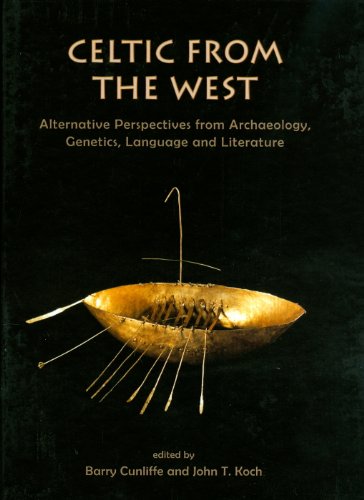
Although not directly Arthurian but certainly of interest to Celtic scholars and anyone interested in Arthurian origins, perhaps the most important book of 2010 is Celtic from the West: Alternative Perspectives from Archaeology, Genetics, Language and Literature edited by John Koch and Barry Cunliffe. The book explores the new idea that the Celtic languages originated in the Atlantic Zone during the Bronze Age, approached from various perspectives of pro and con, archaeology, genetics, and philology. This Celtic Atlantic Bronze Age theory represents a major departure from the long-established, but increasingly problematical scenario in which the story of the Ancient Celtic languages and that of peoples called Keltoí Celts are closely bound up with the archaeology of the Hallstatt and La Tène cultures of Iron Age west-central Europe. The Celtic from the West proposal was first presented in Barry Cunliffe's Facing the Ocean (2001) and has subsequently found resonance amongst geneticists. It provoked controversy on the part of some linguists, though is significantly in accord with John Koch's findings in Tartessian: Celtic in the South-West at the Dawn of History (2009).

Born out of a multidisciplinary conference held at the National Library of Wales in Aberystwyth in December 2008, Celtic from the West presents a collection of articles intended to pursue the question further in order to determine whether this earlier and more westerly starting point might now be developed as a more robust foundation for Celtic studies. Fascinating stuff.

Best wishes for the New Year.


* * *

Sunday, 19 December 2010

Rachel Bromwich

It is with great sadness that we learn Rachel Bromwich passed away on December 15th at the age of 95. An emeritus reader at Cambridge's Department of of Anglo-Saxon, Norse and Celtic, focusing on Old and Middle Welsh literature where her impact cannot be underestimated; she influenced generations of Arthurian scholars, her works quickly became the standard reference texts in the discipline.

Bromwich began specialising on medieval Welsh literature in the 1930's when in 1934 she attended Newnham College, Cambridge, studying the Anglo-Saxon language before shifting departments to focus on Middle Welsh, moving to the University College of Wales, Bangor in 1938 and studied under the tutelage of Ifor Williams. Indeed, it was Williams that encouraged her most important contributions to the study of Welsh literature; Trioedd Ynys Prydein, (1961). The Triads of the Island of Britain (Trioedd Ynys Prydein) went into a second edition in 1978 and quickly became a standard resource for the study of nearly all Old Welsh literature with the appendix of Notes on Personal Names became the reference source for most historic and legendary figures of Old Welsh literature.

In 2006, a substantially revised Third edition demonstrated her continued mastery of the subject at age 90, and proved to be essential reading for Celticists and for those interested in early British history and Arthurian studies.

Early Welsh literature shows a predilection for classifying names, facts and precepts into triple groups, or triads. ‘The Triads of the Isle of Britain’ form a series of texts which commemorate the names of traditional heroes and heroines and which would have served as a catalogue of the names of these heroic figures. The triads are of course 'threes', groups of three names and in some cases three somewhat longer texts devised by the Welsh bards. The names are grouped under various imprecise but complimentary epithets, which are often paralleled in the esoteric language of the medieval bards, who would have used the triads as an index of past history and legend.

The Introduction discusses the significance of the Triads in the history of Welsh literature, and examines their traditional basis. The Third edition contains 97 triads in the original language and in English translation, 46 of which are already attested in manuscript Peniarth 16 from the third quarter of the thirteenth century, together with copious notes and commentary. In addition to the 246 page Notes on Personal Names, further Appendices include The Names of the Island of Britain, The Descent of the Men of the North, The Thirteen Treasures of the Island of Britain and The Twenty-four Knights of Arthur’s Court.

This monumental work has long won its place as a classic of Celtic studies, being the standard edition for scholars of Welsh, but historians and non-specialist Celtic literary scholars will find here a wealth of material, presented in accessible form, giving an insight into the oral culture and poetry of medieval Wales and certainly providing essential reading for Arthurian studies.

In 1971, Bromwich produced an English translation of Sir Ifor Williams' Armes Prydein (The Prophecy of Britain from the Book of Taliesin), and in 1978 was co-editor with R. Brinley Jones of Astudiaethau ar yr Hengerdd (Studies in Old Welsh Poetry), a volume prepared in tribute to Sir Idris Foster on his retirement as Professor of Celtic in the Jesus University of Oxford, containing significant articles such as 'The authenticity of the Gododdin: a historian's view' by Thomas Charles-Edwards and 'Early Stages in the Development of the Merlin Legend' by AOH. Jarman

In the significant Arthurian article 'Concepts of Arthur', (Studia Celtica, No 10/11, pp. 163-181, 1975/1976), Bromwich discusses the “magical meaning” of Arthur, quoting from The Early Evolution of the Legend of Arthur, (Nottingham Medieval Studies #8, 1964) by Thomas Jones:

“How exactly did it come about that a figure about whom we know nothing with certainty, and whose historical existence we cannot prove, should have grown into the centre of so many tales throughout the whole of Europe, and how was it … used, both orally and in writing, not only as a medium for social entertainment, but also as a means of giving literary expression to some of the deepest aspirations and highest ideals of humanity”.

Bromwich follows Jones in questioning how a figure that may or may not have existed could have inspired such depth of literary interest that spanned far beyond the original sphere of the legend both geographically and over the generations. Bromwich continues, stating that by the seventh century, Arthur had become the great national hero of the entire British people “...a defender of his people against witches, monsters, giants, and external invaders”. No doubt her article became the inspiration behind articles such as 'The Nature of Arthur' by O J Padel, Cambrian Medieval Celtic Studies 27 (1994), and Thomas Green's book 'Concepts of Arthur', (2007).

Bromwich's long-standing interest in Arthurian literature produced authoritative editions of the major medieval Welsh tale Culhwch and Olwen in both Welsh (1988) and English (1992) along with D. Simon Evans.

Bromwich was also a co-editor, with A.O.H. Jarman and Brynley F. Roberts, of The Arthur of the Welsh: The Arthurian Legend in Medieval Welsh Literature (1991), an anthology of scholarly essays on the major Arthurian works from medieval Wales, launching a series by Wales University Press containing later works such as Arthur of the English (2001), Arthur of the Germans (2002), and Arthur of the French (2009).

Perhaps best viewed as a continuation and update of Arthurian Literature in the Middle Ages, edited by R S Loomis which first appeared in 1959, Arthur of the Welsh contains a collection of essays by such eminent scholars as Thomas Charles-Edwards, Patrick Sims-Williams, O J Padel, presenting an account of Arthurian literature produced in Wales, in both Welsh and Latin, during the Middle Ages. Essays include 'The Arthur of History', 'The Early welsh Arthurian Poems', 'Culhwch ac Olwen: The Triads, Saint's Lives' , Geoffrey of Monmouth' and the 'The Merlin Legend'. Other chapters include a discussion of the Breton connection and the first transmission of the legend to the non-Celtic world in England and France. Essential reading for anyone attempting to trace the origins of the Arthurian legend.

Eloquent and authoritative, Rachel Bromwich's works will continue to provide superior reference for anyone studying the Arthurian legend. We have reaped the benefits of her generosity in sharing her vast knowledge on the subject. She will be sadly missed by all students of Arthuriana and Welsh literature but right now our thoughts are with her family.


Rachel Bromwich
1915 - 2010

***