Monday, 26 May 2014

Gildas: Peace and Partition

“The graves where their bodies lie, and the places of their suffering, had they not, very many of them, been taken from us the citizens on account of our numerous crimes, through the disastrous division caused by the barbarians.....I speak of Saint Alban of Verulam, Aaron
and Iulius, citizens of Caerlleon.” 1

The Shrines of the Holy Martyrs
Gildas tells us that following the Roman departure from Britain the superbus tyrannus and a council of Britons employed Saxon federates to defend the Island from the threat from the Picts and Scot in the north and north-west respectively. But the federates grew in numbers and the Britons failed to supply sufficient provisions. With the foedus (treaty) broken an outbreak of violence ensued that set the island ablaze from coast to coast. The war with the Saxon federates continued up until the siege of Mons Badonicus, some 40 years before Gildas was born; thereafter an uneasy peace prevailed into his own time; so the story goes.

In Gildas' days memories of the Saxon rebellion are all but forgotten now by the generations that succeeded the kings and priests that witnessed the storm, but the cities are still not populated as they once were; he claims they are deserted, in ruins and unkempt. Gildas delivers a prophetic sermon; it seems luxuria has returned to the land and the Britons again live a life of wickedness, greed and sexual excesses; thus it seems bad times are destined to return to the island as God will again cleanse his flock.

Gildas reports in his homiletic mid-6th century De Excidio et Conquestu Britanniae (On the Ruin and Conquest of Britain) 2 that external wars have stopped but civil war continues as, presumably, the Saxons remain in their territories in the east of the country? However, Gildas refers earlier (c.10) to the “unhappy partition with the barbarians” (lugubre divortium barbarorum) which deprives his fellow citizens of visiting the shrines of the holy martyrs, namely St Alban of Verulam, Aaron and Julius of Caerleon, and others in different places, all of whom he considered to have suffered during the Diocletian persecution. However, there is some doubt that the Diocletian persecutions reached Britannia; the second, third and fourth edicts of the Great Persecution do not seem to have been enforced in the West. The passio included in a Turin manuscript places St Alban's martyrdom during the time of Septimus Severus (193-211 AD), others have argued for mid-3rd century date, during the periods of the persecutions of the emperors Decius (250-1 AD) and Valerian (257-9 AD).3

The First British Christian Martyr
Gildas refers to "St Alban the man of Verulamium" which raises the question as to whether Alban was a citizen of that town or because that was were his cult was practised? According to the legend both claims are correct but Gildas seemed to lack first-hand knowledge of the site as he has Alban crossing the Thames, whose water's miraculously parted, like the Red Sea in the biblical tale, instead of the river Ver on his way to his martyrdom. All accounts are silent on the location of the martyrdom and grave, though the version in the Turin manuscript seems to perfectly match the geography of  Verulamium, accurately describing the Roman town and the hill opposite across the river Ver, where the cult seems to have been focused several centuries later when St Germanus visited in the early 5th century.

Roman Theatre Verulamium
Gildas is quite clear, implicit that in his time neither he or his fellow Christians in Britain were able to visit St Alban's shrine, either because it was located in a region occupied by barbarians or perhaps getting there would involve crossing barbarian territory. This clearly has implications for the geographic horizons from where Gildas is writing. Restrictions to Verulamium, an ancient town in Roman Britain, immediately south-west of the modern city of St Albans in Hertfordshire, north of London, in the east of the country is conceivable if we are to accept his claim that the barbarians first settled on the east of the island. By implication it would appear that in Gildas' time there was division in the country conceded as the price of peace with the barbarians with the establishment of pagan enclaves.

Shrine of St Alban
Clearly it wasn't always this way. About one hundred years previously Germanus of Auxerre visited Britain around 429 AD and is said to have returned before he died c.448 AD, the very period that the Gallic Chronicle records Britain had fallen to the Saxons. Yet, Germanus, coming from Gaul, appears to have been able to travel around Britain apparently unheeded by the apparent strife. On his first visit to Britain, Germanus, with Lupus the bishop of Troyes, visited the shrine of Saint Alban, although the author of the Life of Germanus does not specifically state the tomb is at Verulamium. Germanus is said to have collected some of the "still bloody earth" from the site of the first English Christian martyrdom as a relic.

Verulamium seems to have been under British control into the 6th century and the martyrium of St. Alban lay in a Roman cemetery outside the city walls. It would appear nothing at the city would have prevented access to the saint's shrine; more likely something nearer Gildas' place of writing prevented him travelling to Verulamium.

The City of the Legions
The shrines of Aaron and Julius at the 'city of the legions' (urbs legionum) can only be at one of three permanent legionary fortresses in Britannia: Chester (Deva) on the river Dee in modern Cheshire; Caerleon (Isca) on the river Usk in south-east Wales; or York (Eboracum).

Gildas seems to have introduced the phrase "urbs legionum" as the term is not known as a place-name, or as a recognised description of a place, by any other writer in Roman Britain; it seems all known instances derive from Gildas. This must have been a legionary camp within his own geographic horizon known colloquially as "the city of the legions".

The identification of "the city of the legions" continues to puzzle Arthurian scholars as the site of the Dux Bellorum's ninth battle as recorded in the so-called chapter 56 of the 9th century Historia Brittonum. The author simply records the battle without further allusion to the location; presumably it was accepted the reader would know. Writing in the 12th century, Geoffrey of Monmouth had no reservation (not that he was ever shy of invention) in his Historia Regum Britanniae that "the city of the legions" was on the River Usk and the original name "Kaerusc" changed after the Romans made their winter quarters there. According to Geoffrey it had originally been the "metropolis of the Dimetia" (i.e. in The Kingdom of Dyfed, south-east Wales), near the sea of the Severn. Geoffrey, no doubt following Gildas, states this is where the shrines of  Saints Aaron and Julius are located and the "deplorable impiety of barbarians deprived us of them".

Roman Amphitheatre Caerleon
He also makes a clear distinction between York and Caerleon. According to Geoffrey when Guinevere heard Mordred was marching on Winchester, “she fled from York to the City of the Legions and there, in the church of Julius the Martyr, she took her vows among the nuns, promising to lead a chaste life." Geoffrey makes Caerleon-on-Usk one of the most important cities in Britain, it is Arthur's capital at Caerleon and for centuries the site of the Roman amphitheatre there was known as 'King Arthur's Round Table'. It was probably in the amphitheatre just outside the Roman fortress at Caerleon that Aaron and Julius were martyred like so many Christians who would suffer and die in the bloodsports of the Roman arena. Several small chambers excavated at the entrance to the amphitheatre have been rejected as cella memoria to the two martyrs.4

A Medieval cult appears to have evolved at the site of the Roman fortress at Caerleon (Isca) for the two saints. There has been a shrine dedicated to Saints Aaron and Julius at Caerleon-on-Usk since at least the 9th century.  A charter of c.864 preserved in the Liber Llan Dâv (Book of Llandaff) refers to the boundary of Merthir Julius and Aaron 'which runs along the dyke on the Usk.' The word 'Merthir' (Mythyr in Modern Welsh) is derived from the Latin 'martyrium' and also has the meaning of ‘a grave’; thus, the place-name records the district of the burial place of the saints Julius and Aaron on the south side of the river Usk. The martyrium appears to have been located within one of the three cemeteries of the Roman fortress. Around 1860 the fragment of a 9th century sculptured cross slab was found in the locality which may be evidence for the cult.

A church in Caerleon dedicated to SS. Julius and Aaron, was granted, by Robert de Chandos, to the Priory of Goldcliff, founded by him in 1113. The name of St Alban was added to the dedicatees when the church became attached to the priory which seems to have eclipsed the other two lesser known martyrs, yet the original dedication was known to the 16th century antiquary William Camden who, in describing the ruins of Isca, wrote of a house called 'St Julian's' which stood on the site of the church of St Julius the martyr, about a mile out of town.  Today, a hill north-east of the modern town called 'Mount St Albans' serves as an indicator of its former existence.5

According to Butler's Saints Lives (1866) Giraldus Cambrensis claimed the bodies of SS. Julius and Aaron were honoured at Caerleon when he wrote around the year 1200. Each of these martyrs had a titular church in that city; that of St. Julius belonged to a nunnery, and that of St. Aaron to a monastery of canons. According to Bishop Godwin (1595-1601), there existed, in the recollection of the generation preceding that in which he wrote, two chapels called after Aaron and Julius, on the east and west sides of the town of Caerleon, about two miles distant from each other. The chapels deteriorated through time and were finally destroyed under Henry VIII's dissolution of the monasteries in the 16th century. However, the legend continues; in modern times a Roman Catholic church  was built in Caerleon at the end of the 19th century and dedicated to SS. Aaron, Julius, and David.

Church of SS Aaron, Julius and David at Caerleon
Writing some fifty years after Geoffrey of Monmouth, the French poet Chretien de Troyes tells us in Le Chevalier de la Charrette (Lancelot, or the Knight of the Cart), that Arthur was holding court at Camelot which was situated in the region of Caerleon, without providing further details of the location. Although it is now seen as an unreliable pseudo-history of the period, Geoffrey's work was not always regarded with such low credibility; indeed it was accepted as factual history up to the 16th century and in Medieval times Caerleon-on-Usk was accepted as the 'city of the legions' and the site of the martyrium of  SS. Aaron and Julius.

A later Arthurian storyteller, Sir Thomas Malory also makes reference to Caerleon, notably as the site of Arthur's coronation yet he names Winchester as the site of Camelot, probably in response to Edward VI's promotion of the Hampshire county capital's Arthurian connections. However, in his preface to Malory's Le Morte D'arthur, the printer Caxton argues that Camelot is in Wales and describes the ruins of a city which sounds very much like Caerleon; “And yet of record remain in witness of him in Wales, in the town of Camelot, the great stones and the marvellous works of iron lying under the ground, and royal vaults, which divers now living have seen.”

Barbarian Partition?
Chester remained in British control until at least the Battle of Chester in 616 AD when King Æthelfrith of Northumbria massacred a combined Welsh force. Bede's account of the battle claims a large number of monks from the nearby monastery at Bangor-on-Dee who had come to pray for the British were slaughtered on the orders of Æthelfrith before the battle. Within a year of the battle Æthelfrith was dead.

The motives and significance of the battle are unclear; Bede saw the defeat of the Britons as divine retribution for the Celtic bishops refusal to join Augustine of Canterbury's mission in converting the heathen Saxons. Chester does not appear to have become 'English' as a result of the battle. Many historians see the reference to Arthur's "ninth battle...in the City of the Legion" in the Historia Brittonum as a misplaced reference to this later battle.

Archaeological excavations at Heronbridge, just south of Chester, have uncovered post-Roman graves buried beneath a defensive earthwork over an old Roman settlement. The perimortem injuries on the skeletons strongly suggests they are Northumbrian casualties from the Battle of Chester.

The Romans established a fort between the Foss and Ouse rivers around which grew up a town called Eboracum or “place of the yew trees.” Under Roman rule, York became one of the most important cities in Britannia and garrison to the legions of the north. In 306 AD, Constantine the Great, the founder of Constantinople, was declared Emperor there, an election supported by King Crocus and a large contingent of Alemanni troops.

Germanic style material culture in eastern Yorkshire has been interpreted as evidence for the settlement of Germanic people there by the late 5th century. Yet, the first Anglian king of Deira of whom we have any record is Ælla, who Bede claims was one of the kings reigning at the time of the Augustinian mission in 597. By the early 7th century, York had become an important royal centre for the Northumbrian kings with the Anglo Saxon Chronicle making first mention of Saxons at York in 627 AD when King Edwin was baptised in a wooden church there, possibly the precursor of the York Minster.

In conclusion, we must concede that Caerleon may not possess the strongest of historical claims for Gildas' 'city of the legion' but no such tradition for the obscure saints Aaron and Julius exists for either Chester or York. Further, neither Chester or York appear to have been in territories controlled by barbarians in Gildas' time of writing, c.540.

In Gildas' mind the loss of access to the martyrs' tombs was a punishment inflicted on the British because of their sins. Here again, as before, Gildas uses the barbarians as a rhetorical instrument of punishment for the moral decline of the Britons. Clearly Gildas' perception is of a barrier, political or physical, preventing pilgrims visiting the tombs of the martyrs.


>> St Alban


Copyright © 2014 Edward Watson
http://clasmerdin.blogspot.co.uk/


Notes & References
1. Hugh Williams, Gildas: The Ruin Of Britain, edited For The Hon. Society Of Cymmrodorion, 1899.
2. Gildas' time of writing De Excidio et Conquestu Britanniae is dated by historians to the mid-6th century, typically c.540 AD, solely on the entry in the unreliable 10th century Welsh Annals (Annales Cambriae) which records the death of a Maelgwyn king of Gwynedd in 547 AD. It is usually accepted that Gildas' 'Maglocunus', the dragon of the island, who he names but once, was the same person and alive when he chastised him in the third part of his work, the 'Complaint' against the clergy.
3. John Crook, English Medieval Shrines, Boydell Press, 2011, pp.41-46.
4. Ibid.
5. Ibid.

* * *

Monday, 5 May 2014

Gildas and the Saxons

“At that time all members of the assembly, along with the proud tyrant, are blinded; such is the protection they find for their country (it was, in fact, its destruction) that those wild Saxons, of accursed name, hated by God and men, should be admitted into the island, like wolves into folds, in order to repel the northern nations. Nothing more hurtful, certainly, nothing more bitter, happened to the island than this.” [1]

The Old Enemy
Gildas provides a grim picture for the hapless Britons following the departure of the Romans. The power vacuum was filled by a sudden and swift violent invasion of Germanic peoples who, employing a policy of devastation across the land, soon replaced the indigenous population forcing the survivors to flee to the western extremes of the country. 

According to Gildas, no sooner had the Romans left Britain than hordes of Picts and Scots (Irish) emerged in their coracles across the sea-valleys. The Britons fled, abandoning the high wall and the towns and sent an appeal to Rome, for the third time, for assistance; "To Aetius, thrice consul.” But the appeal fell on death ears and this time no help came.

Following the failure of the appeal to Rome, the Britons take up arms and fight back against the Picts and Scots and gain substantial victories. The Barbarians withdraw back to their homelands in the north and north-west. Gildas writes (c.21) that the Britons then experience a period of peace, unprecedented abundance and luxuria: “there are actually reports of such fornication as is not known even among the Gentiles.” Most of the people lay about in drunken stupor, swelling to hatreds, contentious quarrels and the greedy talons of envy. He continues, “it looked very much as though, then as now, contempt was being poured on the princes, so that they were seduced by their follies and wandered in the trackless desert.”
Pictish warrior
God wishing to purge his family and cleanse it from such infection was about to unleash the Saxons as divine retribution on the Britons.

Gildas' Account of the Coming of the Saxons 
(c.22) A rumour circulates that the old enemy were bent on destruction of the whole people from one end of the country to the other. The people ignored the warnings then a deadly plague laid low so many that the living could not bury all the dead.  They convened a council of the Britons to determine how best to counter the invasions and plunderings of the Picts and Scots.

(c.23) Then all the councillors, together with the proud tyrant (superbus tyrannus), were struck blind; the guard – or rather the method of destruction – they devised for the protection of the country was that the ferocious Saxons, (name not to be spoken!) hated by man and God, should be let into the island, like wolves in to the fold, to beat back the peoples of the north. “Nothing more destructive, nothing more bitter, has ever befallen the land.” Of their own free will they invited under the same roof a people who they feared worse than death.

Then a pack of cubs burst forth from the lair of this barbarian lioness, in three ships. On the orders of the ill-fated tyrant they fixed their claws on the eastern side of the island, apparently to fight in favour of the island, but in fact to fight against it. The mother lioness finding her first brood was successful, sends a second and larger troop of satellite dogs, arriving by ship they joined up with the others.

By treaty (foedus) the Britons agree to provide supplies, in return the barbarians will fight for the country. Yet they complain that their monthly supplies are insufficient, and threaten to break the treaty and plunder the whole island. There was no delay: they put their threats into immediate effect.

(c.24) In just punishment for the crimes that had gone before a fire nurtured by the hand of the impious easterners spread from sea to sea devastating towns and country, and did not cease until,it reached the western ocean on the other side of the island. 

All the major towns and the people were laid low as swords glinted all around and the flames crackled. The foundation-stones of high walls and towers exposed as they torn from their bases, holy altars, fragments of corpses covered (as it were) with a purple crust of congealed blood. There was no burial to be had except in the ruins of houses or the bellies of beasts and birds.

(c.25) The survivors flee to the mountains, some leave the country going oversea. After a time the cruel plunderers returned home and God gave strength to the survivors. Their leader Ambrosius Aurelianus, perhaps the last of the Romans, who's parents wore the purple and were slain in the storm, rallied the Britons, and took the war to the barbarians. Ambrosius' descendants, in Gildas day, have become greatly inferior to their grandfather's excellence.

(c.26) Then victories go sometimes to the Britons, sometimes to their enemies, the Saxons, right up to the seige of Badon Hill, pretty much the last defeat of the barbarians but not the least. That was the year of Gildas birth, “as I know, one month of the forty-fourth year seen then has already passed.”

Gildas' words are delivered as a prophetic warning as Britain slips back into the bad old ways that preceded the Saxon wars:  (c.27) Britain has kings but they are are tyrants, and the judges wicked; they often plunder and terrorise the innocent; they have many wives, whores and adulteresses; they make false oaths, wage wars – civil and unjust. He then goes on to denounce the Five Tyrants (c.28- 36): Constantine, 'tyrant whelp of the filthy lioness of of Dumnonia' ;  Aurelianus Caninus 'lion-whelp'; Vortipor, 'tyrant of Demetae'; Cuneglasus, 'red butcher'; Maglocunus, 'dragon of the island'. The remainder of Gildas work is a complaint levied against the clergy.

Divine Retribution
The enemy of Roman Britain in Gildas' account is the Picts from the north and Scots from the north west. He makes no mention the Irish (Deisi) in Wales but, more significantly, he does not refer to the Saxons until he comes to the invitation from the proud tyrant and the council of Britons after the Romans have departed. He makes no effort to disguise his hatred for the Germanic barbarians, informing his readership that they are hated by man and God, name not to be spoken, calling them wolves; a hatred that would have had greater impact if he had mentioned the viciousness of the Saxon's previously but Gildas does not mention the Saxons until they are invited into the island, like wolves into the fold.

Gildas fails to mention the withdrawal of any Roman forces after Magnus Maximus, he totally ignores all tyrants before and after Maximus and the troop withdrawals under Stilicho and Constantine III at the beginning of the 5th century. He clearly sees this as the singular event that stripped Britain of her troops and the flower of her youth that left her open to the menaces of the Picts and Scots. He sees Maximus as unworthy of the position of Emperor calling him a tyrant, consistent with the term for a usurper. But essentially in Gildas' view, military defeat was due to the moral decline of the people of Britain.

The “slash and burn” Saxon invasion  model of Gildas was closely followed and expanded by the Venerable Bede accordingly some two hundred years later in 731 AD when he wrote Historia ecclesiastica gentis Anglorum (An Ecclesiastical History of the English People). The writings of Gildas and Bede have been instrumental in colouring British history with the concept of a mass Anglo-Saxon migration into Britain following the departure of the Romans. Bede provides a firm date (449 AD) for the arrival of the Saxons and tells us that three of the most powerful tribes from Germany, Saxons, Angles, and Jutes, settled in Britain. The Saxons came from the area between the Elbe, the Weser and the Eider in the north and north west of modern Germany. The home of the Angles has been identified as a small peninsula on Jutland called Angeln (Anglia), which, according to Bede, remained deserted from that day to at his own time; by implication, every Angle, Saxon and Jute moved over to Britain. 

Following Bede's account, the Anglo Saxon Chronicle purports to record the origins of the Anglo-Saxon kingdoms but it was not written down until the time of King Alfred in the 9th century and the historicity of these origin myths are doubtful at best. It is significant that many of the earliest Anglo-Saxon kings noted in the Chronicle, such as the dynasty of Cerdic, founder of Wessex, have British names. Are we to believe this was an English invasion party led by British chieftains?

Inviting the Saxons into the country as mercenaries, with hindsight, may seem to have been a foolish move by the proud tyrant (Bede's Vortigern) and his council but the decision to employ barbarians as federate troops was common Roman policy throughout the late Empire. Clearly the Roman way of life did not just suddenly stop in 410 AD but continued in to the immediate Post-Roman period as witnessed by the British military policy.

After the arrival of the Saxons on the proud tyrant's invitation, the threat from the Picts and the Scots fades from Gildas work. And following the defeat of the barbarians at Badon Hill he does not mention the Saxons again. One feels that in Gildas' days, the first half of the 6th century so we are told, an uneasy peace has settled on the land following the decisive defeat of the Saxons at Badon and once more luxuria has returned to the Island.

Evidently, the Britons ignored Gildas' warning and civil wars continued. His rebuke of the five princes, or tyrants, underlines the excesses and abuses of the country's leaders; “Britain has kings but they are tyrants: she has judges, but they are ungodly men.” According to Gildas' earlier prophecy, God would again cleanse his people; a generation after he wrote his sermon the Anglo Saxon Chronicle records the Saxons slew three British kings and took the cities of Gloucester, Cirencester, and Bath in 577 AD.


Copyright © 2014 Edward Watson
http://clasmerdin.blogspot.co.uk/


Notes & References
1.  c.23, Gildas: The Ruin Of Britain, edited For The Hon. Society Of Cymmrodorion by Hugh Williams, 1899.
2. Michael Winterbottom, Translator and Editor, Gildas: The Ruin of Britain and Other Works, Phillimore, 1978


* * *

Wednesday, 30 April 2014

A Very English Conquest?

Recent evidence uncovered from a Dark Age cemetery in Oxfordshire adds to the growing body of evidence that suggests Britain's transition from Roman Britain to Anglo-Saxon England was a cultural shift rather than the violent conquest portrayed in traditional historical narratives.

The 6th century writings of Gildas' De Excidio et Conquestu Britanniae (On the Ruin and Conquest of Britain), our prime text for the period, tells of a brutal conquest by impious barbarian invaders from the east wiping out and replacing the indigenous population. Gildas “slash and burn” model has coloured all following accounts of the Post Roman period; Bede, the Historia Brittonum and the Anglo Saxon Chronicle which so closely follow his account that the adventus saxonum is now part of our national mythology.

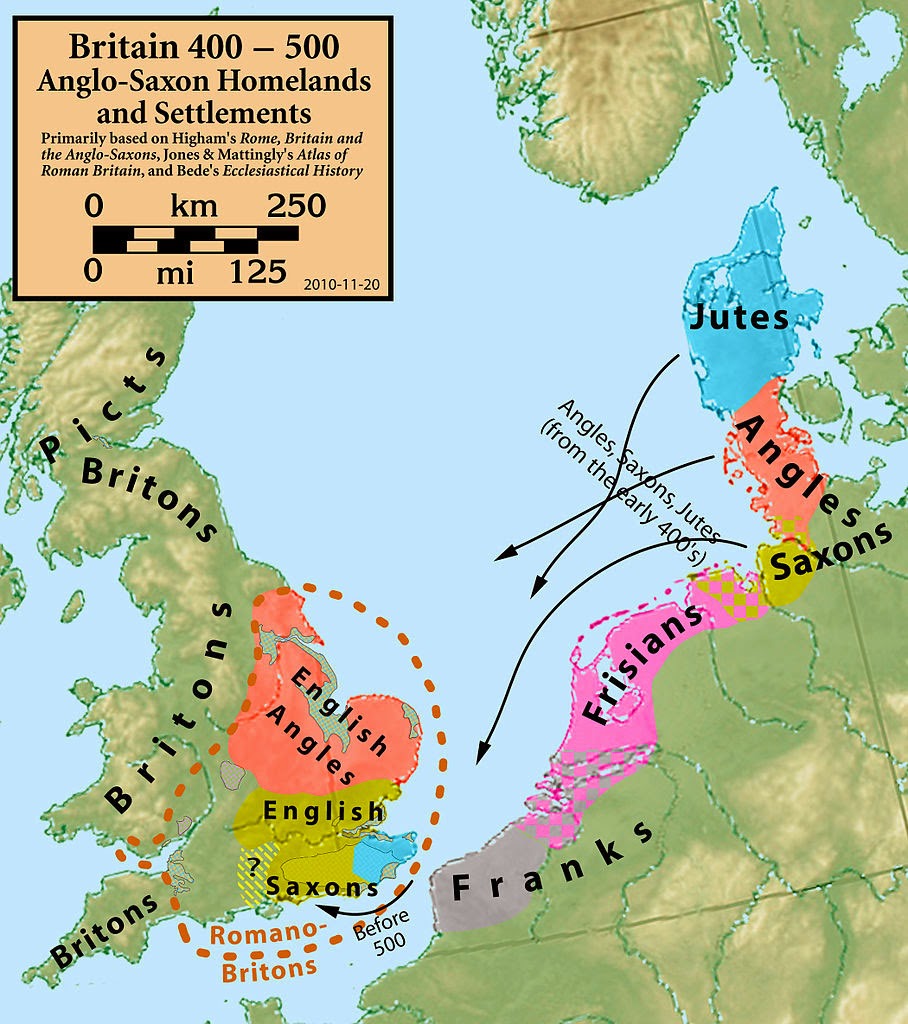
Britain 400–500: Anglo-Saxon Homelands and Settlements (Wikimedia)
However, aspects of the archaeological record do not support Gildas' dismal imagery of the Britons fate like lambs to the slaughter. Now a new study, published in the Journal of Archaeological Science, suggests a more peaceful process claims Dr Andrew Millard, from Durham University, one of the paper’s lead authors.

Dr Millard said, 'The main controversy over the years has centred on how many Anglo-Saxons came across the North Sea.'

He continues, 'Was it a mass invasion, where the existing population was wiped out completely or forced back into Wales, or was it a small band of elites whose ways were then adopted very quickly?'

'Our evidence favours the second option.'

The team of archaeologists investigated the remains of 19 individuals excavated from an early Anglo-Saxon cemetery at Wally Corner, Berinsfield in the Upper Thames Valley, first discovered from aerial photographs in 1934.

Grave-goods from the cemetery, including weapons, knives, jewellery and pottery, indicate the site was in use as a burial ground for about 150 years from Bede's adventus saxonum in 449 AD through to the early 7th century, indicating the cemetery contained some of the earliest Saxon immigrants into Post-Roman Britain. Using information from tooth enamel samples the study team determined where these people are likely to have lived in childhood.

Clearly, the number of Saxon immigrants arriving in Britain is one of the key issues of the debate. For a mass invasion and people replacement to have taken place from the early/mid 5th century, the Oxfordshire graves would have been expected to contain around 20 per cent immigrant remains. But only five per cent of the buried individuals from the cemetery at Wally Corner seem to have come from outside the local area.

'Oxfordshire is quite some distance from the landing point of any invasion, but it seems that there was not a mass invasion everywhere,' says Dr Millard.

'The broader question is still open to debate, and we're still gathering evidence, but our evidence favours a scenario where there was not a wholesale replacement of the population, but a shift in culture.'

'By exploring this question, we hope that we can address the broader issue of how cultural change happens on a wide scale.'

It must be noted that this is one isolated case and further work is still required; however, the results favour a scenario where there was no wholesale replacement of the population, but a strong cultural shift.

The prime text for the period now demands reconsideration; was Gildas writing history?


>> Gildas and the Romans


Sources:

Anglo-Saxon Cemetery Results Question Violent Invasion Theory - Past Horizons

Susan S. Hughes, Andrew R. Millard, Sam J. Lucy, Carolyn A. Chenery, Jane A. Evans, Geoff Nowell, D. Graham Pearson, 'Anglo-Saxon origins investigated by isotopic analysis of burials from Berinsfield, Oxfordshire, UK' Journal of Archaeological Science, 2014


* * *


Wednesday, 23 April 2014

Saint George Who?

Today, 23rd April, is the feast day of Saint George patron saint and National Day for England.

On their respective patron days the Welsh rejoice St David, the Scots have St Andrew's and the Irish celebrate St Patrick's day like it should be. By the early 15th century, St George's Day had become a major feast and national holiday in England on a par with Christmas. Yet, St George's day in England is not even a national holiday in our times.

What happened to the National Day of the English? The emblem of Saint George is a red cross on a white background but how many flagpoles will we see flying the cross of St George today? Do the English have a problem with their national identity; most of us in England probably know very little of our patron saint. Possibly because the patron saint of England is not even English.

23rd April was declared as St George's day in 1222 by the Council of Oxford but it was not until 1348 that St George became the Patron Saint of England. In 1415, when English soldiers under Henry V when won the battle of Agincourt, St George’s Day was declared a national feast day and holiday in England. During the reign of Henry VIII, the cross of St George was flown by John Cabot when he discovered Newfoundland in 1497 and it was adopted as the ensign of the explorers Sir Francis Drake and Sir Walter Raleigh.

St George and the Dragon
George's story has endured for over 1,700 years. However, most of what we know of him today comes from legend and myth. Many modern researchers believe he never existed as a historical character. St George's Day celebrations are not unique to England: he is revered throughout the world as the patron Saint of many countries throughout the world; Georgia, Egypt, Bulgaria, Aragon, Catalonia, Romania, Greece, India, Iraq, Lithuania, Palestine, Portugal, Serbia, to name but a few in addition to a large number of individual cities.

Was George Green?
St George of Christianity was associated with a pagan figure associated with the spring festival. Throughout Europe and the Middle East he is known as “Green George” personifying the fertility of nature, and can be equated with the Green Man of early folklore, whose pagan image can be seen in thousands of churches and cathedrals throughout Christendom. St George appears as the central figure in springtime folk festivals and Mummer’s plays celebrating the renewed fertility of the coming summer season. A leaf-covered young man parades as an accomplice of St George, or possibly even as a representation of St George himself. In many legends St George was also associated with the colour green. The Islamic traditional figure of al-Khidr, a dragon slayer, has been equated with St George. The name "Khidr" is taken to mean "the Green One".

The cult of St. George clearly has universal appeal but remains strongest in the Eastern Church where he is venerated as “The Great Martyr.”

The Great Martyr
George is said to have been born in 270 AD in Lydda, Roman Palestine, His father was Gerontius, a Greek Christian from Cappadocia (Eastern Turkey), and an official in the Roman army. His mother, Polychronia was a local Greek Christian of Palestine. He moved to Palestine with his Mother and became a Roman soldier, achieving the rank of Tribunus Militum. George is said to have later resigned his military post to protest against the Emperor Diocletian (r.284 to 305 AD), who led Rome’s most vicious persecution of Christians from his primary residence at Antioch.

St. George before Diocletianus. 
A mural from the Ubisi Monastery, Georgia.
(Wikimedia Commons)
Diocletian issued an edict in 302 AD that every Christian soldier in the army should be arrested and all other soldiers should offer a sacrifice to the Roman gods. George, being a Christian, objected and protested to the Emperor, an action which resulted in his imprisonment and torture, but he stayed true to his faith.

The Feast of Saint George is still celebrated by Palestinians in the Monastery of St George in al-Khader, near Bethlehem. Here St George is known as "al-Khidr" and according to local tradition, he was imprisoned in the town where the current monastery stands.

Diocletian then had George dragged through the streets and finally, on the 23rd April 303 AD, he was beheaded. Inspired by George’s bravery and loyalty to his God, the Emperor’s wife, Alexandra, became a Christian and was subsequently executed for her faith.

George is said to have been buried at Lydda in Palestine, identified as the seat of his cult by accounts of the earliest pilgrims since soon after his death in the early 4th century. Yet, unsurprisingly for such a popular saint, there are other claims for the burial site of St George, such as the belief that his relics lie in the Church of San Giorgio in Portofino, south of Genoa in Italy. The story goes that Crusaders found where his headless body had been buried in Lydda and intended to bring his relics back to England. After they ran into a severe storm in the Mediterranean they pledged that if they ever met landfall again they would leave the body there as an offering. They found sanctuary from the storm at Portofino.

St. George The Dragon Slayer, from the Church of San Giorgio
However, as patron saint of soldiers and chivalrous orders George is not generally remembered for his martyrdom at the hands of the wicked Emperor Diocletian. At the Siege of Antioch (1097–1098 AD), soldiers of the First Crusade took the city but were then besieged themselves. The Christian Crusaders are said to have experienced a vision of St George which inspired their victory over the Saracens.

When the Crusaders returned to England they brought with them the story of the vision of St George. His reputation spread; the story is etched over the southern door of the church at Fordington, Dorset, which still stands today. It is the earliest known church in England to be dedicated to St George.

St George and the Dragon
The medieval legend of St George and the Dragon is over a thousand years old and said to have been brought back to England by the Crusaders with its origins based in Libya.

Eastern Orthodox depictions of Saint George slaying a dragon often include the image of a young maiden looking on from a distance. The usual interpretation is that the dragon represents Satan and the young maiden is Alexandra, the wife of Diocletian.

The Western version of the legend developed as part of the Golden Legend, compiled in the 13th century and became a late medieval bestseller. The Golden Legend was one of the first books printed in the English language by William Caxton in 1483.

Rejected by the Church
When St George's day falls too close to Easter, religious observance is permitted to change. According to the Church of England's calendar, when St. George's Day falls between Palm Sunday and the Second Sunday of Easter inclusive, it will be moved to the Monday after the Second Sunday of Easter. Interestingly, St. George’s Day is held on 6th of May in the Eastern liturgical calendar, which, considering the associations with the Green Man, is perhaps nearer to where it should fall.

In 1969 the Vatican downgraded the patron saint of England when St. George was demoted to a mere "local" or secondary saint. During the reforms of the Second Vatican Council, St George was removed from the Universal Calendar. Thirty saints were removed from the official liturgical calendar during these reforms because of a lack of historical evidence to support their existence. However, these saints were not "de-canonized," and their feast days can still be celebrated locally.

However, in 2000, Pope John Paul II restored Saint George to the Universal Calendar, and he appears in Missals as the English Patron Saint.

Campaign for an English Patron Saint
The whole matter of St George, his historicity and his association with England is rather tenuous to say the least. Perhaps we would do better with a English king as our patron saint?

There were several national saints of England, such as Edward the Confessor and Edmund the Martyr, until Edward III (1312-1377) adopted Saint George and associated him with the Order of the Garter because he believed that England should have a fearless champion as its patron saint.

Edward the Confessor (c.1003-1066) was the last of the Anglo-Saxon king of England, traditionally seen as unworldly and pious, but his reign was notable for the disintegration of royal power from the House of Wessex and transference to the Godwin family, which ultimately led to the downfall of England at the Norman Conquest. Edward was canonised in 1161 by Pope Alexander III, and is commemorated on 13 October by both the Church of England and the Roman Catholic Church. He was the first Anglo-Saxon and the only king of England to be canonised, the last of a tradition of uncanonised English royal saints including King Edmund the Martyr.

Edmund the Martyr (d.869), venerated as a sacred king of the Anglo-Saxons of the East Angles, he was murdered by the Danes aged only 29 years. After killing Edmund, the Great Heathen army spent sometime pillaging East Anglia before invading Wessex in 870.

The martyrdom of St. Edmund
It is believed Edmund refused to share power with the Danes who he saw as heathens and Godless. He was captured and tied to a tree, shot with arrows and beheaded. His body was buried in a wooden chapel near to where he was killed. Thirty years after Edmund's death, he was venerated by the Vikings of East Anglia, who produced coinage to commemorate him. Later his remains were transferred to Bury St Edmunds, where Athelstan founded a community devoted to his cult in 925 long before the Abbey was established there in the 11th Century. In 1010, Edmund's remains were translated to London to protect them from the Vikings, where they were kept for three years before being returned to Bury. In 1020, King Canute, who converted to Christianity and rebuilt the Abbey, made a pilgrimage to Edmund's shrine and offered his own crown upon it as expiation for the sins of his forefathers. The shrine was destroyed in 1539 and the bones of St Edmund disappeared during the Dissolution of the Monasteries.

He was declared England's national saint, attended by royalty and honoured as far north as Iceland, he was renowned for his miracles of fertility and protection. But his martyrdom was unrecognised for 250 years.

Unlike St George, there is no argument to St Edmund's historicity, who died as a martyr to his Christian faith at the hands of heathen invaders. And he is English. A campaign called for St Edmund to be re-instated as patron saint of England in 2006. A petition was submitted to Parliament but the plea was rejected by the government.

A new campaign was launched in 2013, led by BBC Radio Suffolk's Mark Murphy, author Mark Taylor and the Bury St Edmunds brewery Greene King, who argue the country needs a "unique" patron saint because George currently holds the role for 17 countries. The campaigners also want a new bank holiday to be added to the calendar in his honour. Who could argue with that?


* * *


Wednesday, 16 April 2014

Gildas and the Romans

"The Island was still Roman in name, but not by law and custom. Rather, it cast forth a sprig of its own bitter planting, and sent Maximus to Gaul with a great retinue of hangers-on and even the imperial insignia, which he was never fit to bear: he had no legal claim to the title, but was raised to it like a tyrant by rebellious soldiery....

After that Britain was despoiled of her whole army, her military resources, her governors, brutal as they were, and her sturdy youth, who had followed in the tyrants footsteps, never to return home. Quite ignorant of the ways of war, she groaned aghast for many years, trodden under foot first by two exceedingly savage overseas nations, the Scots from the north-west and the Picts from the north." - Gildas - De Excidio et Conquestu Britanniae, cc.13-14.


The Ending of Roman Britain
As every schoolboy knows, the Romans arrived in Britain in 43 AD and left around 410 AD. In between was peace, civilisation, happy days; before and after the Britons were simple savages experiencing bad times; with famine but without an economy. But of course, the transition from Britannia to England was far from straightforward.

The year 383 marks a significant step toward the end of Roman rule in Britain. In this year Roman troops were withdrawn from northern and western regions of Britain for the last time. The ending of Roman Britain was not a singular datable event. Three dates are given for the terminus: 407 AD when Constantine III left Britain; 409 AD the year the Romano-Britons expelled Roman magistrates from their cities; and 410 AD, the date of the Rescript of Honorius, when the Emperor sent letters to the cities of Britain, telling them to take up arms and defend themselves.

Following the ejection of the Roman administration from Britain in 409 AD a historical vacuum ensued, a period without reliable contemporary insular sources. This Dark Age has been termed “Sub-Roman Britain” based on the inferior pottery of the 5th and 6th centuries, or more acceptably “Post-Roman Britain” in mainly non-archaeological contexts. The duration of this period is generally said to span from the end of Roman Imperial rule in Britain, the early 5th century to the arrival of Saint Augustine in 597 AD.

This historical vacuum, spanning almost two hundred years, the transition from Roman Britain to the Anglo Saxon era, is of immense importance to Arthurian scholars. Conveniently, the period has been termed the “Arthurian Age” to the disdain of academics. But the term has fired the public imagination and continues to be used by popular authors in the title of their books.

Our one substantial, and near-contemporary, source for this period is Gildas, who authored De Excidio et Conquestu Britanniae (On the Ruin and Conquest of Britain), writing in the mid 6th century so we are told. Much has been written by modern historians concerning when and where Gildas wrote. Yet, one thing is certain, as a key historian of the “Arthurian Age,” Gildas would have been a contemporary of King Arthur but he fails to mentions him entirely. The early 9th century text the Historia Brittonum names Arthur as the victor at the Battle of Badon; Gildas assigns the victory to Ambrosius Aurelianus; is this the historical Arthur?

Hadrian's Wall (Oliver Benn/Getty Images)
The Chronology of Gildas
According to Gildas the end of Roman Britain and the coming of the Saxons was divine retribution for the sins of the Britons (cc.13-21):

Britain is denuded of her garrison who went with Maximus never to return leaving Britain at the mercy of the Scots and the Picts.
The Britons appeals to Rome for help. A legion is immediately despatched and drives the raiders back beyond the borders. A turf wall is constructed across the island from sea to sea.
As soon as the legion returned home the barbarian raids re-commenced.
A further appeal went out to Rome who again drive the raiders beyond the sea from which they came to plunder year after year.
This time the Romans left the country saying they could not be bothered with such laborious expeditions telling the Britons to arm themselves and look to their own defences. They built a wall in a straight line from sea to sea and erected towers on the south coast, where they moor their ships.
The Romans then left the island never to return.
No sooner had they gone than the raids by the Picts and Scots started again. The Britons left their cities and abandoned the Wall. The enemy pursued them and butchered the Britons like sheep, who turned their arms on each other in domestic feuds so that the whole island was destitute of provisions.

The Britons appeal to Rome for the third time: "To Aetius, now consul for the third time: the groans of the Britons..............The barbarians drive us to the sea; the sea throws us back on the barbarians: thus two modes of death await us, we are either slain or drowned." But no help came.
The Britons suffering the effects of severe famine, hid out in the mountains, caves and woods, but rallied and took the fight to the Barbarians and overthrew the enemy who for a while was checked.
For it has always been a custom with our nation, it is at present, to be impotent in repelling foreign foes, but bold and invincible in raising civil war. The Picts returned to their winter quarter but before long would return to plunder and for the first time seated themselves at the extremity of the island. Then luxury befell the island.


The Saxon Shore (Wikipedia Commons)
Gildas does not claim to write a history and provides no dates. However, we can provide a rough chronology as we know when Maximus departed Britain (383) and Aetius, thrice consul (446) but he does muddle the building of the Walls. The northern (Antonine) wall was constructed with turf and stone c.140's running for 39 miles across the central belt of modern Scotland from north of the Clyde to the Firth of Forth, whereas construction of Hadrian's Wall, stretching for 75 miles from the Solway Firth to the mouth of the River Tyne in the east, began in 122 AD. He appears to misplace the erection of the towers on the south coast; does he mean the nine Saxon Shore forts listed in the Notitia Dignitatum (Brancaster, Norfolk to Portchester, Hampshire) established by the late 3rd century, or the five coastal watchtowers (Huntcliff to Scarborough) erected on the North Yorkshire coast linked to restoration of the Wall in the 4th century following the Barbarian Conspiracy?

Rome and the Barbarians
The 4th century Roman historian Ammianus Marcellinus records that Nectaridus, the Count of the Saxon Shore, was killed during the so-called Barbarian Conspiracy of 367 AD, when Picts, Attacotti, Scotti and Saxons attacked Britain simultaneously. Fullofaudes, Dux Britanniarum, commander of the armies of the north, was also captured. Order was finally restored when Count Theodosius came in Britain in 369 AD, in all likelihood accompanied by a young Hispanic officer named Magnus Maximus.

The Notitia also included a list of forts on the northern coast of Gaul as part of the Saxon Shore system. However, when the list was compiled for the Western Empire, around 420 AD, Britain had already  been abandoned by the Roman Legions. Debate continues as to the meaning of the name of this maritime defence system; were the forts occupied by Saxon foederati or constructed to protect against Saxon pirates raiding along the Channel? The Notitia suggests the first instance is likely to be correct, using the term Saxon as a generic term for Barbarian soldier. At one shore fort (Branodunum) for example , we find a Dalmatian cavalry unit was stationed. However, the original garrison may have been the First cohort from Aquitania whose homeland bordered the province of Gallia Lugdunensis which may explain the Roman name said to derive from the local Celtic language meaning "fort of the raven". Epigraphic evidence suggests earlier they formed the original garrison of the Carrawburgh fort on Hadrian's Wall before transferring to Brough on Noe, then Bakewell prior to Brancaster.

The Roman policy of employing Barbarians on frontier zones may have provided the principle mechanism for the immigration of many Barbarian peoples into Britain. Eight cohorts of Batavian cavalry are known to have been in the Roman invasion force of 43 AD. Dio Cassius records groups of Germanic Marcomanni being resettled in Britain by Marcus Aurelius in the late second century and Zosimus tells us of many Burgundian and Vandal captives being sent across to Britain in the 3rd century.

By this time regular contingents of Barbarian peoples were being used in Britain as numeri or cunei, bearing the names of their tribes of origin with large numbers stationed in the north and east of England. Epigraphic evidence attests a cohort of Batavians at Carrawburgh during the 3rd and 4th centuries in addition to Tungrians stationed at Castlesteads and Birrens, and the Cuneus Frisiorum at Housesteads. Crocus, King of the Alemanni, employed as a general in Roman service and almost certainly the leader of a large force of Germanic foederati settled in the Vale of York, is recorded as being instrumental in the proclamation of Constantine I as Emperor at York in 306 AD. These are just some of the better known examples, there are many more.

How many of these Barbarians employed in the Roman army remained in Britain after the garrison was repeatedly stripped of its troops to support the ambitions of successive usurpations is impossible to say. However, it is difficult not to speculate on the potential impact that Barbarisation of the Roman Army may have had on the make up of the British population.

The Departure of the Romans
Maximus became a distinguished general under Count Theodosius and in 380 AD was assigned to Britain, defeating an incursion of the Picts and Scots in 381 AD. He is fondly remembered in Welsh tradition as Macsen Wledig of the Mabinogion. In 383 AD Maximus was proclaimed Emperor by his troops. He left for Gaul and is often accused of stripping the British garrison of its troops in pursuit of his imperial ambitions. The year 383 marks the end of Roman rule in northern and western Britain.

The actions of Maximus are repeated a quarter of a century later when in 407 AD Constantine III was acclaimed Emperor in Britain, likely a response to events in mainland Europe when a collective force of Barbarians, comprising Vandals, Burgundians, Alans and Sueves, breached one of the Empire's most secure limines by crossing the Rhine on 31 December in 406 AD to invade Gaul. The Byzantine historian Zozimus (Nova History, Book 6.5.3), drawing on Olympiodurus' largely lost fifth century history, records:

“The barbarians above the Rhine, assaulting everything at their pleasure, reduced the inhabitants of Britain and some of the Celtic peoples to defecting from Roman rule and living their own lives disassociated from Roman law. The Britons, therefore, taking up arms and fighting on their own behalf, freed the towns from the barbarians who were pressing upon them: and the whole of Armorica and other provinces of Gaul, imitating the Britons, freed themselves in the same way, expelling the Roman officials and establishing a sovereign constitution on their own authority.”

Zosimus' account has been the subject of considerable debate. Not least the date of the Rhine crossing has been argued was the last day of 405 AD and as such the catalyst for a succession of three short-lived British usurpations commencing with Marcus and then Gratian. Both were relatively quick in passing but the third promotion of the British garrison, Constantine III, was more successful, yet he is totally ignored by Gildas. Constantine III crossed into Gaul, in all likelihood taking with him the last of the regular Roman troops in Britain, in direct response to the Barbarian horde ravaging through Gaul after crossing the Rhine. His regime disintegrated following a series of military reverses in 409 AD, followed by the British ejection of Roman administration in 410 AD.

Zosimus (6.10.2) records that the legitimate Emperor Honorius sent letters to the cities of Britain, advising them to look to their own defences. This is usually, erroneously referred to as signifying “The Roman Departure from Britain” but as we have seen above, the bulk of the Romans had already departed the island long before. The Honorian Rescript was in all probability official acknowledgement that Britain was now lost to Imperial rule. Constantine III's days came to an end when his last troops guarding the Rhine abandoned him; he was taken prisoner and beheaded on the way to Ravenna in 411 AD.

In Geoffrey of Monmouth's legendary history, Historia Regum Britanniae and the Welsh Brut, the third Constantine appears to have been conflated with Custennin Gorneu (Constantine of Cornwall), who Geoffrey names as the successor to Arthur as King of Britain. The only contemporary account we have of Constantine of Cornwall is from the Epistle (cc.27-33) of Gildas' De Excidio et Conquestu Britanniae in which he rebukes five British kings charging him as the "tyrannical whelp of the unclean lioness of Damnonia" accussing him of disguising himself in abbot's robes and attacking two "royal youths" praying before a church altar.

The appeal to Aetius, the one datable event in Gildas, suggests the Post-Roman governance in Britain still thought a return to Imperial administration was a possibility as late as 446 AD, but it was not to be and Britain moved from Antiquity into the Medieval period on her own in the face of the Barbarians.

> Gildas and the Saxons


Copyright © 2014 Edward Watson
http://clasmerdin.blogspot.co.uk/


References
Thomas S Burns, Barbarians Within the Gates of Rome: A Study of Roman Military Policy and the Barbarians, Ca.375-425 AD, Indiana University Press, 1995.
P J Casey, Carausius and Allectus: The British Usurpers, Yale University Press, 1995.
Rob Collins, Hadrian's Wall and the End of Empire: The Roman Frontier in the 4th and 5th Centuries, Routledge, 2012.
Nic Fields, Rome's Saxon Shore: Coastal Defences of Roman Britain AD 250-500, Opsrey, 2006.
James Gerrard, The Ruin of Roman Britain: An Archaeological Perspective, Cambridge University Press, 2013.
Walter Goffart, Barbarian Tides: The Migration Age and the Later Roman Empire, University of Pennsylvania Press, 2006.
Adrian Goldsworthy , The Fall Of The West: The Death Of The Roman Superpower, Phoenix, 2010.
Peter Heather, The Fall of the Roman Empire: A New History of Rome and the Barbarians, Oxford University Press, 2007.
David E. Johnston, Ed., The Saxon Shore, CBA Research Report No 18, Council for British Archaeology, 1977.
Michael Kulikowski, Barbarians in Gaul, Usurpers in Britain, Britannia 31, 2000.
Michael Lapidge & David Dumville, Eds., Gildas New Approaches, Boydell Press, 1984.
Michael Winterbottom, Ed. & trans., Gildas: The Ruin of Britain (Arthurian Period Sources), Phillimore, 1978


* * *


Monday, 31 March 2014

The Theft of St Dunstan's Relics

In 1508 AD a new shrine was set up in a conspicuous position in the abbey church at Glastonbury, the inauguration attracting a large number of visitors. This shrine was said to have contained the bones of St Dunstan, consequently a long and acrimonious dispute with Canterbury ensued.

A Heavenly Sanctuary on Earth
Glastonbury Abbey was no stranger to controversy when it came to its claims of the saints who rested there; Indract (of Ireland); Gildas (The Wise); David (of Wales); Patrick the Old and Brigid (of Ireland); Guthlac (of Crowland);  Edgar (King of Wessex); and many of Northumbria's most revered saints; Aidan (Lindisfarne); St. Hilda (Whitby); Ceolfrith, and Sigfrid (Wearmouth); Bede (Jarrow); Paulinus (York). Most of whom have better contested burial places elsewhere.

But perhaps the most well known discovery at Glastonbury was the exhumation of King Arthur and his Queen Guinevere in 1191. Later, in the 14th century, claims would emerge that Joseph of Arimathea, a relation of King Arthur through his mother's line, was buried there too.

In the early 12th century William of Malmesbury had been invited by the monks of Glastonbury to write a history of the Abbey with the intention of showing the antiquity of the house and its unbroken history since its inception. By 1126 William, a highly regarded historian of mixed Norman and English descent, had already completed two works, Gesta regum Anglorum (Deeds of the Kings of England) and Gesta pontificum (Deeds of the Bishops) and during the next few years he wrote the Vita sancti Wulfstani (Life of Saint Wulfstan).

William compiled De antiquitate Glastoniensis ecclesiae (Concerning the Antiquity of Glastonbury) between1129-35, in which he wrote that on the site of the Abbey there stood a church constructed of "wattle and daub” which he called "the oldest church in England," a symbol of the ancientness of Glastonbury's Christianity. By William's time the historical origins of the Old Church (vetusta ecclesia) had been lost but legend claimed that it had been built by two early missionaries sent from Rome. William recorded the Glastonbury assertion that during the 2nd century, in response to a plea from King Lucius, Pope Eleutherius dispatched the missionaries, Faganus and Deruvianus (Phagan and Deruvian), to the island of Britain to preach the Gospel.

No original copies of  De Antiquitate have survived but we know of its original text from large sections that had been transcribed into the Gesta Regis Anglorum. The earliest version of the "De Antiquitate" that has come down to us is a 13th century copy heavily interpolated by the Glastonbury monks which adds significant elaboration not present in William's original document. In addition to producing a general history of the Abbey, William also composed the vitae of four its greatest saints, Indract, Patrick, Benignus and Dunstan.

Dunstan the Holy Man of Glastonbury
Dunstan was born near Glastonbury on the estate of his father, Heorstan, a West Saxon noble. Cynethryth, his mother, was miraculously forewarned of the sanctity of the child she carried "would be the minister of eternal light". According to the later 11th century biographer, Osbern of Canterbury, Dunstan was born in "the first year of the reign of King Aethelstan", i.e. 924-5. However, this date has been challenged and many scholars considered his birth to have been earlier in the 10th century.

Dunstan's first biographer known simply as "B" tells us that Dunstan received an excellent education from Irish pilgrims who frequented Glastonbury, learned men who came to the Abbey to worship at the tomb of their blessed Patrick; could the Apostle of the Irish really be buried at Glastonbury?

B also tells us that as  abbot Dunstan enforced the Rule of St. Benedict at Glastonbury as a part of his reform there. He served as an important minister of state to several English kings, as Bishop of Worcester, Bishop of London, and finally Archbishop of Canterbury. Dunstan is remembered for restoring monastic life in England and reforming the English Church. Shortly after his death in 988 he was canonised as a saint and enshrined in the cathedral church at Canterbury.

Furta Sacra
To claim to have rescued relics from dangerous or an unworthy place was a widespread practice in the Middle Ages, the most extreme acts known as “furta sacra”, holy theft; and Glastonbury was a particularly active subscriber.

On 8th September 1011, Canterbury was attacked and besieged by Danish Vikings. After holding out for almost three weeks, the defences were finally overwhelmed on 29th September. Many of the inhabitants were massacred, the city sacked and the cathedral set ablaze. Archbishop Alphege (Ælfheah), who had promoted the cult of St Dunstan at Canterbury, was taken hostage and later martyred at Greenwich in April 1012.

Fearful for Dunstan's relics, Glastonbury claimed a party of four monks from their Abbey arrived at the abandoned cathedral in Canterbury and “rescued” the bones from neglect. Dunstan's relics were then apparently hidden away at Glastonbury for  some 170 years and not written about until after the fire that devastated the Somerset Abbey in 1184. This is a significant date in the “discovery” of relics at Glastonbury and seemingly the watershed when the major interpolations began to take place in De Antiquitate with William's work completely refashioned by about 1230. A further revision took place later to accommodate the emerging story of Joseph of Arimathea into the Abbey's history.

William of Malmebury tells us that the collection of relics at Glastonbury was so fabulous that it was a “heavenly sanctuary on earth”. But in  his original work he cites relatively few saints at rest there; six are clearly original to William, Indract, Benignus, Brigid, Aidan, Coelfrith and Hild, with two more, Vincent and Apollinaris, may also be from the original text. Later interpolations take the number of holy relics to 39. Two later manuscripts, known as Trinity and Titus, list 300 and near to 450 respectively. Clearly the collection of relics at Glastonbury was a growth industry.

An interpolation into the De Antiquitate explains the reason for the recovery of St Dunstan's relics; on visiting Glastonbury, so the story goes, a (chronologically misplaced) King Edmund described the neglected remains of their former abbot lying in the desolate cathedral at Canterbury and encouraged the abbot of Glastonbury to rescue Dunstan's bones. According to the story the four monks of Glastonbury had accompanied Dunstan to Canterbury and remained there until his death in 988. They apparently laid him in his grave in the cathedral so knew exactly where to find his body, identifying his body by a ring on his finger.

Then followed nearly two hundred years of silence in which Glastonbury never publicly announced its claim to possess the bones; everyone knew St Dunstan rested at Canterbury. The motivation behind the late Glastonbury claims had to be a direct consequence of the need to raise funds for rebuilding work following the devastation of the fire in 1184 and attract more pilgrims to the Abbey.

Significantly, William had made no mention of this story in his own Vita S. Dunstani which was composed to please the monks of Glastonbury, by countering the Canterbury claims of Osbern's Vita. Surely if such a tale was extant at this time William would have included in his Vita. Unless of course William doubted the Glastonbury claims himself and was sympathetic to Cantebury's argument.

Needless to say, Canterbury was not impressed by the Glastonbury claims. The contemporary Eadmer of Canterbury wrote to the monks of Glastonbury soon after 1120, ridiculing the claim, "I was not a little confounded to hear such a foolish and even laughable story," and condemned the act as sacrilege if it were not itself a fraud.

Eadmer's apparent disapproval of the Glastonbury claim is met with a strange twist of irony; he had described in his Vita Wilfridi how Archbishop Oda having found the church at Ripon deserted in 948 after King Eadred had destroyed it took the opportunity to remove Wilfrid's relics and bring them to Canterbury. The same account appears in a foreword written by Oda for Frithegod's 10th century poetic Vita Sancti Wilfrithi. Wilfrid's relics were originally placed in the High Altar at Canterbury but after the fire in 1067 they were moved to their own shrine. However, according to Byrhtferth's Vita Sancti Oswaldi, Oda's nephew, Oswald, Archbishop of York, preserved the relics in a new shrine at Ripon and rebuilt the monastery as a supporting community.

Today, the action of the Glastonbury monks in “rescuing” the bones of St Dunstan seems quite outrageous but during the 9th to 11th centuries it was widely accepted that the remains of a saint might be legitimately removed from their place of rest and appropriated by another church. The theft of holy relics, furta sacra, could only take place with the consent of the saint, approval  being displayed in the subsequent miracles that followed.

Miracles at Canterbury
Less than a hundred years after Dunstan's monastic reforms in the 10th century, the Church of England experienced an even greater upheaval as a result of the Norman Conquest. Within a few short years of the Norman arrival, the Saxon archbishop of Canterbury was replaced by a Norman cleric. Lanfranc of Pavia, an Italian by birth, educated as a Benedictine monk in France who later served as Abbot of St. Étienne, Caen, before being appointed the first post-Conquest Norman Archbishop of Canterbury in 1070.

Shortly after his arrival Lanfranc started the rebuilding of the fire damaged cathedral church at Canterbury. Lanfranc's rebuilding program affected most religious buildings to such an extant that little Anglo-Saxon architecture survives in English cathedrals; within half a century every cathedral church in England had been rebuilt. The changes in architecture also saw changes in personnel with Lanfranc accelerating the process of substituting Normans for Englishmen in all preferment's of importance.

One of Lanfranc's first actions was to rescue various sets of holy bones from the ruins of the old cathedral church at Canterbury that had burned down in 1067 and move them to safety, although he did not rescue the relics of Anglo-Saxon saints so that they might form a spiritual focus for new cathedral, yet Dunstan and Ælfheah seemed to have received preferential treatment. Osbern describes how the the bones were moved to an oratory dedicated to the Blessed Virgin, together with the body of St Dunstan whose reliquary-cofin had been exhumed. Eadmer recalls that the bodies of the saints in the eastern part of the church were moved to the western end, where after a three day fast the most precious bodies of the bishops of Christ, Dunstan and Ælfheah, were elevated. They were then translated to their place of burial.

Lanfranc opened Dunstan's tomb in 1070 and found a body dressed as a bishop. The solution according to Glastonbury was simple, they had substituted Dunstan's remains with the corpse of a deceased former abbot of Glastonbury thereby concealing the holy theft.

Osbern reports miracles occurring at the shrine of St Dunstan at Cantebury that he personally witnessed, a shrine which Eadmer tells us was surmounted by a pyramis, meaning simply a raised monument, suggesting it was visible to all and not secluded in a crypt. When Dunstan cured Lanfranc, after the doctors had feared for his life, the archbishop told the monks to lock themselves in the cathedral and offer up thanks for his cure at the saint's monument. The act must have been influential in Lanfranc's gradual acceptance of the cults of English saints.

The controversy concerning ownership of Dunstan's relics continued in to the early 16th century when the Archbishop of Canterbury Warham wrote to the Abbot Beere in 1508, after Glastonbury had erected a new shrine to Dunstan. Warham's letter explained that Canterbury's shrine to St. Dunstan had recently been opened and found to contain a complete skeleton of a man in full archiepiscopal dress, described on a lead sheet therein as "Sanctus Dunstanu Archiepiscopus".

Bere's response was that he was unwilling to prevent the pious from venerating St Dunstan at Glastonbury. However, he was willing to concede that the Glastonbury shrine might not contain all the saint's bones as some smaller ones may have been taken back to Canterbury where Warham may have seen them. Furthermore, he would counsel Canterbury not to publicise their so-called relics until they could be certain they were not counterfeits. Warham demanded Bere to appear before him with the so-called Glastonbury relics. Bere ignored the archbishop's demands.

Regardless of the protestations from Canterbury, the Glastonbury shrine to Dunstan continued to occupy a prominent place and turned out to be the last important monument to be erected at the Abbey relating to the cult of saints. Thirty years later the commissioners of Henry VIII had begun their destruction of the medieval shrines of England and any remains at Glastonbury purportedly belonging to St Dunstan were scattered to the four winds.


Copyright © 2014 Edward Watson
http://clasmerdin.blogspot.co.uk/
*


Notes & References
James P Carley, Glastonbury Abbey: The Holy House at the Head of the Moors Adventurous, Revised Edition, Gothic Image, 1996.
James P Carley & Martin Howley, Relics at Glastonbury in the Fourteenth Century, pp.569-616, in James P Carley, ed. Glastonbury Abbey and the Arthurian Tradition, DS Brewer, 2001.
John Crook, English Medieval Shrines, Boydell Press, 2011.
Richard Sharpe, Eadmer's Letter to the Monks of Glastonbury Concerning St Dunstan's Disputed Remains pp. 205-16, in Lesley Abrams & James P Carley, eds,The Archaeology and History of Glastonbury Abbey: Essays in Honour of the Ninetieth Birthday of CA Ralegh Radford, Boydell Press, 1991.

* * *


Monday, 17 March 2014

Saint Patrick

Today is the celebration of St Patrick, patron Saint of Ireland. The day is a principal holy day in the liturgical calendar, a holy day of obligation and has become a celebration of Ireland itself. Yet the origins of the man who became the most important Saint in Ireland are as enigmatic as his burial place.

Today 17th March is the feast day of Saint Patrick, Apostle of Ireland, who died on this day at Downpatrick, in 493 AD. In modern times St Patrick's Day has become an international celebration of Ireland. Patrick is said to have used the shamrock in his preaching as a representation of the Holy Trinity. The shamrock has become the symbol of St Patrick's Day.

Most of what we know of Patrick is based on the accounts from hagiographies from the seventh century or later in which we enter the realm of legend. Patrick is said to have banished all snakes from Ireland, chasing them into the sea after they attacked him during a forty-day fast. He is to have carried with him a walking stick or staff made from ash wood. Legend claims that when he pushed this stick into the ground it took root; this place came to be known as Aspatria (ash of Patrick). This is a trick typical in many saint's Lives, such as Joseph of Arimathea's staff and the tale of the Holy Thorn at Weary-all Hill, Glastonbury.

Little is known of Patrick's early life, though it is celebrated that he was born in the late fourth century, towards the ending of Roman Britain, into a wealthy Romano-British family. Patrick provides no dates in his writings that have survived, although they have been interpreted as suggesting that his ecclesiastical conversion did not take place before the early 5th century. Two Latin letters, the Confessio and the Epistola, have been authenticated as being written by Patrick.

In the Confessio Patrick provides a brief account of his early life, writing that he was born in Roman Britain at`Bannavem Taberniae', and that his father was a deacon and his grandfather a priest: "I had as my father the deacon Calpornius, son of the late Potitus, a priest, who belonged to the small town of Bannavem Taberniae; he had a small estate nearby, and it was there I was taken captive". In his Letter to Coroticus, Patrick claims his father was a decurion, a town councillor.

At the age of 16 he was captured by Irish raiders and taken as a slave to Ireland, remaining a captive for six years where he worked as a herdsman. He escaped by sea to an undisclosed land, eventually returning to his home in Britain. He began his studies for the priesthood and said to have been ordained by St. Germanus, the Bishop of Auxerre, whom he had studied under for years. Following his episcopal ordination he was sent to take the Gospel to Ireland. He returned to Ireland in 432 and credited with founding Ireland's first Christian church at Armagh.. Patrick preached and converted all of Ireland for 40 years.

`Bannavem Taberniae' is improbable Latin and is usually amended to Bannaventa Berniae, an unknown location, which has been identified as being near in the north of Britain, east of Carlisle, possibly near to the Roman Fort 'Banna', now known as Birdoswald, towards the western end of Hadrian's Wall. Others locate the place of Patrick's birth at Ravenglass in Cumbria; the similarity of the Roman name 'Glannaventa' needing no further explanation. However, these suggestions do not stand up to scrutiny; the western coasts of southern Scotland and northern England would offer little attraction to a raider seeking quick access to loot and slaves. Furthermore, there was a Roman town called 'Bannaventa', one mile northeast of the village of Norton in Northamptonshire, situated on the Roman road of Watling Street, but this is considered an unlikely target for seaborne raiders as it is deep in land.

Bannaventa Berniae appears to be a Latinisation of a Celtic placename where 'Banna' is Latin for spur or promontory of rock, with 'venta' being the name used by the Romans as a prefix for three civitas capitals: Venta Icenorum (Caistor St. Edmund, Norfolk);Venta Belgarum (Winchester); Venta Silurum (Caerwent, Gwent). Venta has a disputed meaning, it is argued that its is derived from the Brittonic *uentā,meaning something like ‘field’ or ‘market’. The Latin word 'Vendo' means 'to sell', as in the modern word vendor (seller) and the late Latin word 'vendito' means 'market sale' possess the same root. Therefore, it is usually accepted that Venta means a 'market place, or meeting place'. Thus, the names of the three civitas capitals mean the market towns of the the Iceni, the Belgae and the Silures respectively. However, Patrick could have been taken from anywhere on the west coast of Britain subject to raids by Irish pirates; from the south west of England to the Western Isles of Scotland.

South Wales or the south western peninsula of England has been argued for the location of Bannavem Taberniae as these areas were subject to incursions by Irish raiders in Patrick's time. Somerset was highly Romanised, offering a plausible location for Patrick's family estate, unlike some of the more remote locations suggested above. An alternative candidate for Patrick's home town is the late Roman settlement near the village of Banwell, five miles east of Weston-super-Mare, on the North Somerset Levels.

It seems we will never know for certain Patrick's birthplace as controversy continues to surround the chronology of his life and his achievements. The typical, and most popular, view is that Patrick was the only apostle of Ireland who converted the whole country to Christianity single-handedly. He was certainly active in Ireland during the second half of the fifth century. The Irish annals record Patrick's arrival in Ireland at 432, but this date may be confused with the arrival of Palladius in 431. The matter is confused further by the Book of Armagh which says Palladius was known to have also been called Patrick.

Palladius may have accompanied St Germanus of Auxerre to Britain in 429 in response to the Pelagian heresy. After returning to Rome he was despatched by Pope Celestine to Ireland shortly after. He appears to have landed and mainly worked in Wicklow, where three places (Tigroney, Donard, Dunlavin) claim to have churches founded by Palladius. His apostolate does not seem to have lasted long and he moved on to Scotland where he is said to have ended his days at Forddun, Aberdeenshire. It seems fairly certain Palladius was the first bishop of Ireland, but after he moved to Scotland, Patrick seems to have replaced him. However, recent research disputes the traditional dates, suggesting Patrick may have lived a generation or so later.

The chronicle tradition claims that Patrick died in 461. Yet, historians still can't make up their minds about Patrick and the latest wisdom declares that he died on 17 March 493. Several sites claim to be his final resting place, Glastonbury a notable alternative. However, the people of Ireland claim their patron Saint is buried at Down Cathedral in Downpatrick, County Down, alongside St. Brigid and St. Columba.


It is said that on the day Saint Patrick died  the sun did not set, but shone for twelve consecutive days and nights. His body was wrapped in a shroud and placed on a cart, drawn by two unrestrained white oxen. The oxen wandered to Downpatrick where it is claimed he is buried. A granite boulder marked with a cross and simply inscribed 'PATRIC' marks his grave.


Notes & References
Harry Jelley, Saint Patrick's Somerset Birthplace: A Serious Study into the Birthplace of
Saint Patrick in the Fifth Century, Cary Valley Historical Publications, 1998.
David Farmer, The Oxford Dictionary of Saints, Fifth Revised Edition, Oxford University Press, 2011.
David N. Dumville et al, Saint Patrick, Boydell Press, New Edition, 1999.
Thomas F. O'Rahilly, The Two Patricks: Lecture on the History of Christianity in Fifth-century Ireland, Dublin Institute for Advanced Studies, 1981.


* * *