Monday, 31 October 2022

How Fionn gained Wisdom

A Halloween Tale
Probably one of the most popular tales from the Fenian Cycle is the story of how the great Gaelic hero Fionn mac Cumhaill gained wisdom. Later stories tell of the Salmon of Knowledge in which the young Fionn gained his wisdom by accidentally tasting part of a magical salmon. However, an older version from the 8th century tells a different story:

“Fionn and his men the Fianna were was cooking a pig at Badhamair on the bank of the Siúir river, Cúldubh the son of Ua Birgge came from the sí fort on Femen and snatches it from them. For three nights Cúldubh did this but on the third occasion Fionn chased him to the sí fort on Femen. Fionn kills him with a spear throw as he entered the sí fort, so that he died over there. As Fionn stretched his hand towards him, an Otherworld woman inside, with a wet vessel in her hand after distributing drink just beforehand, tries to shut the door. As she closed the door on the sí fort, and Fionn inserted his finger between the door and the post. Then he put his finger into his mouth. When he took it out again he began to utter an incantation; mystic knowledge illuminated him.”

Other variants of this old tale claim that it was Fionn’s thumb that the door to the Otherworld closed on and he then put it in his mouth. Either way, it is clear that the digit, thumb or finger was the only part of Fionn’s body that entered the Otherworld and therefore the carrier of knowledge. 

Dáithí Ó hÓgáin sees the idea of Fionn entering the Otherworld, a visit to world of the dead at Halloween, as the background to the tale, surviving only obliquely in the older tradition.


Slievenamon
In this tale the Otherworld being called Cúldubh (literally “black-haired”) comes out of the cairn (sí fort or sidhe) on Slievenamon, the "mountain of the women". This mountain seems very apt for the tale.

The mountain of Slievenamon rises 2,365 ft out of a plain  known in Old Irish as Mag Femin, or the Plain of Femen. The mountain is steeped in folklore associated with Fionn mac Cumhaill. The remains of prehistoric burial cairns, seen as portals to the Otherworld, are strewn across the summit. One of these ancient burial cairns, with a natural rocky outcrop on its east side, has the appearance of a doorway. This may be where Fionn is said to have trapped his finger in pursuit of Cúldubh.

There is evidence of a ceremonial avenue leading up to the cairn from the east. Another burial cairn and a ruined megalithic tomb are sited on the mountain's north-east shoulder. These burial cairns are known as Síd ar Femin (Sí ar Feimhin, the "fairy mound over Femen") and were seen as the abodes of gods and entrances to the Otherworld.

The Salmon of Knowledge
By the 12th century the old story above seems to have been largely forgotten and replaced by the tale of the Salmon of Knowledge.

A poet named Finnéices (“éices” meaning “seer”, possibly an ancestor of Fionn), commonly called Finnegas, had been on the Bóinn (River Boyne) for seven years seeking the salmon of Féc’s Pool, for it had been prophesied to him that he would eat this fish then nothing would remain unknown to him after that. The young Fionn, known here by the name "Demne", when seven years old was being tutored by this old man to learn the art of poetry.

The salmon itself may have received its wisdom by eating the nuts of hazel trees which had dropped into the Bóinn. The hazel tree is particularly associated with magic and folklore and its nuts were believed to hold concentrated wisdom.

The old man finally caught the salmon he had been waiting for and told Demne to clean and cook it,  warning the young lad that he must not taste it, as he knew that the first one to taste the fish would gain its special knowledge. As Demne was cooking the fish, he burnt his thumb and immediately put it in his mouth to ease the pain. When he took the salmon to Finnegas, the old poet immediately noticed a difference in his young pupil’s face and asked if he had eaten anything of the salmon? Speaking the truth Fionn said that he had not eaten the salmon, but had burnt his thumb and put it to his mouth. Finnegas knew then that Demne had absorbed eternal Knowledge and was to become a great man and he then named him “Fionn” from that point on.


Reference:
Dáithí Ó hÓgáin, Fionn MacCumhaill: Images of the Gaelic Hero, Gill & Company, Dublin, 1988. 


* * *


Friday, 14 October 2022

Where was King Harold Buried?

The Death of the King
On a hilltop 7 miles from Hastings in the early morning of 14 October 1066, two great armies prepared to fight for the throne of England.

The last Anglo Saxon king of England Harold Godwinson, who had been crowned King Harold II just nine months earlier, faced the army of Duke William of Normandy, who believed he was the rightful heir to the throne. By the end of the day thousands lay dead on the battlefield, including Harold, and his two brothers Gyrth and Leofwine, and by Christmas the victorious William would be crowned King of England in London.

Harold and his army had just won a hard-fought battle at Stamford Bridge, near York, where he had defeated another claimant to the English throne, Harald Hardrada, King of Norway, on 25 September. This was a decisive victory for the Anglo Saxon army which effectively brought to an end the Viking period in England.

When Harold heard of William’s landing on the south coast he immediately marched his battle-weary army from Stamford Bridge to meet them in the battle for the crown of England near Hastings in East Sussex.

Tradition claims Harold fell after taking an arrow in his eye as depicted on the Bayeaux Tapestry.


However, an early source describes Harold being hacked to death by Norman knights:

"The first, cleaving his breast through the shield with his point, drenched the earth with a gushing torrent of blood; the second smote off his head below the protection of the helmet and the third pierced the inwards of his belly with his lance; the fourth hewed off his thigh and bore away the severed limb."

At dusk, after some nine hours of ferocious fighting, the battle was finally over, with the death of their king the Anglo Saxon Army disintegrated, the outcome would change the course of English history.

In 1070 Pope Alexander II ordered the Normans to do penance for killing so many people during their conquest of England. The following year William founded an abbey on the site of the battle, which, according to an early tradition, its high altar was placed on the exact spot where Harold’s body had been found. This became known as Battle Abbey.

Where Was King Harold Buried? 
The whereabouts of the remains of King Harold after the battle have become something of a mystery. We would expect to find him buried in Westminster Abbey alongside other Anglo Saxon kings such as his predecessor Edward the Confessor. But we have no grave for Harold.

One story claims the body of the King was found on the battlefield with his two brothers nearby but Harold had been stripped of all his regalia and could not be positively identified. Edith the Fair, his mistress or second wife, came to identify his dismembered body by from 'marks known only to her'.  Yet where his body went from there remains a mystery; there are claims that Edith had responsibility for the burial.

A chronicler says that Harold’s mother Gytha offered William her son’s weight in gold in order to recover the body and give it a Christian burial. But William refused and Harold’s remains were brought to the Duke’s camp and given to a certain William Malet, said to be related to both William and Harold. However, there is no account of what William Malet did with Harold’s remains if he did indeed have responsibility for them after the battle.

The story goes that Duke William did not want Harold’s burial spot to become a shrine for discontented Anglo Saxons and had his remains buried at a secret location. The contemporary writer William of Jumièges claimed that Duke William had the body buried under a cairn on the shore. Other stories claim that William gave Harold a Viking burial, in otherwords he was cremated.

The Waltham Chronicle records two monks who took part in the search for Harold’s mutilated corpse. Waltham Abbey in Essex is a favoured spot for Harold’s burial to where his body was transported in secrecy at the order of Duke William. Edith had a demesne not far from Waltham Abbey and his family owned the local manor, unsurprisingly sources from the 1100s refer to Harold's burial at Waltham Abbey. However, as was fashionable in these times for high status individuals, it is possible that Harold had a 'heart burial' in which his heart was buried at Waltham and a separate location to the rest of their body.

Waltham Abbey Church 

There has been an Anglo Saxon church on the site at Waltham since the 7th century. Harold had received the church as part of the estate of the Anglo-Danish Thegn called Tovi the Proud, which had passed to King Edward the Confessor on Tovi’s death. The 12th century Waltham Chronicle contains the Legend of the Holy Cross which records how, in 1016, a large black marble cross had been found on a hill in Somerset on another of Tovi’s estates and taken to Waltham by an ox-cart. The Holy Cross became an item of veneration and pilgrimage.

Harold rebuilt and lavishly endowed the church, which was re-founded and dedicated in 1060. A tradition claims that Harold’s relationship with Waltham began when as a child he had been miraculously cured of paralysis by the Holy Cross of Waltham.

Harold stopped at Waltham Abbey on his dash south to Hastings following the battle at Stamford Bridge to pray before the Holy Cross but it is claimed that on this occasion the cross bowed down to Harold - an ill omen. His Anglo Saxon army used “the Holy Cross” as their battle cry at Hastings.

It seems any grave memorial to Harold at Waltham was lost and the Holy Cross with it during Henry VIII’s Dissolution of the Monasteries, the last of the religious houses to close in 1540. The Abbey Church of Waltham Holy Cross is all that remains today and serves as the parish church of the town of Waltham Abbey.

Harold's 'grave stone' at Waltham Abbey

In the 1960’s grave stones, which we see today, were placed on the former site of the High Altar of Waltham Abbey as a memorial to Harold. The inscriptions reads: 

"Harold King of England. Obit 1066" and "This stone marks the position of the high altar behind which King Harold is said to have been buried 1066".

The Search Continues
In the 1950’s an idea developed that Harold’s body had been moved to Bosham Church at Chichester Harbour on the West Sussex coast. This of course may tie in with William of Jumièges’s claim that Duke William had the Anglo Saxon king buried on the shore.

During work at Bosham Church in 1954 an Anglo Saxon grave was discovered near the chancel close to a grave containing the remains of King Cnut’s 8-year old daughter who had drowned in the nearby river. The head and part of a leg were missing which seemed to match the description of Harold’s death by the Norman knights as above.

 Analysis of the bones in the Anglo Saxon grave at the time suggested someone older than Harold but it does remain a possibility when we consider legends that Harold did not die in the battle of Hastings but lived on to old age.

The 12th century Vita Haroldi, originally kept by Waltham Abbey, claims that Harold left the battlefield alive and went abroad to raise military support to retake the throne. Unsuccessful in raising an army he returned to England and ended his days living as a hermit before dying at St John’s Church in Chester. 

This theory of Harold’s survival was developed further and in 2014 amateur historian Peter Burke had a ground-penetrating geological radar survey carried out at Waltham Abbey to try and locate Harold’s grave. The theory, based on the Vita Haroldi, argues that the king recovered and lived for 40 years after the battle of Hastings before going back to Waltham to die. 

Stratascan, the team that discovered Richard III’s grave two years previously, said the scan was positive and identified an unmarked grave close to markings on an ancient wall in the grounds of Waltham Abbey Church as highlighted by Mr Burke. An application was submitted to English Heritage to exhume the grave believed to be the final resting place of King Harold but has so far been denied.

In 2017 two amateur historians followed Harold’s trail to St Michael's Church, Bishop's Stortford, Hertfordshire, claiming four surviving, intact high status Norman stone coffins in a vault under the church may hold Edith, King Harold and his brothers Gyrth and Leofwine. Edith is recorded in the Domesday Book as the owner of the Manor of Stortford.

This short piece barely scratches the surface; theories about the whereabouts of the body of Harold abound yet it seems the true story of what happened to the last Anglo Saxon king of England after the battle of Hastings will never be known for certain.


* * *


Sunday, 2 October 2022

An Irish Arthur?

Arthurian References in the Irish Annals
In the previous post Evidence for a pre-Nennian Arthur we noted four men of the 6th-7th centuries all bearing the name ‘Arthur’ from Irish Royal families with British connections:

• The first historically attested Irish Arthur is found in the family of Áedán mac Gabráin, king of the Scottish Dál Riata from 573-608 AD. 

• Artuir ap Bicuir 'the Briton' of Strathclyde who killed an Ulster chieftain. The Irish Annals record the death of Mongán mac Fíachnai of Dal Fiatach in Strathclyde in 625,

• Artur, grandfather of Feradach, documented in 697,

• Arthur ap Pedr of Dyfed, grandson of Vortipor (“tyrant of the Demetae” as mentioned by Gildas). This Arthur is mentioned in the Harleian Genealogies and the Irish text The Expulsion of the Deisi.

It has been argued that these four men were named after a peerless warrior, a military superhero who had by that time attracted mythological properties that the native Britons were so in awe of they could not use the name. Clearly no such qualms applied to these Irish families who were seemingly unaware of this great soldier, mighty defender of the Britons and had complete disregard for any reverence of the name. 

Dál Riata 

Mongán mac Fíachnai
The most intriguing of these connections with these “Irish Arthurs” is Artuir ap Bicuir 'the Briton', who killed Mongán with a dragon stone from the sea.1

The Annals of Tigernach (T627.6) records Mongán’s death:

Mongán son of Fiachna Lurgan, stricken with a stone by Artur son of Bicoir Britone died. Whence Bec Boirche said:

Cold is the wind over Islay;
There are warriors in Cantyre,
They will commit a cruel deed therefor,
They will kill Mongán son of Fiachna
.2

This poem by Bec Boirche, a 7th century bard, suggests that Mongán was killed on Islay in a battle against warriors from Kintyre who fought with Artur against the Dal Fiatach of Ulster. Islay may have been a disputed territory at this time.

The account of the death of Mongán mac Fiachnai by a stone dealt by Artur, the son of a British king, is supported in other Irish Annals. An account of the same event is included in Chronicon Scotorum Annal CS625.3

An apparent historical figure Mongán is also a well-known figure in later Irish mythology; tales of Mongán appear in the early 12th century manuscript Lebor na hUidre (The Book of the Dun Cow). He has significant connections with the Otherworld and Manannán mac Lir, the sea god of the Tuatha Dé Danann.

In the tale Scél asa mberar combad hé Find mac Cumaill Mongán (A Story from which it is inferred that Mongán was Finn mac Cumaill) Mongán is also said to be a re-incarnation of Finn, as the title suggests, a character who shares many traits with a pre-Galfridian Arthur of the Britons.

Mongán also appears in Immram Brain the 7th or 8th century text in which Bran mac Febail embarks upon a quest to the Otherworld; The Voyage of Bran. After travelling over the sea for several days Bran and his crew come across Manannán mac Lir in his chariot riding over the sea towards them. Manannán tells them that this may seem like a body of water to them, to him it is an Otherworldly plain. Manannán also foretells the birth of his son as Mongán mac Fiachnai. 

There is more than one copy of Mongán’s conception, Compert Mongáin, in addition to that contained in Lebor na hUidre it is also found in Leabhar Buidhe Leacáin (The Yellow Book of Lecan). The tale of Mongán’s birth bears some remarkable similarities to the conception of Arthur of the Britons in later legend. Here the Irish sea god, Manannán mac Lir, claims that Mongán is his son and was conceived while his father Fíachnae mac Báetáin, king of Dal Fiatach, was away assisting Áedán mac Gabráin on his campaigns in Britain. While Fíachnae is away Manannán takes on his appearance and sleeps with his wife Caíntigern to produce Mongán. Mongán bears the patronymic ‘mac Fiachna’ despite his misattributed paternity. 

The story of King Arthur’s conception as told by Geoffrey of Monmouth in the 12th century Historia Regum Britanniae (The History of the Kings of Britain) has Arthur’s father Uther take on the appearance of Gorlios, Duke of Cornwall, by Merlin’s magic, so that he can enter the castle at Tintagel and sleep with the Duke’s wife Igerna. We can dismiss any possible borrowing from Geoffrey’s later work which was not very popular in Ireland with no Middle Irish translation known, although Latin manuscripts were in circulation. Arthurian literature did not flourish until the late medieval period in Ireland and this does not appear to be influenced by Geoffrey’s work, but more from continental Romance.4

The Arthurian Legend in Ireland
Supporting the apparent disregard for the Arthurian legend is evidenced by the treatment of the Arthuriana in the Lebor Bretnach (LB), the Irish translation of the Historia Brittonum (HB). As we have seen above, the Arthurian legend came late to Ireland; the date for the reception and translation of the HB was proposed as the second half of the 11th century by van Hamel editor of the Lebor Bretnach. Irish Historian Ann Dooley sees the date as slightly earlier, circa 1050.5

Elements of the Arthurian legend did not receive the most attention in the translation, the material apparently not of particular interest to the Irish literati, resulting in the Arthuriana being handled rather carelessly.6

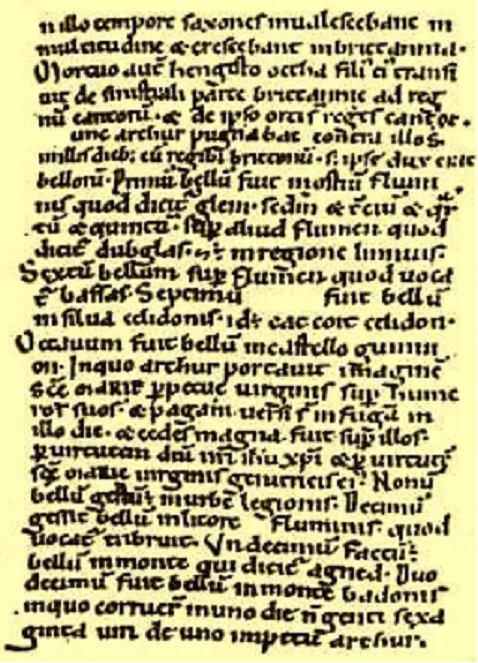
In the Irish version, LB ch.43 the battle list, it simply refers to Arthur who fought with the Britons, omitting his military leader status as “dux bellorum” and the reference to the Kings of Britain. The battles are summarised carelessly except for the religious appeal of the symbolism in the eighth battle at the “fort of Guinneain” in which Arthur carried the image of the Virgin which seemed to attract the attention of the Irish translator.7

The “Miracula” section (Wonders or Marvels of Britain) chapters 44-46 treat the Arthurian material in a similar manner. The tenth marvel refers to the cairn for Arthur’s dog, Cafal without reference to the legendary boar hunt as found in the Latin text of the Historia Brittonum. The eleventh marvel in the Irish version recalls the tomb in the region of Ercing of varying size but without reference to Arthur or his son Amr at all.8

Artur, son of Bicuir the Briton
We find the earliest mention of the Britons of Strathclyde in Irish literature. Beinne Britt, or Beinne the Briton (we find various spellings), led a Strathclyde army at the Battle of Magh Mucruimhe (Cath Maige Mucrama), against the Irish in the middle of the 3rd century. Some Annals date this battle earlier, toward the end of the 2nd century. 

Location  of Strathclyde (Ystrad Clud) 

Cath Maige Mucrama
In the tale Cath Maige Mucrama. Lugaid MacCon of Cork was foster-brother to Eogan son of Aileel Aulom, king of Munster. He and Eogan quarrelled over the possession of a fairy minstrel. They assembled their forces and fought a battle at Cenn Abrat which ended in the defeat of Lugaid. Lugaid went to Alba (North Britain) where he took refuge with the king of that country. This king was grandson of the king of the Britons and son-in-law of the king of the Saxons. He took up Lugaid's cause, and the combined forces of the Britons and Albanachs (North Britons) set out to attack Art MacCon, the king of Ireland. When the two armies met, one of the British detachments was led by Beinne the Briton who is fairly well known in Irish heroic literature. 

From the Annals of the Four Masters:

M195.1 After Art, the son of Conn of the Hundred Battles, had been thirty years in the sovereignty of Ireland, he fell in the battle of Magh Mucruimhe, by Maccon and his foreigners. In the same battle, along with Art, fell also the sons of his sister, Sadhbh, daughter of Conn, namely, the seven sons of Oilioll Olum, who had come with him against Maccon, their brother. Eoghan Mor, Dubhmerchon, Mughcorb, Lughaidh, Eochaidh, Diochorb, and Tadhg, were their names; and Beinne Brit, King of Britain, was he who laid [violent] hands upon them. Beinne was slain by Lughaidh Lagha, in revenge of his relatives….9

In addition to the 9th century tale of Cath Maige Mucrama, Beinne Britt is also mentioned elsewhere in Irish literature: as we have seen he appears in the Irish Annals as the father of the man who killed Mongán, and in the tale of the Battle of Crinna. There is also a passage in the Coir Anmann, a compilation which gives popular etymologies for certain well-known names, that records the "Three Fothads" who were the offspring of Lugaid Maccon and Fuiche the daughter of Beinne Brit, king of Britain.10

However, as a king from the early medieval kingdom of Strathclyde (Ystrad Clud) he is noticeably absent from the early king lists, although it must be admitted the early years are not good, yet Gaelic storytellers claim him as an ancestor of MacCailín, the Gaelic style of the Duke of Argyll. Clearly a Strathclyde king who fought at Cath Maige Mucrama in the 2nd or 3rd century cannot be the same as the father of the man who killed Mongán in the 7th century; were there two kings called Beinne Britt, or was this a title rather than a personal name?

In the Agallamh na Senorach (AnS -Tales of the Elders of Ireland), an early 13th century compendium of Fenian tales, there is a tale of Artuir, son of Benne Brit, here a member of the Fian, the band of Finn, in a tale in which he stole three of Finn's hounds and took them across to Britain:

“Artuir, son of Benne of the Britons, was at that time a member of the Fian with a retinue of twenty-seven. Finn had arranged a hunt on Benn Etair and the hounds let loose. Finn sat at Carn in Feinneda (The cairn of the Fian-warrior) between Howth and the sea. Artuir was positioned on the coast, between the hunt and the sea to prevent the quarry swimming away. While he was at the edge of the water he saw three of Finn's hounds, Bran, Sceolaing and Adnuall and decided on a plan. He and his twenty-seven companions would cross the sea and take the three hounds with them to their own land. Executing the plan they landed at the estuary of the Sandy Shoal in the territory of the Britons. They then went to the Mountain of Lodan, son of Lir, and hunted there.

"After the hunt, the Fian found three of Finn's hounds were missing. He ordered three companies of the Fian to carry out a search but the hounds were not found. Finn washed his face then put his thumb under his Tooth of Wisdom so that the truth would appear to him.

"It was Artuir, son of the King of the Britons" he said. Nine men were chosen to go after them. They found Artuir sitting on his hunting mound, they captured him and killed all of his twenty-seven companions. They returned across the water to Finn with Artuir, the heads of the twenty-seven men, the three hounds Bran, Sceolaing and Adnuall, and two horses, a stallion and a mare, from these stock have come all the horses of the Fian. Artuir remained Finn's warrior till the day he died."11

Conclusion
The late arrival of the Arthurian legend in Ireland would explain why there was no reason why the use of the name should hold any prohibitions for the Irish immigrants of the 6th-7th centuries. The poor treatment of Arthuriana in the Irish version of the HB and the disregard for Geoffrey of Monmouth’s work clearly demonstrates that Arthur of the Britons did not hold any great interest for the Irish storytellers. This only too well demonstrated by the tale in Agallamh na Senorach   in which Arthur is subservient to Finn. Thus, there is no reason why these Irish families would not have used the name; they were probably not aware of the Arthur of the Britons until they arrived in the British Isles. There is also the possibility that, on these rare occasions, when they came into contact with stories of this "Great Arthur" they used the name purposefully to demonstrate their military prowess over the local Britons.

Despite the various references to Beinne Brit in Irish Literature, he remains elusive in the British record and attempts to uncover him come to a dead end. We cannot even be certain if Beinne Brit’s son Artuir as mentioned in the AnS is meant to be THE ARTHUR. However, the enigmatic connection between Mongán and Arthur and Finn is suggestive of a tale that binds these three men together and suggests a knowledge of Arthur the Briton before the 9th century Historia Brittonum on both shores of the Irish Sea.


Notes & References
1. Joseph Falaky Nagy, “Arthur and the Irish”, in: Helen Fulton, ed., A Companion to Arthurian Literature, Wiley-Blackwell, 2009. pp.117–127.
2. The Annals of Tigernach (T627.6) - Translated by Gearóid Mac Niocaill Electronic edition compiled by Emer Purcell, Donnchadh Ó Corráin. CELT: Corpus of Electronic Texts: a project of University College Cork, 2010. 
3. Chronicon Scotorum Annal CS625 - Translated by William M. Hennessy, Gearóid Mac Niocaill, CELT: Corpus of Electronic Texts: a project of University College, Cork (2003) (2010).
4. Joshua Byron Smith, "The Reception of Geoffrey of Monmouth in Ireland", in Joshua Byron Smith and Georgia Henley editors, A Companion to Geoffrey of Monmouth, Brill, 2020, pp.475–476.
5. Ann Dooley, "Arthur of the Irish: A Viable Concept?", in Arthurian Literature XXI: Celtic Arthurian Material, edited by Ceridwen Lloyd-Morgan, DS Brewer, 2004.
6. Ibid.
7. Ibid.
8. Ibid.
9. Cath Maige Mucrama - Background information - References in the Annals of the Four Masters: Irish Sagas Online 
10. Clark Harris Slover, Early Literary Channels Between Britain and Ireland, Studies in English, 1926, No. 6, pp. 5-52.
11. Ann Dooley, op.cit. Appendix pp.26-28.


* * * 

Saturday, 10 September 2022

Evidence for a pre-Nennian Arthur

 The Historicity of the Arthurian Battle List - Part II

"[The use of the name Arthur] …… reflects a desire to capture whatever mythological kudos and religious potency already surrounded the name with British/Welsh families avoiding its use primarily because of its newly-acquired mythological connections which might have been considered un-Christian"11

Whence the name Arthur?
In Part I of the Historicity of the Arthurian Battle List we explored the possible origins of the Arthurian battle list as contained within the 9th century History of the Britons (Historia Brittonum – aka 'Nennius') raising more questions than answers. However, although the History of the Britons is our first securely dated documentary evidence for Arthur, it is clear that the figure of Arthur was known well before the 9th century and was not invented by its author. So who was this Arthur who inspired the record of twelve successful battles against the Saxons, culminating in the Battle of Badon? In hope of finding any answer to this we need to examine evidence for Arthur prior to the 9th century.

Our first call is four figures who appear in the mid-6th and the early 7th centuries all named Arthur who are often cited as evidence for the existence of a historical Arthur, named in the memory of a great military leader.

All these occurrences of the name as recorded in Gaelic sources are connected to Irish settlers belonging to high-status Irish royal families who founded the kingdoms of Dyfed (Demetae) in south-west Wales, and Dalriada in southern Scotland: 

    • The first historically attested Irish Arthur is found in the family of Áedán mac Gabráin, king of the Scottish Dál Riata from 573-608 AD. Adomnán's Vita Columbae (The Life of Columba) records how Áedán's sons Arthur and Eochaid Finn died in battle against the Miati some time before 597. This is confirmed by the Annals of Tigernach.; 

    • Artuir ap Bicuir 'the Briton' of Strathclyde(?) who killed an Ulster chieftain. The Irish Annals record the death of Mongán mac Fíachnai of Dal Fiatach in Strathclyde in 625. This is the Mongán of legend of legend whose real father was said to be Mananna mac Lir, the Irish Sea god; it is claimed that Mongán was conceived while his father Fíachnae mac Báetáin, king of Dal Fiatach, was away helping Áedán mac Gabráin on his British campaigns when his wife Caíntigern slept with Manannán mac Lir to produce Mongán. Mongán often bears the patronymic mac Fiachna, despite his true paternity. The record of Mongán’s death in the Annals of Tigernach has him killed by a stone thrown by one Artuir ap Bicuir, described as a Briton.

    • an Irish Artur, grandfather of Feradach, documented in 697; 

    • Arthur ap Pedr of Dyfed, grandson of Vortipor (“tyrant of the Demetae” as mentioned by Gildas). This Arthur is mentioned in the Harleian Genealogies and the Irish text The Expulsion of the Deisi.


‘Arthur’ was a very rare name both before and after this time and to have four appear in the genealogical record all within a generation or so of each other is a very unusual occurrence; notably, the name does not appear again in Welsh genealogies for several hundred years. All appear to have belonged to high-status Irish royal families with British connections. As the Arthur of the 9th century History of the Britons is clearly a British text with a British hero, not Irish, we require an explanation to how the fame of Arthur spread among the Irish as well as the Britons?11

These 6th-7th century Arthur’s are often presented in the argument for a historical Arthur that claims they must have all been named after a renowned British warrior probably from the generation previous.12 However, Ken Dark concludes:

"The account of Arthur in the Historia Brittonum can be seen as wholly fictional, representing our earliest glimpse of the Arthurian legend. But this legend may well have developed in the previous centuries from a genuinely historical figure, active either in the 'Irish' areas of Britain or in Ireland, in the sixth century. This figure, the ' Irish Arthur', as he might be termed, may have been a military hero among Irish elites with British connections in the later sixth and seventh centuries, and possibly also among the Britons. Perhaps we should look to Dyfed, even to Arthur son Pedr/Retheoir in particular, for this 'protypicaI Arthur'.”13

Contra Dark, Caitlin Green asserts that clearly none of these ‘Irish’ Arthurs can plausibly be considered as the ‘original’ Arthur of the History of the Britons;  in accepting that Green is correct then how then do we explain the appearance these four men in the historical record all within a few generations of each other?14

Significantly, from what we know of their biographies, none of them has any connection with the events of the 5th century war of the Saxon federates and the battle of Badon. Green, quoting the authority of Rachel Bromwich, argues that to find four men all named after the historical Arthur… ‘would be a type of commemoration for which Celtic tradition offers no parallel.’ Green asserts that the only plausible explanation is that these men were not being named in memory of some historical figure from a previous generation or so, but after a character already renown in legend and myth that these Irish families came into contact with during their interactions with the Britons.15

The name ‘Arthur’ was likely commended to these Irish chieftains as that of a ‘peerless warrior’, a military ‘superhero’ as found in battle poems such as Y Gododdin and Marwnad Cynddylan, during their contact with the Britons. Green reasons that this would provide an explanation for some people with Irish connections at this time having used the name regardless of any native British superstitions against its use as suggested by Oliver Padel.16

Padel argues that “the absence of this name from British contexts is due to Arthur being regarded ‘with exceptional awe’ as a legendary hero of folklore, whilst the Irish ‘when they came into contact with the folklore as a result of their settlements in western Britain, need not have felt such reverence or reluctance' ”17

A detailed study of the Welsh genealogical tracts by Peter Bartrum’s found that not one single person of British descent in Wales (rather than Irish, such as Arthur map Pedr) bore the name ‘Arthur’ in the genealogies until the late 16th century at the earliest. Bartrum is therefore in agreement with Padel that the name may have been avoided by the Britons as it had some sort of awe and superstition attached to it.18 

Thus, Bartrum and Padel offer a feasible explanation for the peculiar avoidance of the name by the Britons who by the mid-6th century held ‘Arthur’ in sufficient awe and superstition that no one would use the name. However, the use of a legendary superhero’s name did not prove prohibitive to Irish-immigrants who may have adopted the name to boost their own military reputation. We find a similar situation among the Irish where the name of the mythical figure Cú Chulainn was likewise avoided by the Irish, suggesting that Arthur was regarded in a similar light.19


Notes & References
11. Nicholas Higham, King Arthur: Myth-Making and History, Routledge, 2002, p.76.
12. See for example: John Morris, The Age of Arthur:  A History of the British Isles from 350 to 650, Weidenfeld and Nicolson, 1973.
13. Ken Dark, A Famous Arthur in the Sixth Century? Reconsidering the Origins of the Arthurian Legend, Reading Medieval Studies, 26, pp.77-95 (2000).
14. Green, Concepts of Arthur, Tempus, 2007, pp.48-49.
15. Green, Ibid.
16. Oliver Padel, The Nature of Arthur, CMCS 27, 1994.
17. Padel, Ibid.
18. Peter Bartrum, ‘Arthuriana in the Genealogical MSS’, The National Library of Wales Journal, 1965, quoted in Green (2007:48).
19. Patrick Sims-Williams, ‘Cú Chulainn in Wales: Welsh Sources for Irish Onomastics’, Celtica 21 (1990), quoted in Green (2007:49).


* * *

Sunday, 21 August 2022

The Historicity of the Arthurian Battle List

“Early in the ninth century an anonymous cleric in Gwynedd…… wrote a text …which became known as the History of the Britons … [and]... took the Arthur figure with whom he was apparently familiar from folk tales rooted in what is now the west Herefordshire/Powys countryside and converted him into a historical character. This was still a warrior hero, reminiscent of the man in the ‘mirabilia’ stories, but now Arthur came forth as the great British leader, the glorious victor in the ‘war of the Saxon federates’.”1

Poets and Scribes
There have been many attempts to identify the “Real King Arthur”, the legendary British war leader who according to medieval histories and chronicles led the defence of the Britons against the incoming Saxons in the so-called Dark Ages. Yet evidence of Arthur's historical existence rests solely on two late sources, the 9th-century Historia Brittonum (History of the Britons, also known as “Nennius”) and the 10th century Annales Cambriae (Welsh Annals). The History of the Britons clearly places Arthur in the late 5th century/early 6th century, appearing before Ida (the Flamebearer) became king of the Anglian kingdom of Bernicia in AD 547.

The two Arthurian entries in the Welsh Annals, short references to the battles of Badon and Camlann, are generally accepted by many historians as genuine chronicle entries. The History of the Britons contains a section listing twelve battles in which Arthur was victorious in all, culminating in the battle of Badon without any mention at all of Camlann. Here Arthur is described as the leader of battles (dux erat  bellorum); manifestly, only his successes interested the author. This sequence of battles, leading up to and including Badon, corresponds with the 6th century account of Gildas.2 Historians generally agree that Badon occurred within ten years of AD 500, which corresponds with the History of the Britons date for Arthur’s battle campaign. Significantly the Welsh Annals state that Arthur fell at Camlann in 537, ten years before Ida is recorded as ruling in Bernicia. Thus, we have pinpointed Arthur’s floruit as the late 5th-early 6th century.

However, we should note that the History of the Britons and the Welsh Annals are the only sources to assign Badon to Arthur. Neither Welsh heroic poetry or contemporary sources for the period, such as Gildas and later Bede, associate Arthur with the victory at Badon. 

The History of the Britons

It was suggested many years ago that the Arthurian battle list in the History of the Britons may have its origin in an Old Welsh praise poem.3 We find evidence for the composition of early panegyric poetry by the Britons in works such as the “Moliant Cadwallon” which lists a sequence of victories by Cadwallon ap Cadfan of Gwynedd, and an elegy to Cynddylan, Prince of Pengwern, called “Marwnad Cynddylan”. 

A recent work attempting to identify the Arthurian battle sites made two assumptions necessary for its central theme, that the battle list has its origins in such an old battle poem and secondly, that Arthur was a genuinely historical figure.4 Not everyone would agree with either assumption.5 There may be glimpses of a rhyme-scheme in the Arthurian battle list, yet conversely the construction of a poem around Arthur’s battles may indicate a non-genuine campaign which required victories to be conveniently borrowed from other heroes to maintain such a rhyme-scheme as we shall see below. However, even if it could be proven that the battle list originated in an old bardic work it would not alone prove the historicity of Arthur.

Yet, how many Arthurian detectives have used the battle list as a primary source in reconstructing a biographical account of Arthur’s wars against the advancing Saxons proclaiming that they have identified the “Real King Arthur”; how many books or articles have you seen claiming this in the title? And how many have you read that were actually convincing?

Some of the earliest Arthurian material, known as the pre-Galfridian tradition, that is prior to Geoffrey of Monmouth’s 12th century Historia Regum Britanniae (The History of the Kings of Britain), portrays Arthur as a mighty defender of Britain fighting witches, beheading giants and hunting supernatural boars.6 Significantly Caitlin Green (then writing as Thomas Green), champion of a pre-Galfridian Arthur, deconstructs the Arthurian battle list as a series of Otherworldy adventures.7 Green identifies some of these as mythical battles taken from Welsh poetry8 and Higham9 sees other battles in the list as taken from other heroes exploits and wrongly attached to Arthur. We will discuss these in more detail later.

It has also been claimed that the battles in the list are not in chronological order, yet it has a clear division noticeable at the mid-point in which the nature of the descriptions changes significantly. The first six battles are simply listed as all occuring at obscure rivers: Glein; Dubglas (four battles); Bassas, without much further detail. The author of the list may have claimed four battles were fought at the Dubglas simply to have made the total number up to twelve, always a favoured number in medieval literature. Positive identification has no doubt been impeded by the loss of place names from the original language as the English spread west.

The next six battle locations provide place names which at first glance appear to offer some hope but become problematic in identifying these sites with an Arthurian campaign: Cat Coit Celidon; Castle Guinnion; City of the Legions; the river Tribuit;  Mount Agned (or Breguoin); and Badon as we have seen above only associated with Arthur by the History of the Britons and the Welsh Annals. We will come back to these in more detail later.

The Welsh Annals

It may have been that some of these battle sites were taken at random from Bede, Gildas and the (6th century) Taliesin who’s works all predate the History of the Britons, to construct a rhyme-scheme for a poem in an attempt to historicise Arthur. Yet as we have seen the majority of these are obscure and defy positive identification; anyone who claims otherwise in their quest to identify the “Real King Arthur” is deluding themselves and their readers.

What if Arthur were not a historical figure and the battles were pure invention on the part of the author of the History of the Britons? After all, not one of the many 5th-9th century British inscriptions contain the name "Arthur", or even anything that could be interpreted as the name. As the Stanzas of the Graves tell us, there is no 'grave for Arthur'.

We must consider if the author was a genuine compiler as he claims in the Nennian prologue, bringing together many different strands from different periods of time (the heap), or was he producing a synthetic history, selectively using and inventing material to suit the politics of 9th century Gwynedd?10 A genuine battle poem would fit in to the first category, but an invented Arthur fits comfortably in the second. Ironically the History of the Britons was a major source used by Geoffrey of Monmouth in his History of the Kings of Britain and he is generally accused of inventing much of his story.

It is certainly a complex picture and we should not assume the battle list in the History of the Britons is a genuine first hand record of a campaign fought in the late 5th/early 6th century such as that portrayed by Gildas as noted above. Certainly many of these battles attributed to Arthur in the History of the Britons are found nowhere else. Yet, one thing is certain, and we can work with this, is that although the History of the Britons is our first securely dated documentary evidence for Arthur, it is clear that the figure of Arthur was known well before the 9th century and was not invented by its author.


>> Continued in Part II - Evidence for a pre-Nennian Arthur 


Notes & References:
1. Nick Higham, King Arthur, The History Press, 2015, p.61.
2. Gildas appears to be describing a similar sequence of battles: “From that time, the citizens were sometimes victorious, sometimes the enemy, in order that the Lord, according to His wont, might try in this nation the Israel of to-day, whether it loves Him or not. This continued up to the year of the siege of Badon Hill.”– Section 26, de Excidio et Conquestu Britanniae (trans) Hugh Williams 1899.
3. HM Chadwick & NK Chadwick, The Growth of Literature - Volume 1. Cambridge University Press, 1932.
4. Tony Sullivan, The Battles of King Arthur, Pen & Sword, 2022.
5. For an opposite view see: David Dumville, Sub-Roman Britain: History and Legend, History, 62 (1977).
6. Rachel Bromwich & D Simon Evans, Culhwch and Olwen: The Oldest Arthurian Tale, University of Wales Press, 1992, Introduction, pp.v-lxxxiii.
7. Caitlin Green, Concepts of Arthur, Tempus, 2007.
8. Green, Ibid.
9. Nick Higham, King Arthur: The Making of the Legend, Yale, 2018, pp.185-194.
10. David Dumville, The historical value of the Historia Brittonum, Arthurian Literature 6,


* * *


Monday, 20 June 2022

BOOK REVIEW: The Roman King Arthur? by Tony Sullivan

The Roman King Arthur?
Lucius Artorius Castus
By Tony Sullivan

Pen & Sword Military, Hardback, 240 pages
ISBN: 9781399084024
Published: 8th June 2022

There are many theories as to the true identity of the legendary King Arthur, most preserve the fifth to sixth century Post Roman era, but can be located in all geographic locations across the UK and sometimes beyond. One oddly-popular theory places the origin of Arthur way out-of-time by several hundred years, and places him in Roman Britain. This theory proposes that the Arthur of the Post-Roman period (c.480-520) has his origin in a Roman Officer named Lucius Artorius Castus stationed in Britain in the late second or early third century. 

The connection was first suggested nearly a hundred years ago by Kemp Malone in 1924, based largely on the etymology of the Latin name 'Artorius' which could certainly evolve into 'Arthur' in Welsh. As the only known figure in Britain of this name it is unsurprising that Lucius Artorius Castus should attract attention.

The theory drew little attention for the next fifty years but was revived and advanced by Helmut Nickel in the 1970s who argued that Artorius was the original Arthur and that a group of Sarmatian cavalry posted to Roman Britain in the late second century serving under him inspired the tales of the Knights of the Round Table.

C Scott Littleton, along with Anne C Thomas and later Linda Malcor, expanded this further, arguing that in addition to Artorius being in contact with these Sarmatians, many elements of the Arthurian legend actually derive from Caucasian mythology, which the Sarmatians brought to Britain in the second century, finding parallels for key features of the Arthurian legend such as the Sword in the Stone, the Holy Grail, and the return of Arthur's sword to a lake. This has become known as the Sarmatian Connection. 

In The Roman King Arthur? author Tony Sullivan provides the first historical study detailing the military and civilian career of Lucius Artorius Castus and investigates the links claimed by proponents of the Artorius - Arthur theory that:

  •  Lucius Artorius Castus was a legionary commander in the north of Britain;
  •  He was governor during the reign of Commodus;
  •  Following defeat in AD 175, 5,500 Sarmatians were posted to Britain bringing their families with them, numbering around 20,000 in total;
  •  These Sarmatians remained in Britain throughout the centuries leaving an archaeological signature;
  • The legends of 'swords in stones', 'magical cups' and ‘red dragon banners’ can be traced back to the Sarmatians;
  • Lucius Artorius Castus fought and led these Sarmatians in battle;
  • Lucius Artorius Castus career can be dated accurately;
  • An inscription on a memorial to Lucius Artorius Castus can only be interpreted as 'ARMATOS' (armed men).
  • He was leader (Dux) of the three British legions against armed men?

In the first chapter the author commences his investigation by examining the two inscriptions on the funerary stones from the Roman province of Dalmatia, in modern Croatia, discovered in the nineteenth century; the first from a sarcophagus was discovered in the wall of a churchyard, the other nearby. Both the stones are eroded and broken leading to much speculation and debate with regard to the exact lettering. 

The first inscription details the career history of Lucius Artorius Castus and forms the essence of the 'Artorius - Arthur' theory, indeed a full and interesting military career in its own merit. But, as Tony Sullivan point out, there is not a single reference to Artorius from our Roman sources from the second to the fifth centuries. It appears that all the evidence we have for Artorius is on the two memorial stones from Croatia and possibly a third inscription on a ring.

Tony Sullivan dissects the inscription in forensic detail and provides clear definitions, explaining the debate over Artorius’s adversaries as either ‘Armenia’, ‘Armatos’ or ‘Armorica’ and discusses possible timeframes, which is critical for the correct interpretation. 

For many years the missing letters were interpreted as giving AMORICANOS (Brittany) suggesting that Castus led Legions from Britain to Gaul in an attempt to fit the campaign to the Gallic expedition of King Arthur in Geoffrey of Monmouth's Historia regum Britanniae, c.1136. 

However, the AMORICANOS interpretation has largely been discredited as the best candidate for an expedition to Gaul was Clodius Albinus who took three legions from Britain there in 196 but was defeated by the Emperor Septimius Severus at Lugdunum (modern Lyon) the following January. There is no evidence whatsoever to link Lucius Artorius Castus to this campaign; we must also question why anyone would want to commemorate such a disaster on their tombstone? Furthermore, the wording does not appear on any other known Roman inscription. 

From the epigraghic evidence historians now favour ARMENIANS as Castus’s enemy. If the inscription does refer to the The Roman–Parthian War of 161–166 it has a devastating impact on the Artorius = Arthur theory, in other words, Castus had left Britain before the Sarmatians arrived in AD 175. Therefore proponents of the theory have now opted for ‘ARMATOS’ as the missing word, meaning ‘armed men’ which could mean any armed adversary in just about any country in any suitable timeframe.

From this scant career history on a tombstone in Croatia fantastic stories have developed claiming Artortius led a force of Sarmatian knights in the north of Britain in response to Cassius Dio's commentary on the northern tribes crossing Hadrian's Wall and slaying a general (AD 180-184). This episode has been used in an imaginative reconstruction of Castus and his team of Sarmatian knights fighting along The Wall to provide an original account of the Arthurian battle list in the ninth century Historia Britonnum [See: Malcor, Heroic Age 1999b, & Appendix to From Scythia to Camelot, Revised Edition, 2000], when all we know from Dio is the northern tribes crossed the Wall - he certainly does not describe a series of battles. When something is just too fantastic to be true it usually isn't.

The dating of Castus’s posting to Britain now becomes critical; as we have seen above for the Arthorius-Arthur theory to work, they have claimed he was in Britain during 181-184, the time of the uprising of the northern tribes according to Cassius Dio.

Supporters of the Artorius – Arthur theory claim that in 181 Castus was sent to Britain as praefectus of an auxiliary unit stationed at Brementennacum (Ribchester, Lancashire) where there is evidence for Samatian cavalry in the third century.  Yet, the longer inscription shows quite clearly that Castus was actually ‘prefect of legion VI Victrix’ and does NOT mention Brementennacum. He was undoubtedly camp prefect at York where legion VI Victrix was stationed.

Supporters of the Artorius – Arthur theory then claim that in 185 Castus was appointed Dux (Duci) , a term they consider equivalent to governor of Britain, and led three legions against the ARMATOS (armed men). The following year he was Procurator of Liburnia where he finished his military career.

Much significance is placed on the word 'Duci' on the inscription, the dative form of ‘dux’, in a further attempt to link to Arthur who was of course described in the Historia Brittonum as 'Dux Bellorum' (leader of battles). Duci was a temporary position held by Castus to lead three legions (or more likely parts of) from Britain (probably to Armenia c.161) and there is absolutely no reason to link this position to the title given to Arthur in the ninth century.

The inscription is difficult to date securely. Tony Sullivan says the style of the inscription is suggesting it was Antonine yet the wording leans toward the Severan period. 

He provides four options for dating the period the three legions were led from Britain by Lucius Artorius Castus :

1. The Armenian campaign of AD 161-6
2. Campaign against mutineers in Britain or Gaul AD 184-7
3. The civil war between Clodius Albinus and Septimus Severus AD 197
4. The Armenia campaign of Caracalla AD 215.

The first option is the one most widely accepted by the majority of historians (see Higham, 2018:135) who see Castus stationed in Britain c.160 - which means he had left Britain many years before the Sarmatians had arrived in AD 175.

Surprisingly, Tony Sullivan opts for a late date seeing Castus into the third century, but credits Higham’s early timeline as probably the most likely.

Chapter 2 recaps on the Arthurian legend from the ninth century Historia Brittonum, Saints' Lives,  through the twelfth century and Geoffrey of Monmouth, to later French Romances and Welsh Tradition. 

The next chapter looks at Artorius's place in the history of Rome between AD 150-250, discussing ranks and responsibilities, before providing an overview of Roman Britain. At the end of this chapter (Table 9) the author provides an analytical assessment of the Artorius - Arthur theory; from a possible 13 points riased by the theory only 3 provide any possible evidence for the points mentioned above; the rest are negative indicators with no evidence. This is quite a persuasive result leaving the reader little alternative than to agree with the author's conclusion that the theory has performed very poorly against the evidence and should be rejected.

The Sarmatians are examined next to find evidence of their contact with Artorius. Again, summarised in a table at the end of the chapter there seems to be a distinct lack of evidence for the 5,500 Sarmatians bringing their families with them to Britain in AD 175 (totalling 20,000 people) and certainly no evidence of Artorius leading a Sarmatian cavalry unit. 

It is claimed that the tales of the Narts have been handed down orally through many centuries, but were not written down until the nineteenth century. Alarm bells should now be ringing! The theory claims these tales can be traced back to Sarmatians in the second century - this is pure speculation in large piles. Tony Sullivan says that we are asked to compare these legends with the Arthurian legends, themselves written down 600 years or more after any historical Arthur could have lived, which is of course several hundred years before the Nart Sagas were written down. The historical Arthur of the ninth century bears little resemblance to the Arthur of the Romances written down from the twelfth and thirteenth centuries; to attempt to link the Nart Sagas back to this is just not credible.

However, first and foremost, it must be demonstrable that there is a direct link between Artorius and the Sarmatians and the Arthurian legends must also be traceable back to the second century Sarmatians. Further, the later legends and tales which evolved between our earliest Arthurian reference in the ninth century to the later middle ages must possess a link back to the Roman era. Thus, we should have something linking Artorius in the second century to a Post-Roman leader of battles named Arthur of the fifth/sixth century. Tony Sullivan is unable to present any evidence these can be traced back to the Sarmatians or influenced Arthurian legend.

Conclusion
In The Roman King Arthur? author Tony Sullivan presents a convincing case that the Artorius - Arthur theory does not stand up to scrutiny; with little evidence the imagnative theory rests heavily on huge amounts speculation and wishful thinking. Sullivan reveals that there is nothing linking the second century Roman officer named Artorius to a Post-Roman Arthur as recorded in the ninth century, or to the Arthurian legends written down from the twelfth-thirteenth centuries and concludes that there is no Sarmatian Connection; it is a modern myth.

The Roman King Arthur? is a fascinating, comprehensive and important contribution to the Arthurian debate.


Copy received from the publisher in return for posting a review without obligation.


Further Reading:
Kemp Malone, "Artorius". Modern Philology. University of Chicago Press, 1925, 22 (4): pp.367–374.
Helmut Nickel (1975). The Dawn of Chivalry -From the Lands of the Scythians: Ancient Treasures from the Museums of the U.S.S.R., 3000 B.C – 100 B.C. published by The Metropolitan Museum of Art Bulletin, pp.150-152.
Helmut Nickel, "The Last Days of Britain and the Origins of the Arthurian Legends", cited in Matthews, 2019.
C. Scott Littleton and Ann C. Thomas, The Sarmatian Connection: New Light on the Origin of the Arthurian and Holy Grail Legends, The Journal of American Folklore, Vol. 91, No. 359 (Jan. - Mar., 1978), pp. 513-527.
C. Scott Littleton, Linda A. Malcor, From Scythia to Camelot, Routledge, 1st Edition, 1994 (Revised edition 2000) Appendix.
Linda Malcor, “Lucius Artorius Castus, Part 1: An Officer and an Equestrian”, 1999a, Heroic Age, 1 (Spring/Summer).
Linda Malcor, “Lucius Artorius Castus, Part 2: The Battles in Britain”, 1999b, Heroic Age, 2 (Fall/Winter).
John Matthews, King Arthur of the Romans: Lucius Artorius Castus and the Sarmatians in Britain, BCM Hallowquest, 2019.
Nicholas J. Higham, King Arthur: The Making of a Legend, Yale University Press 2018.


Edited 22/06/22 - and several times since

* * *

Sunday, 12 June 2022

Book Review: The Battles of King Arthur by Tony Sullivan

The Battles of King Arthur
By Tony Sullivan
Pen & Sword, Hardback, 288 pages + 32 illustrations
ISBN: 9781399015301
Published: 26th May 2022

This is Tony Sullivan’s second Arthurian book from publisher Pen & Sword, the first outing being King Arthur: Man or Myth? (2020) an investigation of the evidence for King Arthur based on the earliest written sources, weighing the possibility of Arthur as an historical figure or purely a creation of fiction.

Many recent works by a new generation of authors has become tedious in their pursuit of identifying a specific person in a particular location as the legendary king. This is fuelled by the limited reliable information available and the vagueness of Arthur’s battles as recorded in the ninth century Historia Brittonum allowing poetic licence to run a mock.

Refreshingly, KingArthur: Man or Myth? examined a list of possible suspects without bias toward identify a particular figure as King Arthur and is therefore the best starting point for anyone new to Arthurian studies.

The Battles of King Arthur continues with the author’s unbiased approach, focusing on Arthur’s battles in the Historia Brittonum, but making two assumptions: firstly that Arthur was a historical figure; and secondly, that this battle list is genuine. Not all will agree with these assumptions as this is a contentious subject, but these assumptions are essential for a study of Arthur’s battles; otherwise the page remains pretty much blank.

Tied to these two assumptions the author sets out the case for the most likely locations of Arthur’s battles using archaeological evidence and historical sources to place Arthur and his battles in the correct political, cultural and military context. To this end the book focuses on three broad hypotheses: firstly, that there is a reasonable amount of evidence to estimate the political, cultural and military context; secondly, some of Arthur’s battles can be located on the balance of probabilities; and finally, the proposed locations will make sense in the context of the political and military situation and the archaeological and literary evidence.

We start with a brief look at historical events leading up to the time when Arthur fought, from Roman Britain to Post-Roman Britain AD410-450. Next we move on to examine the Anglo Saxons, investigating the archaeological and literary evidence to understand the Germanic migration and the possible meaning of Gildas’s “partition” before examining how regional polities evolved from civitas to Kingdoms. It quickly becomes clear that this was a far more complex picture than what we are often told; it seems there is not one single scenario that comfortably fits all.

Using contemporary accounts of fifth and sixth century battles (such as Y Gododdin for example) the next chapter on weapons and warfare sets the scene for how these battles must have been fought discussing sizes of armies, battle formations and tactics.

The author acknowledges that having laid out the historical background in great detail, a complex picture has emerged. A fragmenting political and civilian structure in addition to changes in cultural identities across a range of different groups: aristocratic elites; townsfolk; peasants; military and mercenary groups; and a heterogeneous group of Germanic settlers. Into this pressure cooker of economic, religious and social frictions he places Arthur within a time-frame of c.450-520.

We now move to the climax of the book, Chapter 7, The Thirteen Battles of Arthur, a solid forty pages. Here the author discusses all twelve battles from the Historia Brittonum with the addition of Arthur’s apparent final battle at Camlann from the Annals Cambriae. Each battle is discussed in depth in turn with a map to show the location as identified against the balance of probabilities. The locations of Arthur’s battles is another contentious issue, and not everyone will agree with these conclusions, yet Tony Sullivan provides the best fit for a historical Arthur in the context of the timeframe.

This is weighty volume, packed with detailed information, but the author’s writing style makes for a very easy read that moves on at a fair pace. This is an important addition to the Arthurian debate and so refreshing when the genre is polluted these days with whacky theories claiming to identify King Arthur as whoever you like.

In The Battles of King Arthur author Tony Sullivan has taken popular Arthurian studies to a new level. Highly recommended.


Copy received from the publisher in return for posting a review without obligation.


* * *